Composite cases in this article are drawn from consignments we handle on the Guangzhou–Gulf corridor; names and figures are changed, the mechanics are not.
The UAE is cheaper and faster at the border — 5% VAT versus Saudi Arabia’s 15%, and a World Bank LPI customs rank of 14 versus 47 — but the right market depends on who you are: unregistered buyers pay the tax difference in full, registered traders recover most of it, and Saudi Arabia offers the Gulf’s deepest consumer demand to sellers who meet its stricter import rules.
Two buyers, one carton, two different bills
In the same week in September, two buyers we work with placed orders for almost identical cargo: phone accessories — cases, cables, chargers — from suppliers in Shenzhen, about $8,000 of goods each. One, a trader we’ll call Khalid, sells through the wholesale lanes around Deira in Dubai. The other, Faisal’s cousin you might say, runs a shop front and an Instagram catalogue in Riyadh. Same cartons, same factories, same week of production. By the time both consignments were delivered, their landed costs differed by enough to change what each man would reorder — and neither of the two differences that drove the gap was the one either had guessed at.
The question we get on the phone, in Arabic and English, is always some version of the same one: “UAE or Saudi — which one is cheaper to import into?” It sounds like a comparison of two tax rates, and most answers on the internet treat it that way. It isn’t. VAT — 5% in the Emirates, 15% in the Kingdom — is the headline number, and it is close to the least important thing on the sheet once you look at what kind of buyer you are, what you’re importing, and what your calendar looks like.
This article is the version of the comparison we give on the phone, written down: the real cost structure of the two gateways, the two clearance machines behind them, and the decision rule that actually predicts which market will treat your carton better.
The VAT headline, and the recovery mechanics underneath it
Start with the number everyone knows. The UAE charges 5% VAT on imports; Saudi Arabia tripled its rate to 15% in mid-2020 and has held it there since (UN Comtrade tracks the trade scale behind both). On a $8,000 consignment of accessories carrying, say, a 5% customs duty, the VAT line alone reads AED 1,540 in Dubai versus SAR 6,510 in Riyadh. Spread over a spreadsheet, that looks like a verdict: Dubai is cheaper, done.
It isn’t, for a reason that matters more than the rate: who the VAT actually sticks to.
VAT on imports is not, for a registered business, a cost. It is a pass-through. A trader in either country who holds a VAT registration charges VAT on his sales and reclaims the VAT he paid at import; the tax is collected on the margin and on the final consumer, not on the import event. For Khalid in Dubai, VAT-registered, the 5% at the border is a cash-flow timing issue — money out at clearance, recovered on his next return — not a cost line. The same logic applies to a registered Riyadh importer: painful at clearance, recoverable later.
The 15% versus 5% gap therefore bites hardest on a different person entirely: the unregistered importer — the individual buying for himself, the family business below the registration threshold, the reseller operating informally through WhatsApp catalogues. For him, import VAT is a pure, unrecoverable cost, and Saudi Arabia’s is three times the Emirates’. Since a very large share of the Gulf’s cross-border buying — including most of what moves through buying agents — is done by exactly these buyers, the VAT headline is real. It is just real for the right people, and it is a cash-flow question rather than a cost question for the wrong ones.
Before deciding a market on the VAT line, answer one question honestly: are you registered, or are you ever going to be? If yes, discount the difference. If no — and you’re buying in volumes that make 10 percentage points of goods value matter — the answer is already leaning one way, and we haven’t even reached the parts of the comparison that most buyers have never been shown.

The clearance machines: same region, different clocks
The second difference doesn’t appear on any tax schedule, but every experienced importer on the corridor can feel it: the two countries run clearance machinery of very different maturity, and the gap shows up in your calendar rather than your invoice.
The World Bank Logistics Performance Index puts it in numbers. The UAE scores 3.7 overall and ranks 14th globally — comfortably inside the European-and-Singapore tier of logistics performance, with a customs score to match. Saudi Arabia scores 3.0 and ranks 47th — a solid middle-income performer that has been improving fast under Vision 2030 investment, but whose border processes remain, in practice, more document-sensitive and slower at the margin. Neither number is bad. But the six-point spread between ranks 14 and 47 is what a buyer experiences as a simple fact of life: a consignment into Jebel Ali that is correct tends to behave predictably, while a consignment into the Kingdom that is merely complete can still meet a query at the border that adds days nobody budgeted.

The physical geography reinforces the institutional one. Dubai sits on one of the great container machines of the world: Jebel Ali handled about 15.5 million TEU in 2024 — a 7% jump that returned it to the global top ten — with sailings to China measured in daily frequency and a hinterland, Dubai itself, that is twenty minutes from the gate. Saudi Arabia’s consumer imports arrive through a longer chain: Jeddah Islamic Port on the Red Sea for the west, King Abdulaziz Port in Dammam and the Riyadh dry port for the centre and east, each adding an inland leg that sea freight pays for in days. Air freight narrows the gap — direct flights into Riyadh and Jeddah are excellent — but the default rhythm of a sea-freight buying cycle into the Kingdom carries more embedded transit than the same cycle into the Emirates.
What does this mean in practice? Not “avoid Saudi Arabia” — the market is a third of the Gulf’s population and its consumption growth is the entire point of the region. It means the cost of being in a hurry differs. In the UAE, urgency is priced and purchasable: air freight, express clearance, next-day delivery are mature commodities. In the Kingdom, urgency is where the money leaks — because the buyer who arrives at the border unprepared meets a machine whose queries are slower to resolve, and the storage clock does not care whose fault the paperwork was. The UAE forgives an amateur. Saudi Arabia, politely and at tariff rates, does not.
It is worth being concrete about what a Saudi border query actually looks like, because “customs was slow” hides the mechanism that a buyer can actually manage. The query almost never arrives as a rejection. It arrives as a hold pending documents: an HS code the broker wants supporting evidence for, a certificate whose product description doesn’t quite match the invoice wording, an importer registration detail that doesn’t reconcile. Each one is answerable — and each answer costs a document, a stamp, a translation, and a working day on the broker’s queue. The consignment that clears in three days and the one that clears in fifteen are frequently separated not by luck but by whether somebody, before departure, read the invoice the way a Saudi inspector would read it: description matching certificate matching carton, quantities reconciling, HS code defensible. That reading is a skill, it is cheap in Guangzhou and expensive in Jeddah, and it is one of the quiet things a competent buying-agent operation is actually selling.

Two different economies wearing one coastline
The third difference is the one that decides businesses, and almost nobody writes it down, because it isn’t in any tariff table: the two countries are importing for different reasons, and that shapes everything from what sells to how fast you get paid.
The UAE, first, is not really a consumption market — it is a distribution market. A substantial share of what lands in Jebel Ali does not stay in the country. It is re-exported: to the wider Gulf, to East and West Africa, to the Levant and South Asia, moved by a trading ecosystem — free zones, forwarding houses, freight brokers stacked around Deira and Bur Dubai — that has spent fifty years perfecting the art of receiving a container and splitting it into a hundred consignments headed elsewhere. For a buyer, this gives the Emirates a specific superpower: flexibility of exit. Stock that lands in Dubai can be sold in Dubai, or in Sharjah, or shipped onward to Mogadishu or Muscat without changing its legal character much. The free zones add their own toolkit — 0% import duty on goods that stay within the zone, simple re-export procedures, licensing designed for exactly this trade.
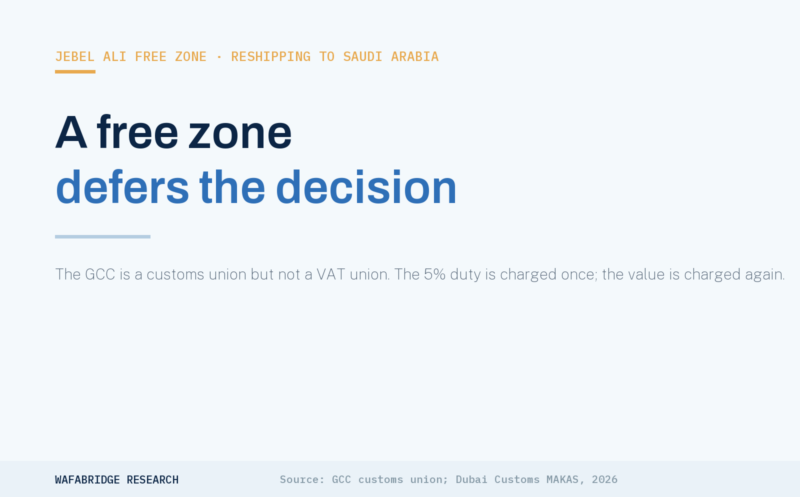
One caveat on the free zones, because it is the most expensive misunderstanding on this corridor: duty-free applies inside the fence. The moment goods move from a free zone into the UAE mainland — to a Deira shop, a Dubai warehouse serving local customers, an end consumer — duty and VAT attach at that point, assessed on the goods’ value. The “0%” that draws buyers to zone registration is a deferral and a re-export privilege, not an exemption from selling into the local market. The traders who benefit understand this and structure around it; the ones who registered a zone company expecting duty-free local sales discover the bill at the first mainland delivery. Ask which of the two you are before you let the “0%” headline make your decision.
If your model is “buy in China, sell wherever the margin is this month,” the UAE is not the cheaper market; it is a different machine, built for optionality, and the 5% VAT is almost a footnote to that.
Saudi Arabia is the opposite temperament. It is a consumption market — the largest in the Gulf by population and spending power, in the middle of the fastest consumption build-out in its history. The goods that land in Jeddah and Dammam are there to be sold to Saudi households, full stop. That gives the market its own virtues: deeper demand for mainstream categories, less re-export arbitrage noise, and a government — via Saudization, local-content preferences and “Saudi Made” programmes — actively engineering advantages for goods and sellers that commit to the Kingdom. It also gives the market its stricter face: the SABER conformity regime, the 15% VAT, and a clearance culture that expects imports to be properly declared by properly registered parties. The Kingdom is telling you, in policy dialect, what kind of buyer it wants: a committed one.
So the honest answer to “which is cheaper” is: cheaper for what? For a trader who wants low friction, low tax at the border, and the option to redirect cargo wherever the market moves — the UAE wins and it isn’t close. For a seller betting on the largest consumer market in the region, willing to do the compliance properly in exchange for demand depth — Saudi Arabia is the prize, and its higher border costs are the admission fee to a market the UAE cannot offer.
What each buyer profile should actually do
Put the three differences together — VAT recovery mechanics, clearance maturity, market temperament — and the decision stops being a coin flip and becomes a profile match.
If you are an unregistered, smaller-volume buyer — buying for a shop, a family business, or a WhatsApp clientele — and you are sensitive to every point of landed cost, the UAE’s 5% unrecoverable VAT versus the Kingdom’s 15% is worth real money on every reorder. Pair it with the more forgiving clearance environment and the shortest, cheapest last mile in the region, and Dubai is the rational base for a first cross-border sourcing operation. Learn the trade there; the mistakes cost less.
If you are a registered trader or an e-commerce operation with Saudi ambition, run the numbers the registered way: VAT recovered, duty compared by HS code, conformity costs amortised over a product line. On that basis the 15% headline shrinks dramatically, and what remains is Saudi Arabia’s actual offer — a market of tens of millions of consumers whose government is actively pushing retail consumption, and whose import rules, once you hold the certificates and the importer arrangement, are simply a moat around you against lazier competitors. The buyers complaining loudest about Saudi clearance are, overwhelmingly, the ones who treated the paperwork as optional.
Before committing either way, model the actual sheet rather than arguing about headlines. For the two phone-accessory consignments this article opened with, the comparison looked roughly like this (indicative figures on $8,000 of goods, sea-freight DDP door-to-door, unregistered buyers — your HS code and service mix will move every line):
| Line | Dubai (UAE) | Riyadh (Saudi Arabia) |
|---|---|---|
| Goods value | $8,000 | $8,000 |
| Sourcing fee (8%) | $640 | $640 |
| Customs duty (HS 8517 accessories, ~5%) | $400 | $400 |
| Import VAT | $400 (5%) | $1,200 (15%) |
| Sea freight + clearance + delivery | ~$550 | ~$650 (longer inland leg) |
| Landed, delivered | ~$9,990 | ~$10,890 |
Nine hundred dollars on a matched pair — the VAT gap, plus the inland leg. For a registered trader, the two VAT rows convert into recoverable input tax on both sides and the sheet tightens to a difference of one inland truck. Same cartons, same week, two different verdicts — decided entirely by who is receiving them. Run your own numbers per HS code before you let anyone’s rule of thumb, including ours, decide a market entry.
If you are a trader supplying both, and many are, the corridor answer is not “choose” — it is sequence. Base the inventory pipeline in the UAE, where stock is flexible and clearance forgiving, and feed Saudi-bound volume through it once the Saudi compliance file — certificates, importer-of-record arrangement, HS code history — is properly built. That is, in miniature, exactly what a DDP buying-agent service does for buyers who don’t want to build the file themselves: the Dubai-side flexibility and the Riyadh-side legality, bought as one service instead of constructed as two capabilities.
The one-line answer
So: which Gulf market costs less to import into? The UAE is cheaper at the border, faster at the port, and kinder to the unprepared — the right answer for flexible, smaller, margin-sensitive trade. Saudi Arabia costs more to enter and forgives less — and in exchange offers the deepest consumer demand in the region, to sellers willing to meet its rules before the goods ship. Khalid in Dubai and Faisal’s cousin in Riyadh were never really asking about tax rates. They were asking which country’s machine fits the business they are actually running — and once you know that, the spreadsheet fills itself in.
VAT recovery rules, conformity requirements and clearance practice change; confirm current treatment for your registration status and HS code, or ask us to model the landed cost both ways before you commit.
Frequently asked questions
Is it cheaper to import into the UAE or Saudi Arabia?
For most buyers, the UAE. Import VAT is 5% versus Saudi Arabia’s 15%, clearance is faster (World Bank LPI customs rank 14 vs 47), and Jebel Ali’s sailing frequency shortens transit. The gap narrows substantially for VAT-registered traders, who recover import VAT in both countries.
Do I get Saudi Arabia’s 15% import VAT back?
Only if you hold a Saudi VAT registration: import VAT is recoverable input tax, claimed on your return against VAT charged on sales. Unregistered buyers — individuals and small importers below the threshold — pay it as a final, unrecoverable cost.
Why is Jebel Ali significant for UAE imports?
Jebel Ali is the Gulf’s dominant container hub, handling about 15.5 million TEU in 2024 (Lloyd’s List) — enough to rank it back in the global top ten. Daily China sailings, a 20-minute hinterland and mature express clearance make it the region’s most predictable entry port.
Can I use a UAE free zone to avoid duty when selling in Dubai?
No. Free-zone duty relief applies while goods stay inside the zone or are re-exported. Moving goods into the UAE mainland triggers duty and VAT at that point. The free zone is a deferral and re-export tool, not an exemption for local sales.
Which market is better for e-commerce sellers?
Both work, differently. The UAE suits fast-moving, flexible inventory with lower border costs; Saudi Arabia offers the region’s largest consumer base and e-commerce growth (Salla, Noon), provided you complete SABER certification and arrange a licensed importer of record before goods ship.
Can one buying agent serve both markets?
Yes — DDP agents quote door-to-door per destination country, holding the certificates, HS-code judgment and import capability each market requires, so you pay one landed price in USD instead of building compliance capability in each country yourself.
Internal links: DDP Shipping · Saudi Arabia · UAE · Cost Calculator · six-Gulf tax comparison · itemised landed cost · nine-market corridor map · air versus sea freight to the Gulf
Sources: UN Comtrade; World Bank Logistics Performance Index 2023; Lloyd’s List One Hundred Ports 2024 (Jebel Ali throughput); UAE Federal Tax Authority and ZATCA (VAT regimes).
Chart: © WAFABRIDGE RESEARCH