The same cargo pays 5% common GCC duty at the border, then each destination’s own VAT on top: 20.9% of CIF in Saudi Arabia, 15.6% in Bahrain, 10.3% in the UAE and Oman, 5.3% in Kuwait and Qatar before their 5% local surcharge. Rates are current to 2026, with the GCC-China free trade agreement at working-group stage since 25 October. Clearance runs market by market, each of the six needing its own importer licence and certification path. WaFaBridge quotes all nine markets in USD, duty and VAT prepaid.
For the fundamentals of SABER certification itself, see our earlier guide: Shipping from China to Saudi Arabia: SABER Certification Explained. That article covers the certificate itself. This one covers the arithmetic around it: what the same carton costs to land in six Gulf markets, and which door to bring it through.
A buyer in Riyadh and a buyer in Dubai are looking at the same Chinese invoice. Freight is close to identical. Customs duty is identical. What differs is the consumption tax, and the gap is wide enough to decide where the stock sits and how much margin survives the sale. This is the arithmetic behind the question buyers keep asking us: same goods, same supplier, why does the landed quote in one country come out lower than the quote in another?
The Gulf Is One Tariff, Not One Tax Bill
The viewpoint this chart carries: on one cargo value, Saudi Arabia takes 20.9% and Kuwait takes 5.3%, and the four-fold spread comes from consumption tax rather than from the tariff. Read the chart as a ranking of markets, not a table of rates: fix the destination before you fix the retail price list, because a unit price that clears a margin in Riyadh does not clear one in Kuwait. Shortlist which markets are worth pricing, then run freight and clearance for that shortlist only.
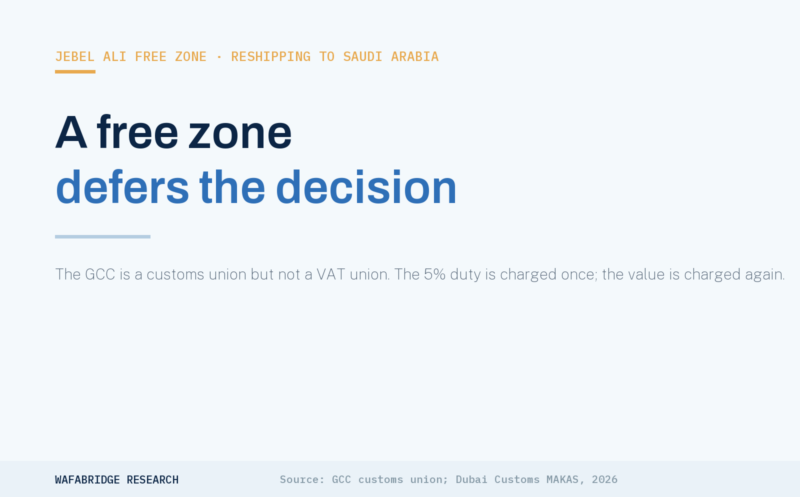
The six GCC states run a customs union. Goods entering the union from outside pay the common external tariff once, and once they have cleared they move between member states without further customs duty. That part is genuinely one market, which is why the same 5% duty line appears on every quote you will see for Saudi Arabia, the UAE, Qatar, Kuwait, Oman and Bahrain alike.
Everything downstream of that line is national. Consumption tax is a domestic matter in each state, collected where the goods are sold and consumed, not where they were imported. Import licensing and conformity certification are national too, and they differ enough that the same pallet can be straightforward in one market and paperwork-heavy in the next.
So “one tariff” and “one tax bill” are different things. The duty is settled at the union border. The VAT is settled on the other side, in the country where your customer is. If you are comparing two quotes for identical goods, the comparison that matters is rarely the freight and rarely the duty. It is which country’s VAT is sitting on the invoice, and whether your importer in that country is registered to reclaim it.
Two reminders before you run the numbers. The tax lines are not frozen: the GCC-China free trade agreement is still in negotiation, so confirm the current figure before you sign rather than after. And the wider region does not follow the GCC template, which our page on nine markets on one standard sets out against Egypt, Jordan and Iraq.
Duty: The Same 5% Everywhere (and Where It Isn’t)
The common external tariff runs at 5% on most imported lines, calculated on the customs value. That is the number your forwarder will quote, and for standard consumer goods out of China it is usually correct.
Three exceptions are worth holding in your head. First, some lines are exempt rather than taxed at 5%. The exempt list is short and specific, and whether your product sits on it comes down to its classification, so check the code rather than the product description. Second, goods that originate in a GCC member state enter duty-free, which matters if you are buying from a Gulf supplier rather than from a Chinese factory directly. Third, and the one that reshapes a landed-cost calculation, free zones: goods entering a UAE or Omani free zone can be held in bond, so the duty is suspended rather than paid until they are released into the mainland market.
What does not change: the consumption tax at the destination, and the certificate obligations. A re-export route reduces the duty bill. It does not remove the conformity paperwork, and it does not change who pays VAT in the market where the goods are finally sold. Anyone quoting you a “duty-free” number should be asked which duty, on which leg, into which country.
VAT: The Only Real Fiscal Divide Across Six Countries
Here is the split, on the same CIF basis, with the effective rate combining duty and consumption tax on a customs value of 100:
| Market | Common duty | VAT | Effective rate on CIF |
|---|---|---|---|
| Saudi Arabia | 5% | 15% | 20.9% |
| Bahrain | 5% | 10% | 15.6% |
| United Arab Emirates | 5% | 5% | 10.3% |
| Oman | 5% | 5% | 10.3% |
| Kuwait | 5% | 0% | 5.3% |
| Qatar | 5% | 0% | 5.3% |
The VAT base is the customs value plus the duty you just paid, which is why the effective rate lands above 5% plus the headline VAT rate in every market that levies one. Saudi Arabia is the extreme case: 5% duty and 15% VAT compound into an effective 20.9%, and ZATCA adds a service fee of 0.15% on the consignment, capped at 500 SAR per entry.
Two lines in that table need context. Kuwait and Qatar show 5.3% because they levy no VAT, but both add a local surcharge of 5% on top, so the combined fiscal load on the same cargo lands nearer 10.5%. The UAE and Oman figures of 10.3% apply to goods released into the mainland market; inside a free zone the duty stays suspended and the VAT clock stops until release.
The last practical point is about who pays. All six markets require VAT registration, so a registered importer recovers input VAT through their return rather than carrying it as a cost. Buy under your own name and resell, and VAT is largely a cash-flow question. Buy through an agent who carries it, and it becomes margin.
How to use the table: read the effective rate as the number to divide your target retail price by, and read the VAT column as the part that comes back to you if you are registered. A registered buyer should treat Saudi Arabia’s 20.9% as roughly 5.9% of real cost once the VAT returns through the return. An unregistered buyer treats the whole 20.9% as cost, and that decides whether the Saudi market is worth the freight at all.
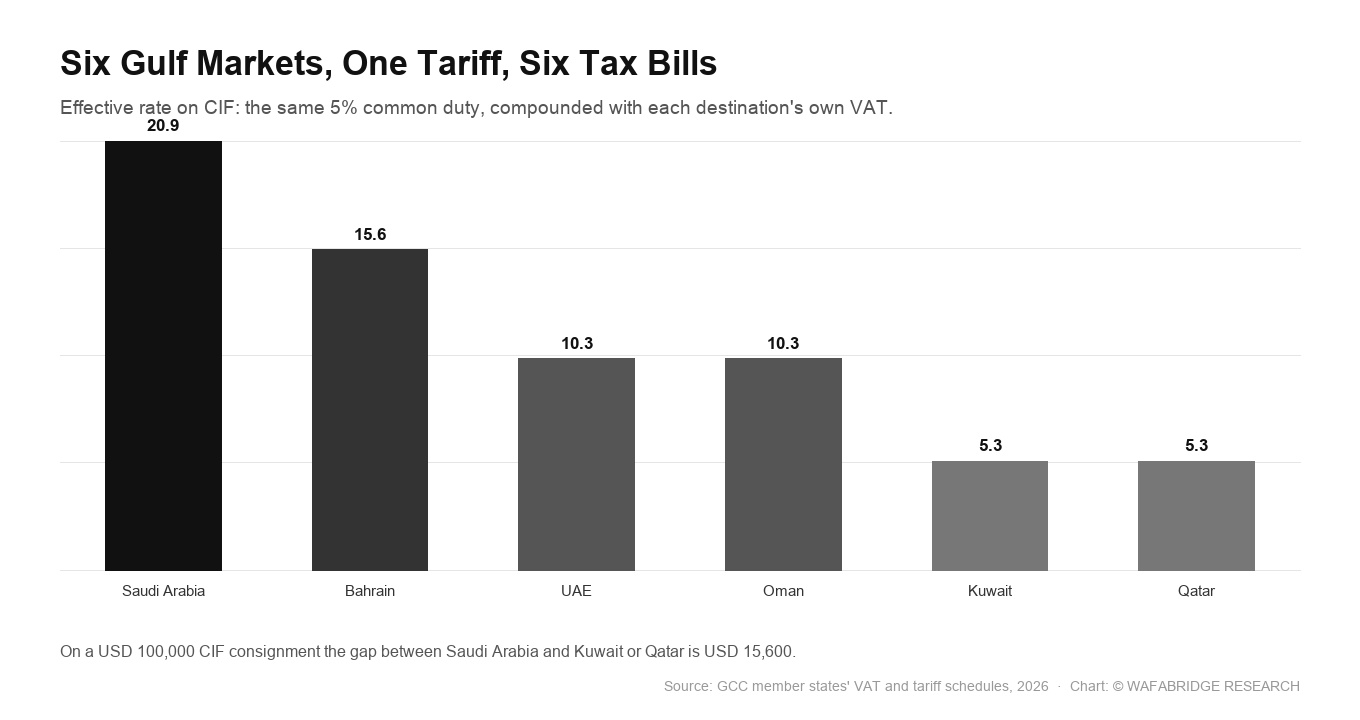
The chart above shows the effective rate each market lands on once its own VAT is added to the common 5% duty.
De Minimis, Measured on Freight-Inclusive Value
Every one of the six markets has a low-value threshold below which a consignment clears under a simplified regime with a reduced or zero duty and tax load. The thresholds differ by country and they are revised, so treat any figure handed to you as dated until it is confirmed against the current customs notice for that market and that year.
The detail that catches people out is what the threshold is measured against. It is not the FOB value on your supplier’s invoice. It is the customs value, which includes the goods plus insurance plus freight and charges up to the point of entry. Split a container into twenty small parcels and the freight still counts towards the value; splitting the shipment does not reduce the tax base, and a pattern of repeated low-value consignments can read as deliberate avoidance.
Simplified regimes also do not remove everything. Depending on the market, a low-value consignment may still need an import permit, a conformity certificate for the product category, and a registered importer of record. Relief on duty is not relief on certification.
What to do: get the current threshold and the valuation rule for your destination market in writing from the local agent before you split anything, and confirm which party is named as importer on the entry.
What the Spread Costs on a Real Order
On a USD 100,000 CIF shipment, VAT moves the total more than duty does
Indexed to 100 points of goods value. VAT is charged on the customs value plus duty.
The viewpoint this chart carries: the tax lines stack on top of each other instead of sitting side by side, and VAT is charged on the customs value plus duty rather than on the invoice total. That single mechanic is why two markets sharing the same 5% duty still land the same carton fifteen percentage points apart. Read the chart as an index: it shows which line is doing the damage on your product, and that line is the one to attack first when a quote looks too expensive to sell into a particular market.
Two boundaries sit on that arithmetic. The first is licence eligibility: the clearance table below records who can be the importer of record in each market, and a buyer who cannot put a qualifying importer behind the entry cannot capture the 5.3% line however attractive it looks on paper. Tax decides whether a move is worth making; the licence decides whether you are allowed to make it at all. The second is timing. A customs value is a fact about the shipment, but the rate applied to it is policy that can move under you: the GCC-China free trade agreement reached the working-group stage at WIF2026 in Doha on 25 October 2026, so the tariff side of this arithmetic is under active negotiation rather than static.
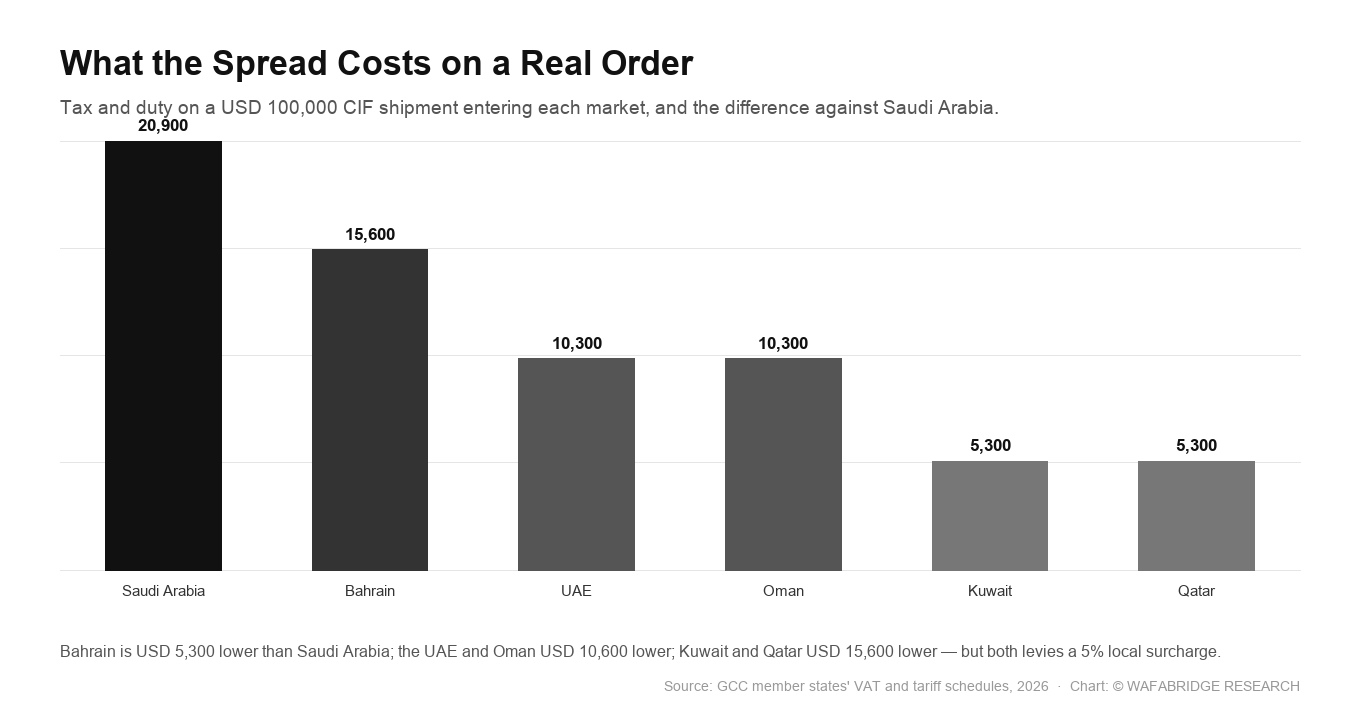
The chart above turns the same rate table into money on a USD 100,000 consignment, which is where the choice becomes a real commercial decision.
How to Choose Your Clearance Gate by Cargo Value
| Saudi Arabia | UAE | Qatar | Kuwait | Oman | Bahrain | |
|---|---|---|---|---|---|---|
| Import licence | Foreign buyers may resell imports | 100% foreign owned in free zones | Nationals or partners only | Citizens or registered agents | Foreign buyers may import | Foreign buyers may import |
| VAT registration | Required (ZATCA) | Required (FTA) | Required | Required | Required | Required |
| Certification path | SABER: PCoC + SCoC | ECAS or sector conformity | SABER | Broader certificate relief | SABER | SABER |
| Main gateway | Jeddah, Dammam | Jebel Ali, Khalifa | Hamad | Shuwaikh | Sohar | Khalifa |
The viewpoint this chart carries: eligibility decides access before tax decides cost. A market that restricts the importer to citizens or registered intermediaries is not a cheaper market, it is an unavailable one, and the rate in the table above is irrelevant until that question is answered. Use the matrix to disqualify markets first and price them second, because a disqualified destination wastes a sourcing cycle and a shipping window — and those are the expensive mistakes, not the tax.
Three routes carry most of the cargo we handle into the Gulf, and each one suits a different cargo profile.
Direct commercial import through a local importer of record. You buy in your own name, duty and VAT are settled at the border, and the container moves on. It suits steady mid-value replenishment.
Free-zone entry and in-bond staging. Cargo enters a free zone, duty is suspended while it sits there, and it is released into the mainland market against a specific order. One freight bill can feed several destinations.
Express and courier for low-value, urgent stock. Fastest to the door, simplest paperwork, by far the highest freight per kilo. It suits replacements, not a pallet.
The decision follows cargo value and sales pattern, not shipping convenience. The gap between a route that pays duty on landing and one that defers it is often larger than the freight saving that attracted you to it. Put both numbers on the same page before you commit.
Ground rules differ by market; the table below sets out what changes in each one.
| Saudi Arabia | UAE | Qatar | Kuwait | Oman | Bahrain | |
|---|---|---|---|---|---|---|
| Import licence | Foreign traders may import for resale | 100% foreign ownership in free zones | Nationals or partners only | Citizens or registered intermediaries | Foreign traders may import | Foreign traders may import |
| VAT registration | Required (ZATCA) | Required (FTA) | Required | Required | Required | Required |
| Certification path | SABER (PCoC + SCoC) | ECAS / category conformity | SABER | Relatively broad certificate requirement | SABER | SABER |
| Main gateway | Jeddah / Dammam | Jebel Ali / Khalifa | Hamad | Shuwaikh | Sohar | Khalifa |
Where to Consolidate: Jebel Ali, Jeddah, Dammam, Hamad, Shuwaikh, Sohar
Each port does a different job, and the choice follows where the stock has to be sold rather than where the vessel lands.
Jebel Ali is the regional consolidation point: deep transshipment volumes, free-zone warehousing, and the feeder networks that feed it. For a buyer splitting one purchase across UAE, Saudi, Qatar and Kuwait consignments, this is where the boxes arrive and get re-labelled before they move on.
Jeddah is Saudi Arabia’s principal gateway for Asian cargo and the point where the largest share of the country’s imported goods enters. Dammam serves the Eastern Province and the Gulf land route, and it is often the smarter door for cargo that will cross into Qatar, Kuwait or Bahrain by road rather than by sea.
Hamad is Qatar’s main container port, Shuwaikh is Kuwait’s principal port and free zone, and Sohar serves Oman with its own free zone and overland links down to the UAE. Bahrain’s cargo runs through Khalifa.
The consolidation decision is usually a trade-off between a longer sea leg and a shorter inland one. Shipping to Jeddah direct from China is often the cheapest way into Saudi, but it locks you into one market. Landing at Jebel Ali, breaking the cargo there and moving it inland on your own schedule keeps the option open on where the goods are finally released. Red Sea routing changes the arithmetic on the direct leg, and seasonal demand around Eid tightens the air side well before the sea side.
How We Run the Duty Decision Before You Buy
The tax comparison above is arithmetic you can do yourself. The part that decides whether the shipment actually lands is procedural, and it starts before a single carton is bought.
It starts with the product. We read the listing and the specification, settle the classification, and check what that classification triggers in the destination market: a conformity route such as SABER in Saudi Arabia or ECAS in the UAE, an import licence requirement, and the VAT registration that has to exist on the entry. Classification is the highest-leverage judgement on the whole sheet, because it moves the duty band and the documentation risk at the same time.
Then the destination is settled, and the entity behind the entry with it. For Saudi Arabia, Oman and Bahrain a foreign trading company can import for resale directly, so the entry can sit in your name. In the UAE the ownership question and the free zone decision come together, because the free zone is what allows duty to stay suspended while the stock waits for its orders. In Qatar and Kuwait the importer has to be a national or a registered intermediary, which changes the structure of the transaction rather than just its paperwork.
After that, the quote is assembled as one sheet in USD: goods value, the 8% flat sourcing fee, China domestic freight, international freight, duty, VAT and delivery. Quotes come back in three to five days, air DDP runs six to twelve days door to door, sea LCL from thirty days, and the first thirty days in our Guangzhou warehouse are free while the shipment fills. Where the route is DDP, duty and VAT are settled before dispatch, our local partner handles clearance in the destination, and the Arabic documentation is prepared before the carton leaves — so nobody is asked to pay anything at the door.
Two boundaries are worth stating. We price the routes we run; we do not give tax advice, and exemption lists are checked line by line against the current tariff for your code rather than assumed from a product description.
The Same Cargo, Six Markets: A Worked Example
One consignment, one customs value, six destinations. The figures below apply the published effective rates to a customs value of USD 100,000, so the differences between the columns are differences of destination rather than of shipment.
| Market | Common duty | VAT | Effective rate on CIF | Tax and duty on USD 100,000 CIF | Difference vs Saudi Arabia |
|---|---|---|---|---|---|
| Saudi Arabia | 5% | 15% | 20.9% | USD 20,900 | — |
| Bahrain | 5% | 10% | 15.6% | USD 15,600 | USD 5,300 lower |
| United Arab Emirates | 5% | 5% | 10.3% | USD 10,300 | USD 10,600 lower |
| Oman | 5% | 5% | 10.3% | USD 10,300 | USD 10,600 lower |
| Kuwait | 5% | 0% | 5.3% | USD 5,300 | USD 15,600 lower |
| Qatar | 5% | 0% | 5.3% | USD 5,300 | USD 15,600 lower |
Two things fall out of that table, and each one changes the decision rather than just describing it.
First, the headline gap is USD 15,600 on this consignment between Saudi Arabia and Kuwait or Qatar. That is not a rounding difference; on a repeat order it is the difference between selling the same carton into two markets or one. Set against it, the freight difference between a Jeddah direct sailing and a Jebel Ali routing is small enough that the tax line usually decides the geography, not the ocean leg.
Second, the USD 5,300 Kuwait and Qatar rows are not bankable on their own. Add the 5% local surcharge both markets apply and the combined load moves to roughly USD 10,500, which cuts the gap against Saudi Arabia to about USD 10,400 — and both markets restrict the importer of record to nationals or registered intermediaries. The right way to read those two rows is as a conditional: if you already have a qualifying importer in place, the arithmetic is attractive; if you do not, the cost of arranging one has to be weighed against the saving. The UAE and Oman rows behave differently again, because the 10.3% applies to goods released into the mainland market: cargo held in a free zone keeps the duty suspended and the VAT clock stopped until release, so one consignment can be released in pieces against real orders. The saving is in timing and in working capital, and the certification obligations still have to be met for every line, in every destination the stock ultimately serves.
Two adjustments sit outside this table. ZATCA charges a service fee of 0.15% on the consignment, capped at 500 SAR per entry, so a Saudi entry carries a small fixed addition that a split shipment multiplies. And a VAT-registered importer recovers the VAT element through its return, so the real comparison for a registered buyer is not 20.9% against 10.3% but 5.9% against 5%, plus the working capital that sits between payment and claim. The invoice total is what the port asks for; the landed margin is what your business keeps.
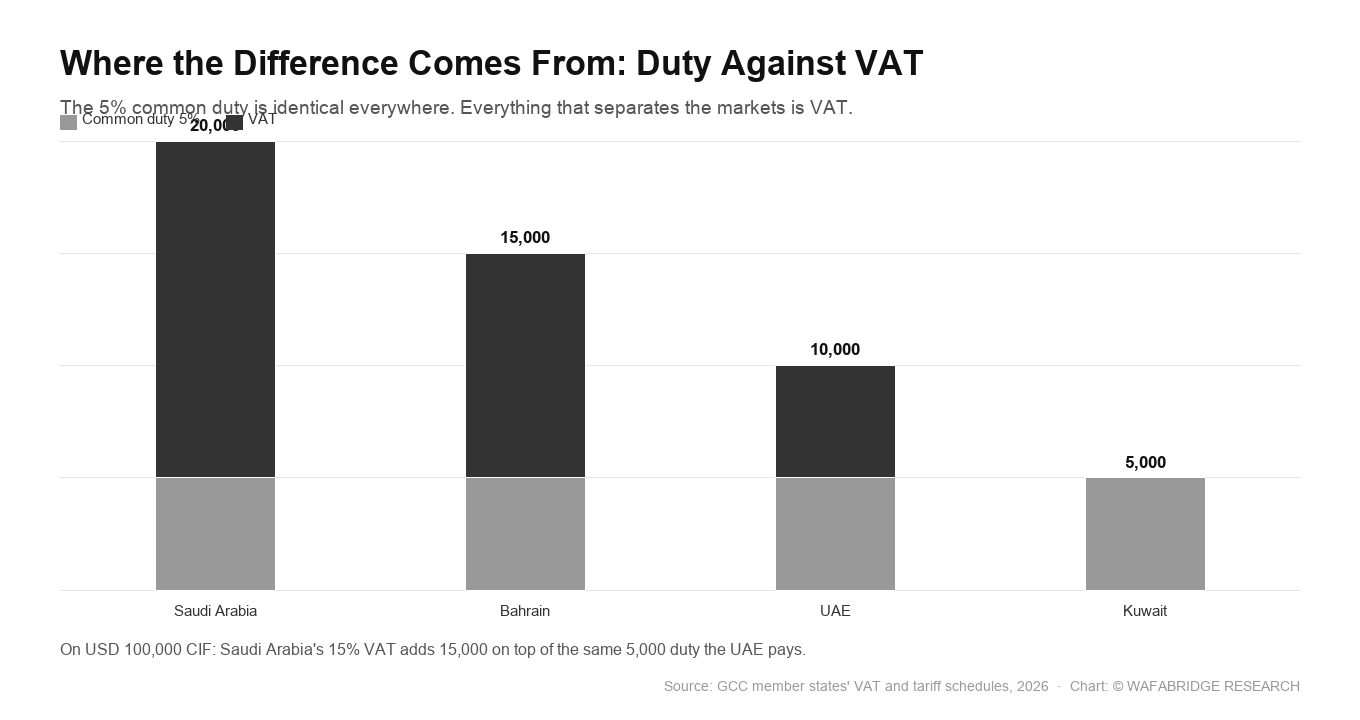
The chart above separates the two components on the same consignment, and shows that the duty never varies while the VAT does all the work.
Frequently asked questions
Which Gulf market has the cheapest tax on the same cargo?
Kuwait and Qatar show the lowest headline figure at 5.3% of CIF, but both add a 5% local surcharge that takes the combined load to roughly 10.5%. Saudi Arabia is the most expensive at 20.9%, and the cheapest rate is also the hardest to use, because both markets restrict the importer of record to nationals or registered intermediaries.
Is import VAT recoverable if I bring goods into Saudi Arabia?
Yes, if you are VAT-registered: input VAT comes back through your return rather than staying on the invoice, which is why buyers price Saudi stock on a net basis of about 5.9% rather than the 20.9% headline. Without registration, the whole 20.9% is a real cost.
Do I pay the 5% GCC duty once, or again in every country I sell into?
Once, at the union border, because goods move between GCC member states without a further customs duty. Each country then applies its own VAT and its own import formalities, so the duty is settled and the tax is not.
Can I land goods in a UAE free zone and sell them into Saudi Arabia without paying Saudi duty first?
The duty stays suspended while the stock sits inside the free zone and the VAT clock stops until release, but once the goods move into Saudi Arabia, Saudi duty, Saudi VAT and the Saudi certification obligations all apply on that entry. Free-zone staging buys timing and inventory flexibility, not a way around the destination country’s tax.
Is the 5% GCC duty going to change?
It is under negotiation rather than settled: the GCC-China free trade agreement reached the working-group stage at WIF2026 in Doha on 25 October 2026. Nothing here assumes a new rate, so confirm the current duty line for your code before you release a purchase order.
Send us the product link and we will tell you the duty band, the certification path and what it costs to land before you buy. Model it in the cost calculator, or send us the link and we will run the sheet for you.
Sources: GCC General Secretariat for customs union and common tariff information (gcc-sg.org); Zakat, Tax and Customs Authority for Saudi import VAT and customs service fees (zatca.gov.sa); US International Trade Administration for GCC member state free trade agreement pages (trade.gov); GCC-China free trade agreement negotiation status, WIF2026, Doha, 25 October 2026. Rates are current as of writing and can be adjusted; confirm the current position with Saudi Customs and ZATCA before you sign. Research and figures compiled by 亚觅出海集团 AMI Global. Chart: © WAFABRIDGE RESEARCH