Composite cases in this article are drawn from consignments we handle on the Guangzhou–Gulf corridor; names and figures are changed, the mechanics are not.
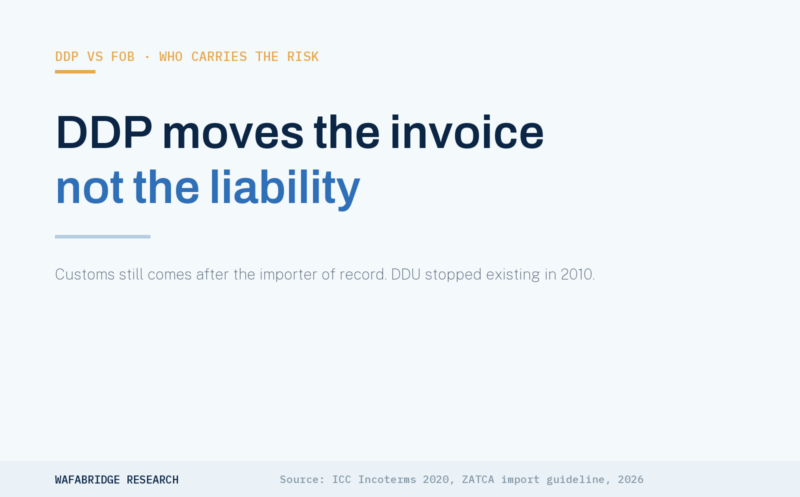
DDP shifts the contract obligation to the seller but not the taxpayer under customs law: Saudi Arabia’s 15% import VAT and 5% common external tariff are still pursued from the importer of record named on the declaration, so a DDP quote is a freight and duty arrangement, not an immunity from customs liability.
A DDP quote, and a payment order addressed to his own company
Faisal, a Riyadh buyer, was moving 240 cartons of polypropylene food-contact storage containers from Guangzhou to Riyadh. The DDP quotation was tidy in a way that should have been reassuring: ocean freight, insurance, clearance, inland delivery, duty at 5% and Saudi VAT at 15%, every tax line marked prepaid, and the whole thing delivered to his door on the standard sea lane.
He read the word “prepaid” as the end of the tax question. On the day the container landed at Jeddah it was not. Customs re-assigned the declared heading on arrival, the rate applied to the goods was not the 5% his quotation had priced, and ZATCA issued a payment order for the additional duty together with the VAT owed on that duty. The order was addressed to Faisal’s company, because his company was the importer of record on the declaration. The seller had prepaid against a declaration that turned out to be wrong, and the shortfall belonged to the buyer.
Nothing about that is unusual, and nothing about it is a dispute between buyer and seller. It is the ordinary result of the most misread term in cross-border trade. DDP moves the invoice obligation to the seller and leaves the customs liability where the law put it — on the importer of record.
DDU stopped existing in 2010
The first fix is terminological, and it is not pedantry. Incoterms 2020 contains 11 terms: EXW, FCA, CPT, CIP, DAP, DPU, DDP, FAS, FOB, CFR and CIF. DDU is not one of them.
DDU — Delivered at Duty Unpaid — belonged to Incoterms 2000. The 2010 rules replaced it with two terms, DAT (Delivered at Terminal) and DAP (Delivered at Place), taking the set from 13 terms down to 11. The 2020 rules kept the count at 11 and renamed one of them: DPU is DAT renamed, Delivered at Terminal becoming Delivered at Place Unloaded. DPU has nothing to do with DDU. It is the terminal variant of DAP, and it asks the seller to unload the goods as well as deliver them.
The practical successor to DDU is therefore DAP, and any contract still citing DDU is referencing a rule that no longer exists. That matters commercially because an undefined term is an argument rather than a standard: whose obligation is it to clear, and where does the risk pass? The usual sequence is a forwarder quoting from a template, the purchase order and the quotation disagreeing, and the disagreement surfacing at the border. Two things close it cheaply — name the rules version (“Incoterms 2020 DDP Jeddah”) and name the exact place, because “DDP Jeddah” and “DDP Riyadh” are different obligations and “DDP Saudi Arabia” is not a place at all.
ICC’s guidance on using Incoterms to manage tariff risk makes the commercial case for doing this deliberately: the term decides which party carries the exposure when duties change, and that is a choice to be written down rather than a default to be inherited from an old template.
Why then does DDU keep appearing on quotations in the Gulf? It is a habit rather than a reference. The term survives in forwarder templates and in order confirmations written years ago, because the commercial idea behind it never went away: the goods arrive with nobody having paid the duty. In practice DDU means duty unpaid, so the party taking delivery has to clear the consignment itself, and it has to be an entity the destination accepts. In Saudi Arabia that is a licensed importer, and 2026 US International Trade Administration guidance on Saudi importer eligibility records that only Saudi nationals may import goods for resale, with foreign industrial entities limited to their own manufactured products. A DDU line on a Gulf quotation is therefore often asking the buyer to do something a buyer without a local entity may not be allowed to do.
Where each term puts the risk
Four terms cover most Chinese export conversations, and they differ along one dimension that matters more than the others: which party is standing in front of the destination customs authority.
| EXW | FOB | DAP | DDP | |
|---|---|---|---|---|
| Export clearance | Buyer | Seller | Seller | Seller |
| Import clearance | Buyer | Buyer | Buyer | Seller |
| Duty and taxes | Buyer | Buyer | Buyer | Seller |
| Risk transfers | Seller's premises | On board at origin | Named place | Named place |
| Main carriage | Buyer | Buyer | Seller | Seller |
| Mode | Any | Sea only | Any | Any |
| The trap | You handle the Chinese export licence | Use FCA for containers | Buyer still clears and pays | Only rule where the seller pays duty |
| Term | Export clearance | Import clearance | Duty and import taxes | Risk passes | Main carriage |
|---|---|---|---|---|---|
| EXW | Buyer | Buyer | Buyer | Seller’s premises | Buyer pays |
| FOB | Seller | Buyer | Buyer | Goods on board the vessel at the port of shipment | Buyer pays; sea and inland waterway only |
| DAP | Seller | Buyer | Buyer | Goods at the named place, ready for unloading | Seller pays |
| DPU | Seller | Buyer | Buyer | As DAP, and the seller unloads | Seller pays |
| DDP | Seller | Seller | Seller | Goods at the named place, ready for unloading | Seller pays |
DDP is the only one of the 11 terms in which the seller takes import clearance and duty. Every other term, EXW included, leaves the destination customs obligation with the buyer — which is why an EXW price looks cheap and lands expensively, and why an FOB quotation hands the buyer a clearance bill the seller never saw.
Two limits on FOB are worth stating plainly. It applies only to sea and inland waterway carriage, so the moment the cargo moves by air it is unavailable and the comparable terms are FCA, CPT, CIP, DAP, DPU and DDP. And it passes risk when the goods are on board the vessel at the port of shipment, which is earlier than most buyers picture: the seller carries the risk to the ship’s rail at origin, not to the loading bay and not to the destination port. A buyer who reads FOB as “my responsibility starts when the container arrives” has misread the one thing FOB is precise about.
There is a third problem with FOB, and it shows up in containerised cargo rather than on paper. FOB was written for a break-bulk shipment, where the seller delivers individual pieces over the ship’s rail and the buyer can verify the count as it goes over. A modern container is stuffed at an inland depot, sealed, and handed to the carrier long before it reaches a ship’s rail, so the moment the term is precise about has nothing to do with the handover the buyer expects. That is why forwarders quoting container freight often propose FCA instead, which passes the goods to the carrier at a named place and fits how a sealed box actually moves. Nothing in ICC’s rules requires the switch, but the term should suit the method.
EXW is the mirror image and the worst fit for most cross-border sales: risk passes at the seller’s premises, before loading, and the buyer takes over export clearance. DAP and DPU push the seller’s obligation as far as the named place, ready for unloading, which is why DAP is the term most often described in the market as DDU’s practical replacement.
The same custom shows up inside DDP, where three arrangements are written on quotations without any of them being a separate Incoterm. The first is DDP to the door, full door-to-door, which is the column priced in the table below and the reading most people assume from the term. The second is DDP to port with clearance completed but no inland delivery, which leaves the buyer to collect from the port or free zone and run the last leg itself. The third is DDP to a named place of destination that is not the buyer’s own address, and the variant that matters most in e-commerce is delivery into a platform’s warehouse, where the arrival is a receiving event rather than the end of a journey. What separates the three is where the delivery obligation ends.
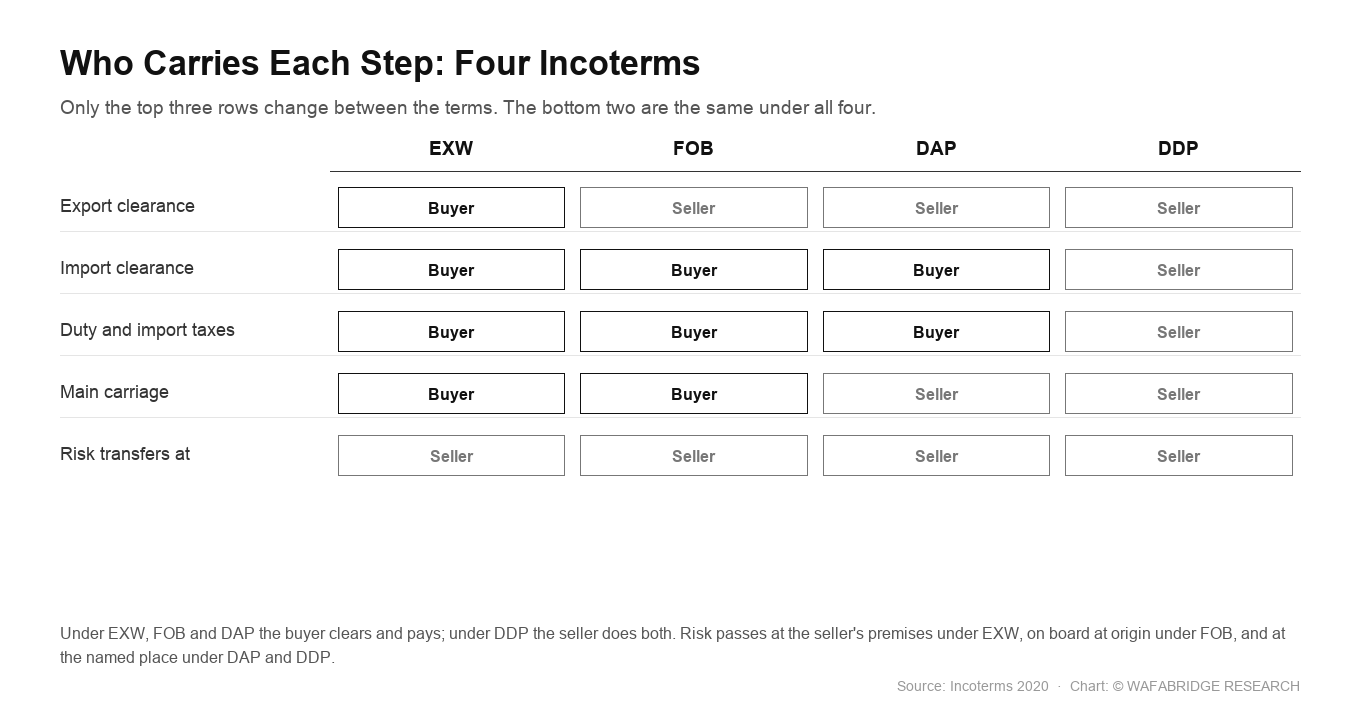
The chart above is the allocation in one view. Only the top three rows change between the terms, and the last two do not change at all.
What the buyer actually funds
The cost difference between the terms is small and legible, which is worth knowing before the term choice is argued on the basis of risk. The worked example below prices one consignment both ways on the published cost index — goods value at 100 points, every other line expressed against that scale — and then converts it to dollars on a stated order value of USD 60,000, so one index point is USD 600. The two freight-side lines are index values on a quote basis rather than published tariffs, and they are identical on both sides because the sea movement is the same movement either way; ocean freight itself is quoted per sailing and confirmed against your dates.
On paper DDP looks more expensive; the real difference is which party carries a rejected certificate
Indexed to 100 points of goods value on a standard consignment to Riyadh. Indicative, 2026.
| Line (USD, indicative — stated order value USD 60,000) | FOB, buyer clears | DDP, door to door |
|---|---|---|
| Goods value | 60,000 | 60,000 |
| China inland freight to port | 1,200 | 1,200 |
| Sea carriage and marine insurance | 7,200 | 7,200 |
| Duty at 5% common external tariff | 3,000 | 3,000 |
| Saudi VAT at 15%, base = customs value plus duty | 9,600 | 9,600 |
| Import clearance handling | 1,800 | 1,200 |
| Compliance and document preparation | 0 | 1,200 |
| Inland delivery to the door | 2,400 | 1,800 |
| Sourcing and buying fee, flat 8% | 0 | 4,800 |
| Total buyer outlay (index points) | 142 | 150 |
| Total buyer outlay (USD) | 85,200 | 90,000 |
| Liability if the HS classification is re-assigned on arrival and duty rises by 5% of the customs value | 3,000 of duty plus 450 of VAT on it, 3,450 in total, pursued from the importer of record | The same 3,450, pursued from the importer of record named on the declaration |
Two notes on the arithmetic. The index rounds the VAT line: 15% of the customs value plus duty is 15.75 points on this example, carried at 16. And the index treats the goods value as the customs value for the two tax lines, whereas a real CIF declaration would bring the freight and insurance lines above inside the customs value, which lifts both duty and VAT above the figures shown. Read the table as a comparison between two terms on one basis, not as a duty computation.
The two tax lines are identical in both columns, because they are the same tax on the same goods: the term decides who writes the cheque, not who the tax is charged to. Saudi VAT at 15% applies to all imports regardless of classification, regardless of the duty rate and whether the goods are exempt from duty at all, and the import VAT base is the customs value plus duty, excise and other charges excluding VAT itself. Duty on most goods moving into Saudi Arabia runs at 5% of CIF under the GCC common external tariff.
Read the DDP column as a funding schedule rather than a saving. Under FOB the buyer funds 142 points, of which 21 are tax recoverable through the VAT return if the buyer is registered, leaving 121 points of real freight and logistics cost paid in cash. Under DDP the buyer funds 150, of which the same 21 is tax, the same 7 points of clearance, compliance and inland work is priced inside the seller’s quotation, and 8 points — USD 4,800 on this order, exactly 8% of the goods value — is the fee for having it handled. The convenience is priced, and it is worth 8% of the order. That is a fair price for a buyer with no local entity behind it, and a fair price to question once the buyer has one.
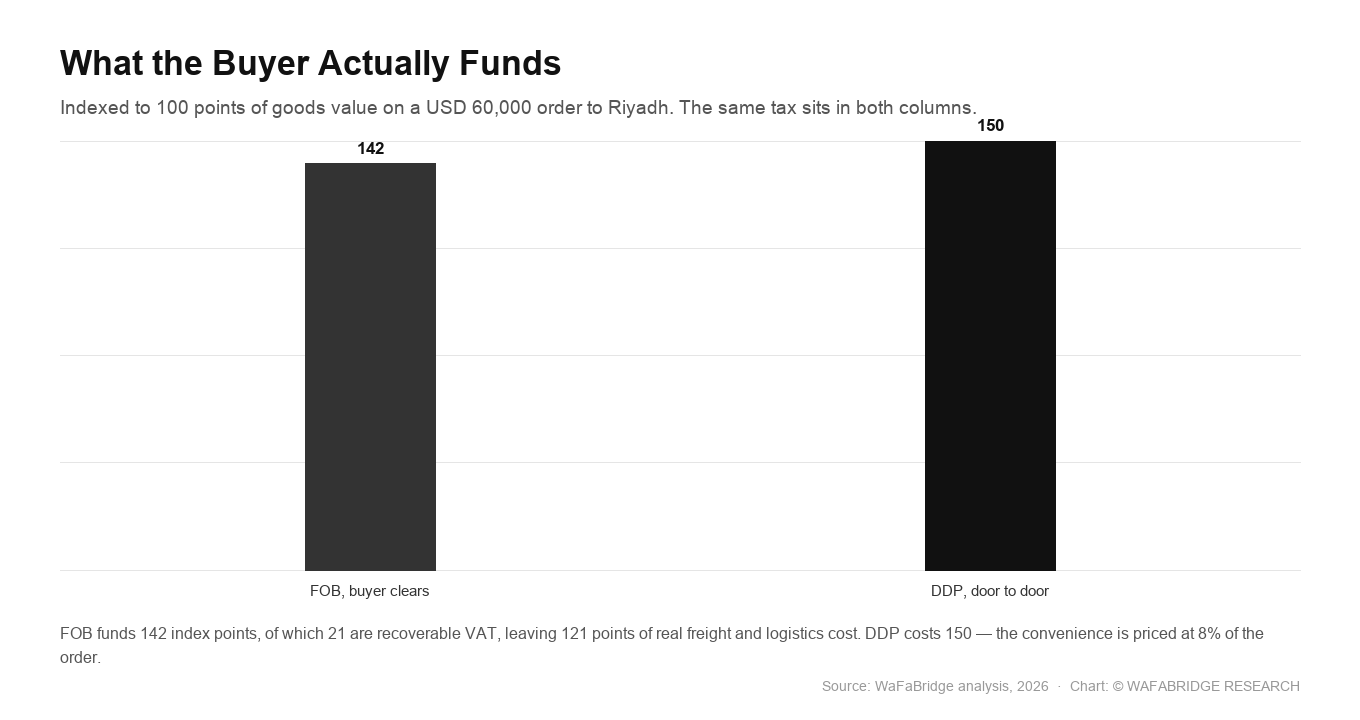
The chart above is what the buyer funds under each term, indexed to 100 points of goods value. The tax line is identical in both columns; the difference is the convenience.
Who customs comes after
Everything above assumes the declaration is right. Here is what happens when it is not.
| What goes wrong | Who carries it |
|---|---|
| HS code does not match the goods | The importer of record, on a ZATCA payment order |
| Correction filed before payment | The importer notifies ZATCA, then pays the difference |
| Certificate misses the goods shipped | The importer, and the goods are held |
| Shipment certificate never uploaded | The importer. A carrier's undertaking is no longer accepted |
| Buyer assumes DDP means no chase | DDP sets the invoice. It does not move liability to customs |
Saudi customs treats classification and value errors as the importer’s problem, in writing. Where an error is identified before payment, the importer must notify ZATCA before paying. Where the goods have already cleared, the correction runs through a ZATCA payment order, and additional amounts are required from the importer. The mechanism is administrative rather than commercial, so it does not respond to who paid the original invoice or to anything promised on the quotation. It responds to the name on the declaration.
The arithmetic of that is unforgiving in a small way. Because the ZATCA base for import VAT includes the duty, every additional point of duty costs 1.15 points of cash — one for the duty and 0.15 for the VAT on it. A reclassification that moves a line from a duty-free heading onto one carrying the 5% common external tariff costs 5 points of duty and 0.75 of VAT on a 100-point consignment, and it costs the importer 5.75 points he did not budget for, on a shipment he was told was prepaid. On the worked example above that is USD 3,000 of duty and USD 450 of VAT, USD 3,450 arriving as a payment order from ZATCA.
This is where DDP and DDP-with-a-local-importer diverge, and the difference is about names rather than money. If your own company applies for the SABER certificates and appears as the importer on the declaration, your company is the taxpayer under a DDP sale and the payment order arrives in your name. If a local entity appears instead, that entity is the taxpayer, and your exposure becomes contractual — the party holding the customs debt is not your company, and the instruction to pay it is not yours to give. A DDP quotation that does not name the importer of record has not told the buyer who is liable, which is why the naming clause matters more than the price.
So the quotation needs more than a price term in it, and the clauses that decide an argument are the ones that go in writing. Name the importer of record and the TIN that will appear on the declaration, and state which party applies for the PCoC and the SCoC. Then deal with reclassification: say whether the DDP amount is computed on the HS heading as declared or on the heading ZATCA finally rules on, and who bears the shortfall if the two differ. The ZATCA guideline helps because it sets the order of operations: where an error is identified before payment, the importer must notify ZATCA before paying. A notice window of a stated number of days, and a right to suspend the shipment while the classification is confirmed, turn a payment order landing on arrival into a question answered before the container moves. That is where Faisal found himself when the order came addressed to his own company.
Two Saudi constraints you cannot design around
Everything in this article runs into two rules that no incoterm can move.
The importer has to be licensed to import. ZATCA’s guidance is unambiguous on the principle: in all cases, the person importing into Saudi Arabia must hold a licence to carry out imports into Saudi Arabia. Public guidance does not settle whether an entity that is not registered in Saudi Arabia can itself stand as the importer of record, so the practice is to have the declaration filed by an entity that holds the permission — in practice a local importer of record service. Either way, one of the parties named on the declaration is a licensed importer, and that party is the taxpayer.
The importer’s tax number has to be on the declaration. The declaration discloses the importer’s TIN: a commercial registration (CR), a 700 Code, a Saudi ID or a GCC ID. There is no anonymous importer. The TIN is the identity the customs authority pursues, which is why a DDP quotation that leaves the importer of record unnamed has left the buyer’s central question unanswered.
Three further constraints shape the timeline rather than the liability. The FASAH advance declaration has to be filed at least 48 hours before the goods arrive. SABER runs on two certificates: for regulated products the importer applies for the PCoC and then applies for the SCoC per shipment, and the SCoC must be handed to customs before the goods enter; for non-regulated products the importer self-declares and still needs an SCoC. And since 1 January 2025 a carrier’s letter of undertaking is no longer accepted for clearance, so an SCoC applied for after arrival is invalid.
Who may import is narrower than the term table suggests. Only Saudi nationals may import goods for resale and for direct sale; foreign industrial entities may trade their own manufactured products; GCC nationals may engage in certain retail trade. A DDP quotation that assumes a Saudi buyer can simply be the importer of record is usually right about that, and usually wrong about a non-Saudi company being able to do it.
One piece of tax history is worth holding on to. Saudi VAT started at 5% on 1 January 2018 and rose to 15% on 1 July 2020 under Royal Decree A/638. A “prepaid at 15%” line is a statement about a rate that has already moved once, and ZATCA’s VAT guidance on imports and exports is the document to check it against. Customs also charges an administrative service fee of 0.15%, capped at SAR 500 per declaration on practitioner guidance, which is indicative and worth confirming for your own filings.
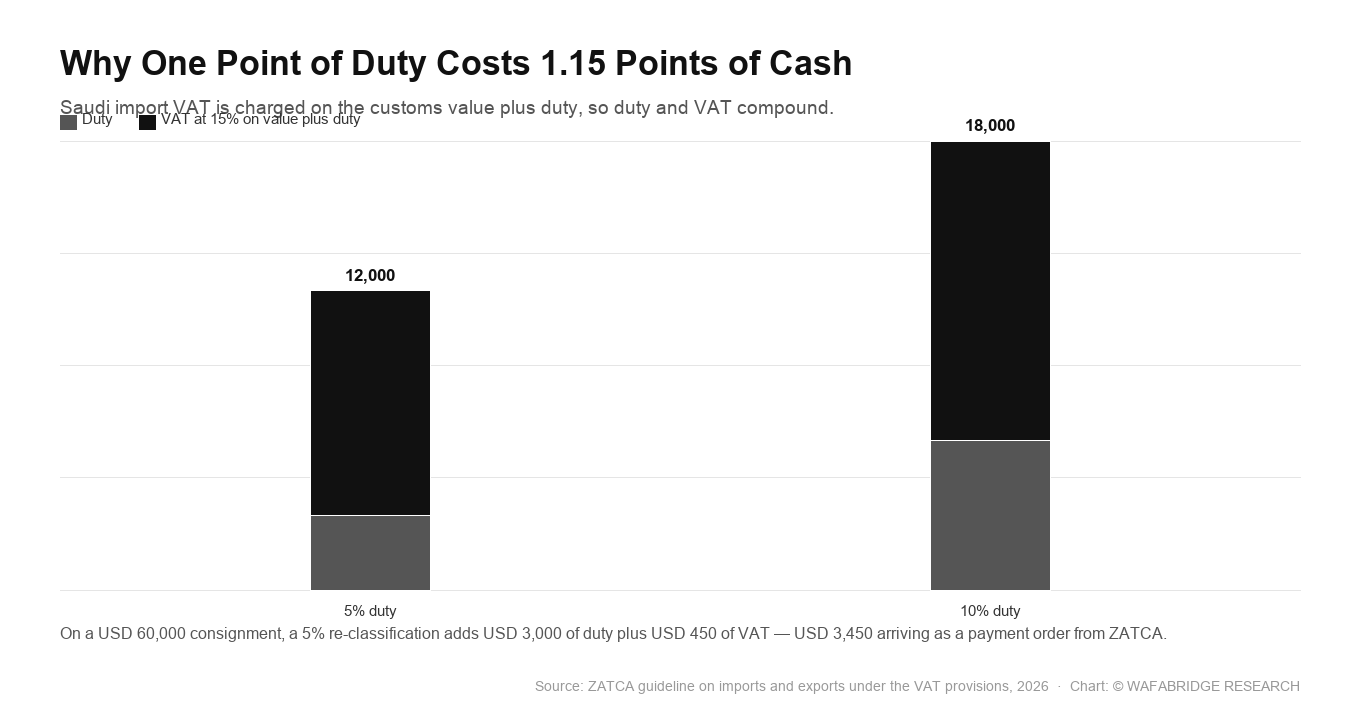
The chart above is the compounding. Because import VAT is charged on the customs value plus duty, one point of duty costs 1.15 points of cash.
Four decision rules, by buyer type
First orders from a buyer with no Saudi entity: use DDP, but write the importer into the quotation. DDP is the right term for a shipment where the buyer cannot yet file a FASAH declaration, hold a TIN or apply for SABER certificates. The clause to add is not a price term but a naming one: the quotation should state which party is the importer of record, which party’s TIN appears on the declaration, and who applies for the PCoC and the SCoC. Without those three lines, DDP has moved the obligation and left the risk in place.
Repeat buyers with an established importer and stable classification: FOB or CIF with your own clearance. Once the buyer has a filing history, the 8 points between the two columns above are buying less than they cost, because the thing DDP sells — someone else’s experience of the border — is something the buyer now has. Owning the clearance file also owns the classification audit trail, and the audit trail is what answers ZATCA when a reclassification arrives. For a buyer with a VAT registration, the recovery also sits in the buyer’s own return rather than in a third party’s.
Buyers with wide SKU ranges or uncertain classification: budget the reclassification reserve instead of discovering it. On a mixed consignment, fix the classification before dispatch rather than after arrival, and keep the seller’s declaration visible inside the buyer’s own file. Every additional point of duty costs 1.15 points of cash, and it costs the party named on the declaration — which is not necessarily the party that paid the invoice.
Regulated products: no term compresses the certificate chain. SABER requires the importer to apply for the PCoC and the SCoC, and the SCoC has to reach customs before the goods enter. That work belongs to the importer under every term, including DDP, and a letter of undertaking has not been accepted for clearance since 1 January 2025. On regulated lines the term decides who pays the freight; the certificate chain decides when the goods can move; and the importer decides whether the file is right.
Tariff lines, VAT rates and customs fees move with regulation and with each market’s implementation. Confirm the current duty line, VAT treatment and fee schedule for your own HS code with the clearing broker or the authority before you release a purchase order.
Internal links: DDP shipping explained end to end · landed cost itemised, with the 8% sourcing fee · SABER certification for goods entering Saudi Arabia · landed cost calculator
Sources: ICC, Incoterms 2020 — the 11 terms, the 2000-to-2010 replacement of DDU by DAT and DAP, and the requirement to name the rules version and the named place (iccwbo.org); ICC Austria, Using Incoterms to Manage Tariff Risks, April 2025 (icc-austria.org); ZATCA, Guideline on Imports and Exports under the VAT Provision — 15% on all imports, the customs value plus duty base, and payment orders for additional amounts required from the importer (zatca.gov.sa); Saudi ZATCA guidance on the import licensing requirement and declaration data; the US International Trade Administration, 2026 — Saudi importer eligibility, the 48-hour FASAH advance declaration and the SABER PCoC and SCoC sequence; Royal Decree A/638, Saudi VAT from 5% to 15% effective 1 July 2020. The worked example is a stated index used to make the arithmetic concrete; freight, duty and VAT figures are indicative and are confirmed against your HS code and your dates by the destination broker. Research and figures compiled by 亚觅出海集团 AMI Global.
Chart: © WAFABRIDGE RESEARCH
One point applies across all of them. The Incoterm decides who invoices whom and who carries the risk on paper. It does not change which border the goods cross, and WaFaBridge ships DDP into all nine markets on the same standard: the six GCC states plus Egypt, Jordan and Iraq. A quotation that does not name the importer of record is incomplete in every one of them, because the licence requirement and the tax registration requirement travel with the cargo, not with the delivery term.
Frequently asked questions
Is DDU still a valid Incoterm in 2026?
No. DDU belonged to Incoterms 2000 and was replaced by DAT and DAP in the 2010 rules, which cut the set from 13 terms to 11, and Incoterms 2020 still has 11 terms with no DDU among them. DPU is the renamed DAT — Delivered at Terminal becoming Delivered at Place Unloaded — and has nothing to do with DDU; the practical successor to DDU is DAP. If an order still says DDU, get it renamed on the order confirmation with the rules version and the exact named place written in.
Under DDP, do I still pay Saudi duty and VAT?
Yes, as a matter of law the taxpayer is the importer of record on the declaration, and DDP changes who contracts for the freight rather than who owes the tax. On a DDP shipment where your own company applies for the SABER certificates and appears as the importer, a payment order for a reclassification is addressed to your company, exactly as it would be on an FOB shipment.
Who pays if customs reclassifies my goods on arrival?
The importer. ZATCA requires the importer to notify the authority before payment where the error is found before payment is made, and where the goods have already cleared the correction runs through a ZATCA payment order with additional amounts required from the importer. Because VAT is charged on the customs value plus duty, each additional point of duty costs 1.15 points of cash.
Do I need a Saudi import licence and a TIN for a DDP shipment?
Import into Saudi Arabia requires a licence to import, and the importer’s TIN must be disclosed on the declaration — a commercial registration, a 700 Code, a Saudi ID or a GCC ID. Public guidance does not settle whether a non-registered entity can be the importer of record itself, so in practice the declaration is filed through a licensed local importer of record, which is also the entity that would be pursued if the file turns out to be wrong.
Can I use FOB if my cargo goes by air?
No. FOB applies only to sea and inland waterway carriage, and the risk passes when the goods are on board the vessel at the port of shipment. For air freight the comparable terms are FCA, CPT, CIP, DAP, DPU and DDP, and a DDP air quotation still leaves the importer of record liable for any classification correction ZATCA raises.
Which term should a first-time Gulf importer use?
DDP for early orders, with the importer of record, the TIN on the declaration and the certificate applicants named in the quotation before dispatch, because on a first shipment that is what determines whether a payment order lands on you. Once you have your own filing history, FOB or CIF with your own clearance is usually the better arrangement: it costs 8 index points less in the worked example above and it puts the classification audit trail and the VAT recovery in your own hands.