Weekly
Friday and Saturday
The working week runs Sunday to Thursday. A Thursday arrival typically means the file is not looked at until Sunday, and container storage runs through the weekend.

What it actually costs, what customs actually asks for, and where shipments actually get held. Written for buyers sourcing from Chinese platforms and Chinese factories, delivering into the Kingdom. Not a regional overview — this is the Saudi lane.
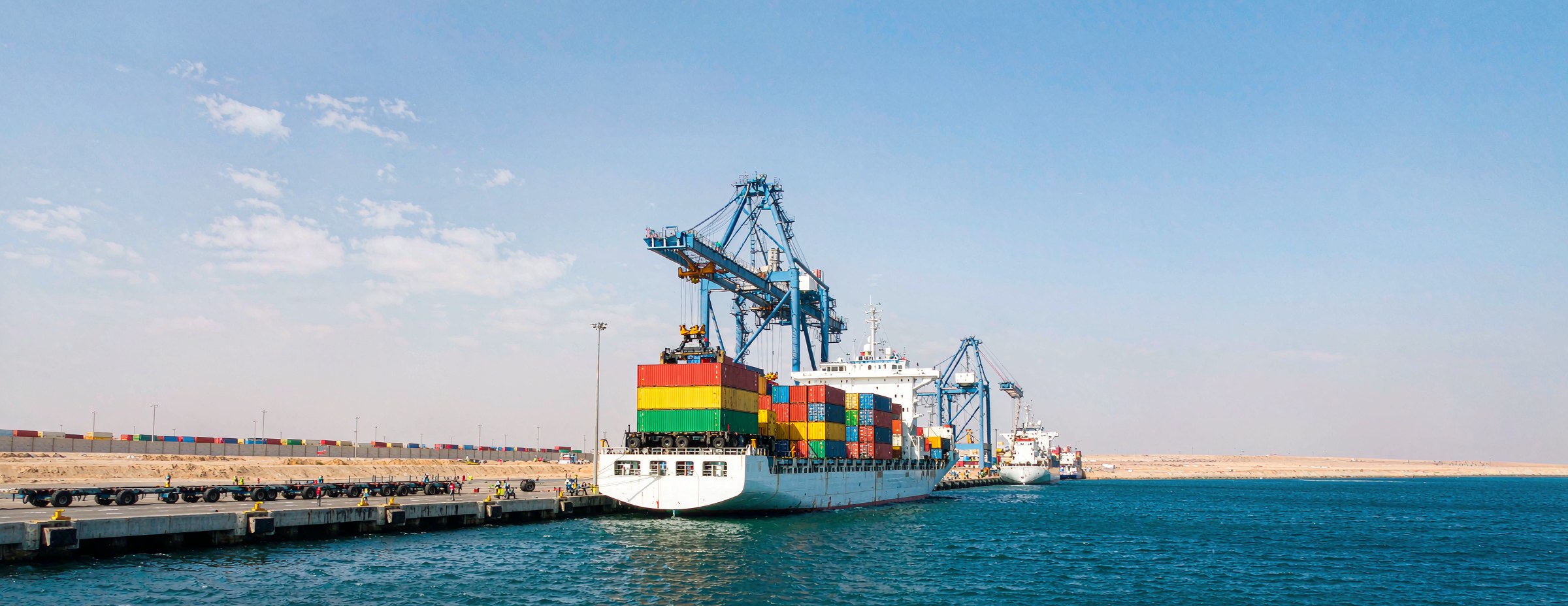
Saudi Arabia is not one destination. Goods enter through Jeddah on the Red Sea, Dammam on the Gulf, or Riyadh by air and inland dry port — and the choice changes your transit time, your clearance agent, and sometimes your duty treatment. What does not change is this: the paperwork is checked before the goods are, and it is checked against the HS code.
| Route | Entry point | Transit from Guangzhou | Best for |
|---|---|---|---|
| Air, consolidated | RUH · JED · DMM | 6–12 days door to door | Samples, electronics, apparel restocks, anything with a launch date |
| Sea LCL | Jeddah Islamic Port | 28–35 days + 4–8 days clearance | Furniture, homeware, fixtures, orders above 3 CBM |
| Sea LCL | King Abdulaziz Port, Dammam | 30–38 days + 4–8 days clearance | Eastern Province and Riyadh-bound cargo via rail |
| Sea FCL | Jeddah / Dammam | 26–32 days + clearance | Full containers, 20ft and 40ft, single consignee |
Transit figures are measured from pickup at the Chinese supplier to delivery at the Saudi address, assuming documents are complete at the time of departure. A missing SABER certificate adds 5–14 days regardless of the mode — see section 04.
Every quote you receive for Saudi Arabia should be reducible to these three. If a supplier or forwarder cannot name them separately, the number they gave you is an estimate dressed as a price.
        // step 1 — dutiable value

        CIF = goods + international freight + insurance


        // step 2 — duty, then VAT on the duty-inclusive value

        duty = CIF × duty rate

        VAT  = (CIF + duty) × 15%

        zatca = min(CIF × 0.15%, SAR 500)


        // step 3 — landed cost, before our fee

        landed = CIF + duty + VAT + zatca
The order matters. VAT is applied after duty, so the two compound. A 5% duty on a SAR 10,000 consignment does not add 5% — it adds 5%, and then 15% on top of that larger base. Our sourcing fee is charged on the goods value only and is not part of the customs base.
Indicative bands for the categories we move most often into the Kingdom. The binding figure comes from the 12-digit HS code on the declaration — the table below tells you whether to budget 5% or 25%, not what the final invoice will say.
| Category | Duty | Notes |
|---|---|---|
| Books, printed matter | 0% | Content review still applies; some titles are held for inspection |
| Medical devices | 0–5% | Requires SFDA registration before shipment, not after arrival |
| Consumer electronics | 5% | Low duty, but radios and cellular modules need CST type approval |
| Industrial machinery & parts | 5% | Spare-part declarations must match the parent machine's code |
| Home appliances, kitchenware | 5–15% | Often needs SABER and, for gas appliances, an additional safety certificate |
| Furniture & fixtures | 5–15% | Bulky; sea LCL almost always beats air on cost per CBM |
| Apparel & textiles | 15–25% | The highest band most small importers hit. Fibre composition on the label must match the declaration |
| Footwear & leather goods | 15–25% | Branded goods need the authorisation chain — see section 06 |
| Cosmetics & personal care | 5–20% | SFDA product notification is mandatory; unregistered cosmetics are refused outright |
| Foodstuffs | 5–25% | SFDA + Arabic labelling + shelf-life minimums; we do not handle this category |
| Tobacco & vaping products | 100% | Where a compliant route exists at all; every case goes through separate review — see section 06 |
Rates reflect the GCC unified customs tariff as currently applied at Saudi entry points. Where a range is shown, the spread comes from sub-heading differences inside the category — a cotton shirt and a polyester shirt are not always the same line. Always confirm against your actual HS code before committing to a retail price.
SABER is the platform. It is not a certificate in itself, and "we have SABER" means nothing without saying which of the two. This is the single most common reason a shipment sits at Jeddah for two weeks while the buyer believes everything is in order.
Registered against a product or product family, issued by an approved conformity assessment body. It proves the product itself meets the applicable Saudi technical regulation.
You obtain this once per product, before the first shipment. It is not issued per order and cannot be created at the port.
Generated on SABER for each individual consignment, referencing the existing PCoC. It is the document the customs broker attaches to the declaration.
No PCoC, no SCoC — there is no workaround, and no broker can issue one on your behalf without it.
The container is not rejected — it is held. Storage accrues at the port against the consignee, typically from day three, and the meter runs whether or not anyone is working on the file. A held shipment also blocks the SCoC application for every later shipment of the same product, because the PCoC record is what the platform checks against.
2026 change to be aware of: the product-code mapping used to link goods to technical regulations was revised. Certificates raised against the older mapping may require re-registration even where the product itself has not changed. If your PCoC predates this revision, verify it before booking freight — re-registration is not instant.
SABER is only one gate. Depending on what is in the box, a second and third authority has an independent right to refuse it — and each keeps its own register, so clearing one tells you nothing about the others.
Governs whether the product may be sold in the Kingdom at all. Electrical safety, toy safety, textiles labelling, building materials. Register first, ship second.
Any device that transmits or receives — phones, routers, smart watches, Bluetooth speakers, drones. Approval is per model, not per brand. A colour variant with a different model number needs its own file.
Separate registration from SASO, separate platform, separate timeline. Cosmetics require product notification; medical devices require establishment and product registration. No SFDA file, no entry.
Files the customs entry and collects duty, VAT and the service fee. The declaration must be lodged at least 48 hours before arrival; a late filing invites inspection by default rather than by exception.
The practical consequence: a single wireless earbud order can require a SASO PCoC, a CST type approval and a ZATCA declaration, filed by three parties, before it is allowed to leave the airport. This is why the first shipment of a new SKU takes longer than the tenth — and why the lead time you should plan against is the certification lead time, not the freight lead time.
The categories below do not get a yes or a no from a price list. Each one is assessed individually before a purchase is made — against Saudi import regulations, the certification route that exists for it, and our own ability to carry it. The outcome is a written decision, not a guess.
Product link or specification, quantity, and the Saudi city it is going to. No purchase yet.
We verify against SASO, CST and SFDA requirements, and confirm whether a certification route exists for the item at all.
Carryable, carryable with conditions, or not carryable — with the reason, before any money moves.
| Category | Our position | What the review looks at |
|---|---|---|
| Replica & alternative goods | Review required | We do not assist with counterfeit or trademark-infringing goods. Unbranded alternatives and look-alike designs sold on their own merits may be carried; each case is checked before purchase. |
| Branded goods without an authorisation chain | Review required | A genuine item without an invoice trail from an authorised distributor is treated as unproven at the border, whatever its actual origin. The review asks whether the chain can be established on paper. |
| E-cigarettes, vapes, heated tobacco | Review required | Import conditions for this category change frequently and enforcement is strict. Each case is assessed against the rules in force at the time — if there is no compliant route, we say so before you buy. |
| Drones and radio transmitters | Review required | Requires CST approval plus, for many models, a security clearance that is not issued to individuals. The review establishes which approvals your specific model needs and who can obtain them. |
| Satellite phones & encrypted comms | Review required | Heavily restricted regardless of certificate. The review is usually short and the answer is usually no — but it is given in writing, not implied. |
| Religious printed material | Review required | Subject to content review; some titles are held. We assess whether the material can realistically clear before shipping it. |
| Alcohol, pork products | Not carried — no review changes this | Prohibited by Saudi law, including gift sets and food hampers containing either. There is no certification route, so these do not enter the review process. |
How to start a review: send the product link through the contact page with the note "sensitive review". Reviews of single consumer items are typically answered within one working day; categories requiring a regulator enquiry take longer, and we will tell you which regulator and why.
A consolidated air shipment: 42 kg of consumer electronics and accessories, sourced from three sellers, delivered to a Riyadh address. Figures in SAR at the pegged rate of 3.75 to the US dollar.
| Goods value, as paid to sellersUSD 1,200 · sourcing fee charged separately at 8% | SAR 4,500.00 |
| International air freight, chargeable weight42 kg · 0.24 cbm — actual weight governs, not volumetric | SAR 672.00 |
| Insurancedeclared value cover | SAR 56.25 |
| CIF — the dutiable value | SAR 5,228.25 |
| Customs duty5% on CIF · consumer electronics band | SAR 261.41 |
| VAT15% on (CIF + duty) = SAR 5,489.66 | SAR 823.45 |
| ZATCA service fee0.15% of CIF, well under the SAR 500 cap | SAR 7.84 |
| Total taxes and duties | SAR 1,092.70 |
| Landed cost, before our fee | SAR 6,320.95 |
| Delivered, all-inincluding 8% sourcing fee of SAR 360.00 | SAR 6,680.95 |
Notice that the taxes on this shipment — SAR 1,093 — exceed the freight, SAR 672. Buyers usually compare forwarders on freight and discover the difference later, when the duty is calculated on a CIF value that includes a freight charge they had not budgeted for. Ask for the CIF breakdown, not the door price.
Saudi customs and ports do not work seven days a week, and the two Eid periods stop them almost completely. A shipment that lands the day before a holiday is not a shipment that clears the day before a holiday.
The working week runs Sunday to Thursday. A Thursday arrival typically means the file is not looked at until Sunday, and container storage runs through the weekend.
Three to five days of official closure, with reduced staffing for a week either side. Government platforms and inspections are effectively paused. Budget 10 extra days.
Same closure pattern, and it coincides with peak livestock and food imports, so port congestion is worse than the calendar alone suggests.
Not closed, but working hours shorten and throughput drops. Clearance that takes four days in March takes six in Ramadan.
Official holiday plus the surrounding bridge days. Ports operate on skeleton crews.
Newer public holiday, same practical effect on government offices and customs counters.
If your delivery date is fixed — a store opening, a season, a promotion — work backwards through the holiday calendar first and pick the freight mode second. Booking an earlier flight into a closed port costs more and delivers later. We will flag the collision when we quote, rather than let you discover it on the tracking page.
Riyadh, Jeddah and Dammam are straightforward. Outside the three main centres, address quality becomes the binding constraint: many Saudi delivery addresses are a landmark and a phone number rather than a street number, and a courier who cannot reach you will hold the parcel for a few days and then return it.
| Destination | Delivery basis | Typical add-on |
|---|---|---|
| Riyadh · Jeddah · Dammam · Khobar | Door delivery, local Gulf partners selected per destination | Included |
| Makkah · Madinah · Taif | Door delivery, one to two days beyond the main centres | Included |
| Secondary cities | Door delivery where coverage exists, otherwise collection point | Quoted per address |
| Remote and industrial sites | Nearest collection point; we will tell you before you order | Quoted per address |
What we need from you at the point of order: consignee name exactly as on the national ID or Iqama, a mobile number that will be answered, the city, and a landmark or building name. An incomplete address is the second most common cause of a returned parcel, after an unpaid duty bill.
PCoC covers the product and lasts a year; a SCoC covers one shipment. Suppliers frequently mean "we can get a PCoC" rather than "we hold one", and a supplier's certificate is registered to their commercial registration — it does not automatically transfer to your import file. Send us the certificate number and we will check it against the shipment before you pay.Price, duty, VAT and delivery in one reply — usually within one working day, and always with the calculation shown. If the item cannot enter the Kingdom, you will hear that first.