Composite cases in this article are drawn from consignments we handle on the Guangzhou–Gulf corridor; names and figures are changed, the mechanics are not.
For a Gulf buyer paying a Chinese supplier in RMB, mBridge is the channel the market expects and the one it is not using: Saudi Arabia completed its proof of concept and left the project on 13 May 2025, and the 4,047 transactions and RMB 387.2 billion mBridge has moved sit three orders of magnitude below CIPS at 8.44 million transactions and RMB 180.15 trillion in 2025. The routes that actually carry RMB between the Gulf and China are CIPS, bilateral currency swaps and payment links — and SWIFT’s own data says the slow part was never the message.
The first RMB payment, and the thing that actually blocked it
Faisal runs a Riyadh trading company that buys from Chinese suppliers. His supplier wanted RMB; his own bank wanted to know how he intended to pay in it. His picture of the obstacle was wrong: he assumed the hard part was that Chinese platforms only take RMB, so the friction would be finding a Chinese account to pay from.
What actually stopped him was a queue. The bank quoted him three things — an FX spread, a correspondent chain, and a cut-off time — and said the message itself would not be the problem. The money arrived at the receiving bank and sat there while that bank cleared it, while the supplier’s finance team waited on an internal approval, and while his own payment run had closed for the day. He had budgeted for a fee structure and been stopped by a queue.
That is the shape of this problem across the Gulf: two of the three most-discussed solutions, mBridge and the swap network, address the part of the journey that was never the problem. This article explains the infrastructure rather than recommending one.
Four paths, and what each one actually charges you
Four routes are realistically open to a Gulf buyer paying a Chinese supplier in RMB, and they differ in more than price: who holds the RMB account, who bears the FX risk between instruction and execution, and who the seller actually gets paid by.
| Your own bank transfer | A buying agent pays for you | RMB settlement via CIPS | |
|---|---|---|---|
| Who pays the supplier | You, once funds reach China | The agent, from its own RMB account | Your bank, once the instruction lands |
| What you need first | A Chinese account and the supplier's details | Nothing on the Chinese side | A bank that settles RMB cross-border |
| Main friction | The supplier wants RMB, you think in dollars | Trust: someone else is spending your money | Onboarding the bank relationship |
| Typical cost | Transfer fee plus the FX spread | An agent fee on the goods value | The bank's fee and the spread |
| Where it is weak | Account and currency are two problems | You need verification and accountability | The rails work. Your compliance work does not |
Path one: a SWIFT transfer through your own bank’s correspondent chain. You instruct your bank in USD or SAR, it converts, and it sends RMB through the correspondent network to the supplier’s Chinese bank — the default route. Its costs are three layers: your bank’s fixed fee, charges levied by the intermediary banks along the chain, and the FX spread between your currency and RMB. SWIFT publishes no rate card — it operates the messaging standard and the directory, not the pricing — so any number quoted for “the SWIFT fee” is somebody else’s tariff. What it does publish is the network: more than 200 markets, 150 currencies and over 12,500 financial institutions, moving 59.8 million messages a day on average in 2025 across 40,000 active payment corridors.
Path two: a bank that reaches China through CIPS directly. If your bank is a direct participant in CIPS, or reaches one that is, it can settle RMB without routing through a Western correspondent. CIPS is the People’s Bank of China’s RMB clearing and settlement infrastructure: 8.44 million transactions worth RMB 180.15 trillion in 2025, an average of 31,900 transactions and RMB 679.821 billion a day, and as of end-June 2026 210 direct and 1,619 indirect participants, covering 130 countries and regions, reaching across 191 to 192 countries and more than 5,200 institutional banks. That is the rail the Saudi and Emirati banks are plugged into, so an RMB payment inside the Gulf need not leave the Gulf to clear.
Path three: a cross-border payment link between two regulators. These connect two jurisdictions directly, with both central banks operating the link and the commercial banks of each side participating. Two are directly relevant here, and both are described below. A link removes a correspondent bank and replaces two bilateral obligations with one, which is where the FX and fee savings come from. The constraint is membership: both banks must be participants.
Path four: a payment intermediary. Your supplier is paid in RMB by an intermediary that settles on your behalf and invoices you in USD, so you never hold RMB and never touch a Chinese bank account. This is the standard structure for marketplace and agent-based purchasing, where the payment instruction is attached to a purchase order rather than to a remittance. Its costs are the intermediary’s spread over the mid-market rate plus a fee, and its characteristic is timing: the supplier is paid on the intermediary’s cycle, usually before you have shipped anything.
Where the time actually goes
SWIFT published the numbers that settle the “is it slow because of the network” argument. Seventy-five per cent of payments reach the receiving bank within ten minutes, and over ninety per cent arrive within an hour, so the in-transit portion of the journey is less than twenty per cent of the total. The last mile — after the message lands at the receiving bank, through local clearing to the beneficiary’s usable account — is over eighty per cent of the journey.
The wire is rarely the slow part: over 80% of the journey happens after the money arrives
Indicative settlement timing by stage, in days. SWIFT figures are the bank's own published network data.
(seconds vs days)
beneficiary bank
receiving bank
clearing and posting
end to end
Read that split against a purchase order. The international leg is largely solved: your message is at the supplier’s bank inside the hour. What remains is a domestic clearing cycle in China, the receiving bank’s posting and cut-offs, and the human queue on the supplier’s side of the account — none of which SWIFT’s network performance can improve, because it happens after the network is done.
Two consequences follow. A quoted transfer fee says almost nothing about whether the money will be usable on the day you need it: the sending bank’s cut-off, the receiving bank’s posting cycle and the supplier’s own approval process decide your exposure. And the cost you compare is the fee plus the FX spread plus the working capital you tie up while the payment travels, so a payment that clears in two hours can still leave your supplier waiting a working day — the real reason a supplier asks for prepayment.
One cost figure is comparable across providers and is also the most often misused. The World Bank’s Remittance Prices Worldwide, Q3 2025, puts the average cost of sending USD 200 globally at 6.36%, against the G20 SDG target indicator 10.c of 3% by 2030. That is a small-value retail remittance benchmark, not a B2B supplier payment and not priced on the same basis, so applying 6.36% to a USD 100,000 container payment produces a number wrong by a wide margin and in the wrong direction — corporate corridor pricing is negotiated, not a published average.
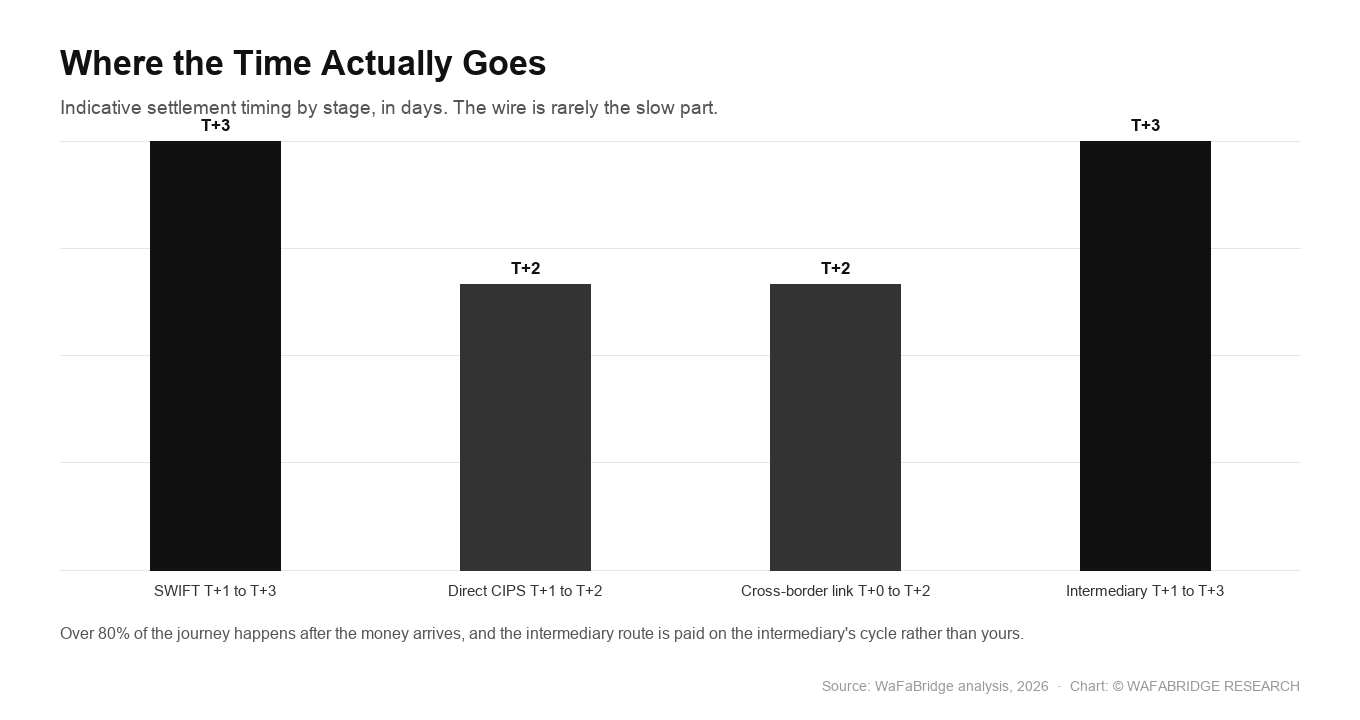
The chart above is the timing on each route. Over 80% of the journey happens after the money arrives, so the last mile is the thing to optimise.
mBridge: what it is, and what it stopped being
mBridge was launched in 2021 by the BIS Innovation Hub with the central banks of Thailand and the UAE, the People’s Bank of China’s Digital Currency Research Institute and the Hong Kong Monetary Authority. Saudi Arabia was not a founding participant. On 5 June 2024 the project was announced as entering its minimum viable product phase, with Saudi Arabia joining as a full participant, and in October 2024 the BIS handed over project management to the participants.
Then the membership changed. On 13 May 2025 Saudi Arabia completed its proof of concept and ceased to be a participating member. SAMA confirmed this to the Financial Times on 20 September 2026, with people familiar with the matter describing the membership as terminated while technical participation continues in a less public form. The UAE remained a participant, and the core membership is now mainland China, Hong Kong, Thailand and the UAE.
That matters for a Gulf buyer: it removes a route many conversations still assume is open, and the scale figures explain why. The 2022 pilot involved 20 commercial banks, 164 transactions worth more than USD 22 million, over a six-week cycle — a demonstration, not a rail. Cumulative to the end of November 2025, mBridge had processed 4,047 transactions worth RMB 387.2 billion, with digital yuan at roughly 95.3% of the value, according to the People’s Bank of China’s deputy governor Lu Lei in a signed article in the Financial Times on 29 December 2025. At year end the figure was described as approaching RMB 500 billion with 49 commercial banks participating, 21 of them foreign banks outside the mainland, by the head of the Digital Currency Research Institute, Mu Changchun, at the Summer Davos Forum in 2026.
On speed, mBridge is genuinely differentiated where it operates: the BIS project report of 2022 records that the prototype can complete an international transfer and the associated foreign exchange operation in seconds, against the days typically required by the correspondent banking model. On cost, the same project is often cited, and the citation is nearly always flattened into a single number — worth separating the three sources.
The first is the BIS’s own project report of September 2022, which describes the generic prototype platform as saving close to half the cost relative to the traditional correspondent banking model, a leap forward in the project’s words. That is a prototype-stage estimate based on that 2022 pilot. The second is an IMF working paper of 2025 citing BIS (2021b), which estimates that cross-border payment costs could fall by up to 50%, with the saving scoped to nostro-vostro liquidity, treasury operations, compliance and foreign exchange — a model estimate, not a measurement. The third is Mu Changchun in November 2023, citing the bridge’s real transaction experience: transaction costs can be reduced by at least 50%, an official’s statement drawn from pilot experience with no published methodology behind it. None of these supports “mBridge has already cut cross-border payment costs by 50%,” a different claim from all three.
Against CIPS the distance is stark: 4,047 transactions against 8.44 million, RMB 387.2 billion against RMB 180.15 trillion. SWIFT messaging tells the same story from the outside, at 3.10% of global payments in July 2026 and 2.34% on the international-payments measure excluding payments within the euro area — fifth and sixth respectively, with the dollar at 50.99%.
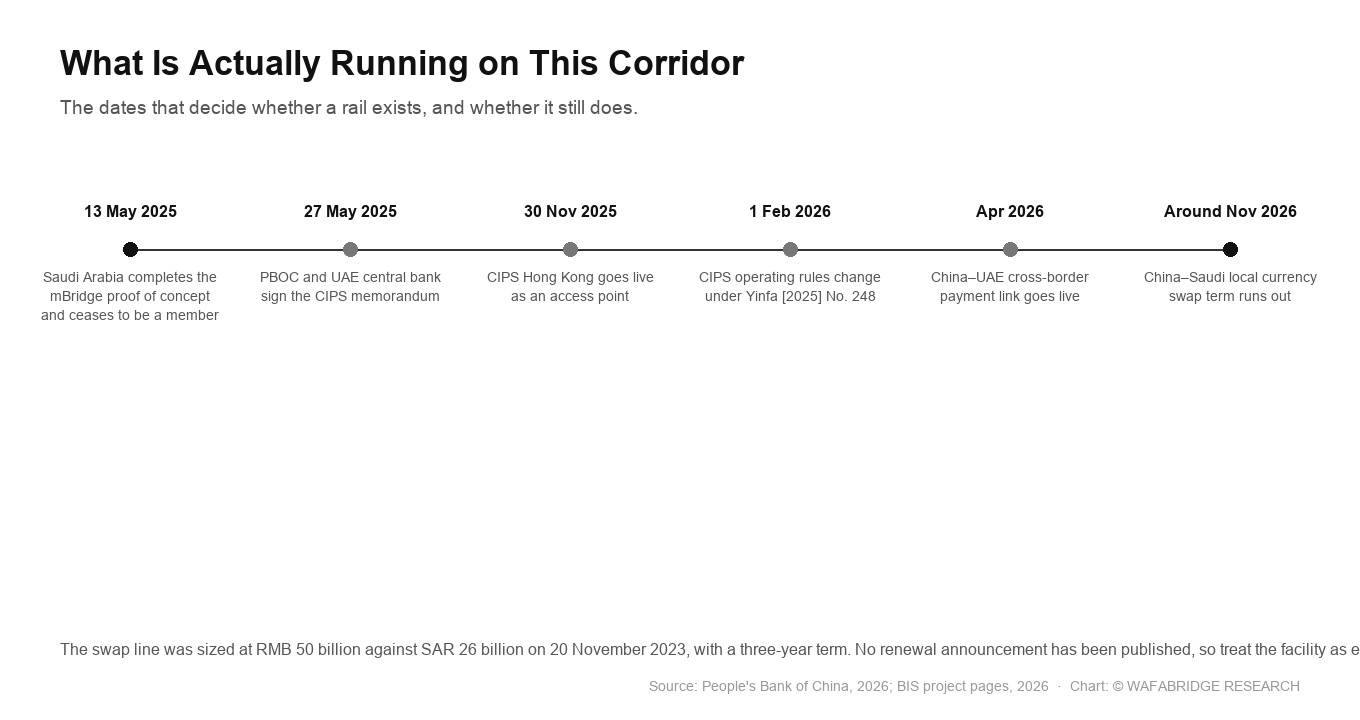
The chart above is the timeline that matters for a buyer planning a payment: what is running, what stopped, and what expires.
What is actually running on this corridor
For a buyer with a supplier in China and a bank in the Gulf, the working arrangements are less exotic than mBridge and considerably more available.
| Rail | Scale | What it means for a supplier payment |
|---|---|---|
| CIPS | 844.19 million transactions, 180.15 trillion yuan, 2025 | The working system for renminbi clearing. 210 direct and 1,619 indirect participants. |
| mBridge | 4,047 transactions, 387.2 billion yuan to Nov 2025 | Three orders of magnitude below CIPS. Saudi Arabia left in May 2025. |
| Swap lines | 32 agreements, 94.2 billion yuan undrawn, end 2025 | A central-bank backstop. The China-Saudi line is 50 billion yuan. |
| Bilateral corridor | China-UAE payment link live since April 2026 | A direct route for two currencies, after the May 2025 CIPS MOU. |
| What it does not change | — | The rail moves money. It does not classify the goods or settle the duty. |
CIPS and its new operating rules. CIPS Hong Kong went live as an access point on 30 November 2025, extending the infrastructure into a jurisdiction where many regional treasuries already sit. The system’s operating rules changed on 1 February 2026, under Yinfa [2025] No. 248, issued on 19 December 2025. They are widely summarised as the removal of market access restrictions for financial institutions, which is not what they say. What they do is relax the custodian-bank requirement for offshore institutions applying to be direct participants — Article 7 permits an applicant to entrust a qualifying direct participant as its funds custodian, where the previous rules required a domestic bank-type direct participant, so the mandatory binding to an onshore bank is removed. The rules also remove the dedicated participant management chapter and delegate that to the authorised operating institution, which files its management rules with the People’s Bank of China; require accounts to run at zero balance with no interest, no overdraft and an end-of-day balance of zero; introduce hybrid settlement, combining real-time gross settlement with scheduled net settlement in batches; and bring the Digital Currency Research Institute into the notification scope for the first time. Read correctly, this is an easing of custody requirements for offshore participants and a transfer of participant-management authority, not a deregulation of who may join.
The China–UAE payment link. The memorandum of understanding between the People’s Bank of China and the UAE central bank on cross-border payment cooperation dates from 27 May 2025, and the China–UAE cross-border payment link went live in April 2026, according to the People’s Bank of China’s RMB Internationalisation Report (2026). For a buyer already banking with an Emirati institution, this is the direct Gulf–China RMB channel, with the UAE as the participating side.
The bilateral currency swap, and its expiry. The China–Saudi local currency swap was announced on 20 November 2023, sized at RMB 50 billion against SAR 26 billion, with a three-year term renewable by mutual agreement. The term runs out around November 2026, and as of the date of this article no renewal announcement has been published — so the facility should be treated as expiring rather than extended. The People’s Bank of China’s official swap table as of end-2025 still listed Saudi Arabia at RMB 50 billion, eighteenth of thirty-two agreements, with RMB 94.2 billion of undrawn balances held by the overseas party. The swap is a standing facility between the two central banks that allows either to draw in the other’s currency, operating through the commercial banks of each side rather than being a channel a buyer can address directly. Its relevance is that it underpins the bilateral RMB liquidity that makes local settlement available.
The volume behind all of it. RMB cross-border receipts and payments handled by banks reached RMB 70.6 trillion in 2025, up 10.1%, and RMB 42.4 trillion in the first half of 2026, up 21.4%. The official characterisation is that the renminbi is now China’s largest settlement currency for cross-border receipts and payments, the world’s second-largest trade finance currency, the third-largest payment currency on the full measure, and the fifth-largest foreign exchange trading currency — the scale the Gulf’s alternative rails are measured against.
One more figure needs care. For Middle Eastern crude sold to China, renminbi settlement reached 41% as of end-March 2026 against 52% in dollars, with renminbi overtaking the euro to become the second-largest settlement currency for that flow — a figure from a Deutsche Bank report by Mallika Sachdeva in March 2026, reported in the Chinese edition of Fortune on 8 April 2026. It is an oil-flow figure for the Middle East as a whole, not a Saudi figure and not a general trade figure, and the Saudi standalone numbers reported elsewhere are lower, at 40% and 45% depending on the source. It also measures something different: the CIPS and mBridge numbers count transaction volumes and values on the RMB clearing infrastructure, while this counts the currency in which one commodity flow is invoiced. Treat them as separate series.
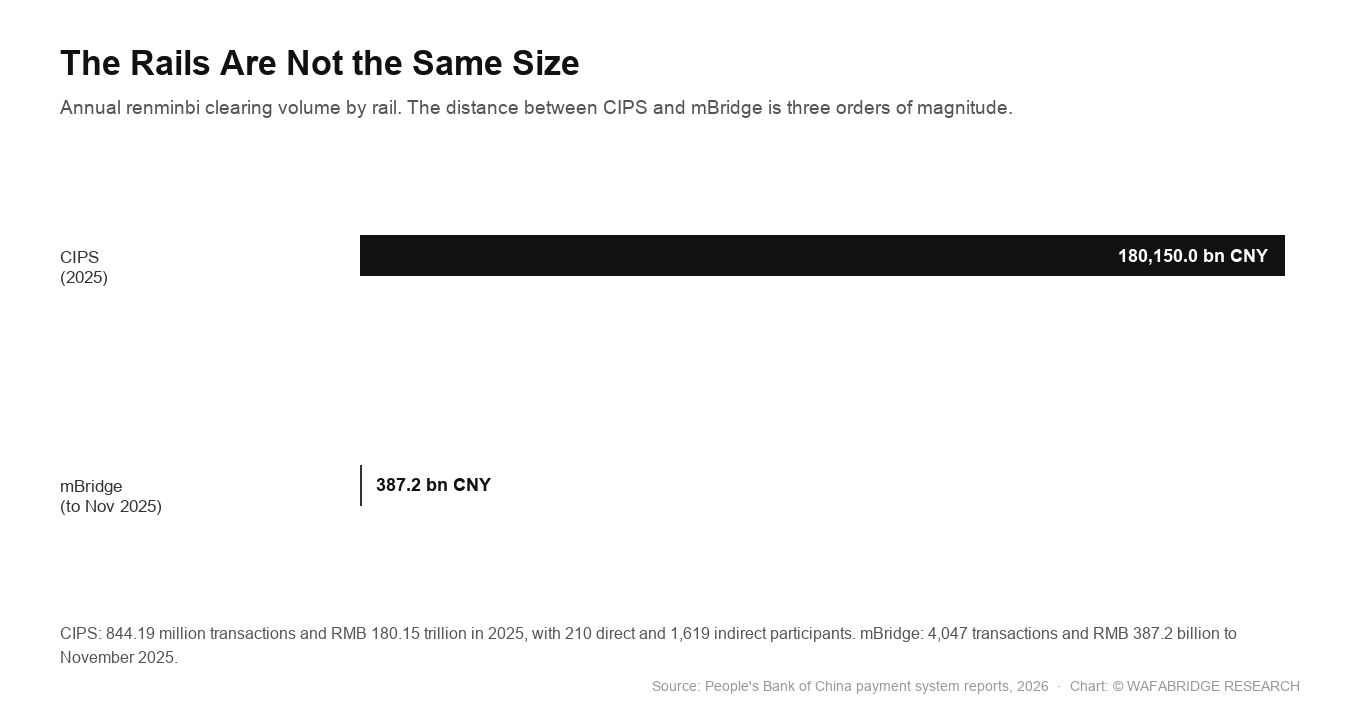
The chart above is the scale gap between the rails. The rail moves money; it does not classify the goods or settle the duty.
A worked example on a USD 100,000 supplier payment
The four routes are not four prices for the same service, and the number to optimise is not the fee. The order value is a stated example; the timing figures are indicative estimates built on SWIFT’s published last-mile split, not service levels published by any provider; and the cost layers are what the charge is made of, not an amount, because no public rate card exists at this size.
| Line (USD 100,000 supplier payment) | SWIFT via your bank’s correspondent chain | Bank with a direct CIPS channel | Cross-border payment link (China–UAE) | Payment intermediary settling in RMB |
|---|---|---|---|---|
| Who is paid, and in what | The supplier’s Chinese bank, in RMB | The supplier’s Chinese bank, in RMB | The supplier’s Chinese bank, in RMB | The intermediary, which settles the supplier and invoices you in USD |
| Message arrives at the receiving bank | 10 minutes for 75% of payments; under 1 hour for over 90% | Same messaging layer, but with fewer correspondent legs | Same messaging layer, with the link replacing a correspondent leg | Same messaging layer; the intermediary’s instruction sets the timing |
| Time to the supplier’s usable account (indicative) | T+1 to T+3, dominated by the last mile | T+1 to T+2 where the supplier banks with a mainstream Chinese bank | T+0 to T+2 | T+1 to T+3, but paid on the intermediary’s cycle |
| Explicit cost layers you pay | Your bank’s fixed fee, plus intermediary bank charges, plus the FX spread | Your bank’s fee, plus the FX spread, with fewer correspondent charges | Your bank’s fee, plus the FX spread, no correspondent bank charge | The intermediary’s spread over the mid-market rate, plus its fee |
| Where the FX spread is set | Your bank’s rate at the time of execution | Your bank’s rate at the time of execution | Your bank’s rate at the time of execution | The intermediary’s rate, which is a commercial term |
| Who bears currency movement between instruction and execution | Usually you, on the bank’s terms | Usually you, on the bank’s terms | Usually you, on the bank’s terms | The intermediary, for the period it carries the payment |
| Working capital you commit | Your cash leaves when you instruct | Your cash leaves when you instruct | Your cash leaves when you instruct | You pay on the order; the supplier is paid before your cargo moves |
| Published benchmark you can check against | SWIFT publishes network reach and the 75%/90% timing split; it publishes no rate card | CIPS published volume for 2025: 8.44 million transactions, RMB 180.15 trillion | PBOC and UAE central bank MoU, 27 May 2025; link live April 2026 | World Bank Remittance Prices Worldwide, Q3 2025: 6.36% average on a USD 200 retail remittance — a small-value benchmark, not this transaction |
The row that decides most cases is the third one. A route that reaches the receiving bank in ten minutes and a route that takes three days can cost the same in fees and still be different products, because the buyer who needs the supplier to start manufacturing on Monday is buying a settlement time, not a message speed. Four-fifths of the journey happens after the network has finished its part, which is why a strong bank relationship and a mainstream Chinese bank as supplier can beat a poorly designed link.
Four decision rules, by buyer type
Buyers with an existing RMB relationship at their own bank: ask what the bank’s own channel costs before anything else. If your bank is a CIPS participant or reaches one, the correspondent chain is the avoidable layer rather than the default.
Buyers placing a first order with a new Chinese supplier: fix the currency and the timing in the purchase order, not in the payment instruction. A supplier asking for RMB is telling you about their own bank’s cut-off and their factory’s cash cycle, and agreeing the currency, the value date and who bears the FX movement in the order removes a dispute that otherwise appears after the goods are committed.
Buyers who cannot hold or convert RMB comfortably: use the intermediary structure and price it properly. It removes the need for a Chinese bank account and your exposure to the RMB move between instruction and execution, at a spread over the mid-market rate plus a fee.
Buyers modelling the cost of the corridor: use the right denominator. The published 6.36% average on a USD 200 remittance and the SWIFT fee tiers are retail benchmarks that will misrepresent a container payment, so ask your bank for a written quote on your actual amount, in the currency you will instruct — and note that the swap and payment-link news reaches you as a priced bank product, not a channel you can dial into.
Wherever the goods land, the standard is the same across the nine markets this corridor covers — the six Gulf states plus Egypt, Jordan and Iraq — and the agency fee is 8% of goods value whichever route you use. The route decides who bears the FX movement and how long the last mile takes, not the fee; payment path and DDP fulfilment are two parts of the same chain.
Payment rails, participating bank lists, swap tenors and exchange rates all change. Confirm the current participants, cut-offs, fees and FX treatment with your own bank and with the intermediary’s written quote before you commit to a route for a live order.
Internal links: buying on 1688 and paying in USD · 1688 sourcing and buying agent service · landed cost calculator · answers to the questions we are asked most
Sources: BIS, mBridge project — founding participants, the MVP phase announced on 5 June 2024, Saudi Arabia joining as a full participant, project management transferred from the BIS in October 2024, and the 2022 pilot of 20 banks and 164 transactions worth over USD 22 million (bis.org); BIS project report, 2022 — prototype settlement in seconds and a close-to-half cost saving at prototype stage; IMF working paper, 2025, citing BIS (2021b) — up to 50% lower cross-border payment costs scoped to nostro-vostro liquidity, treasury operations, compliance and foreign exchange; Saudi Central Bank (SAMA) confirmation to the Financial Times, 20 September 2026, that Saudi Arabia ceased to be a participating member of mBridge on 13 May 2025; Lu Lei, deputy governor of the People’s Bank of China, signed article in the Financial Times, 29 December 2025 — 4,047 transactions and RMB 387.2 billion cumulative to end-November 2025, digital yuan about 95.3% of value; Mu Changchun, head of the Digital Currency Research Institute, Summer Davos Forum 2026 — cumulative approaching RMB 500 billion, 49 commercial banks including 21 foreign banks outside the mainland; People’s Bank of China, 2025 payment system operation report — CIPS 8.44 million transactions worth RMB 180.15 trillion, daily average 31,900 transactions and RMB 679.821 billion (cips.com.cn); People’s Bank of China — CIPS participation at end-June 2026 (210 direct, 1,619 indirect participants, 130 countries and regions, over 5,200 institutional banks) and Yinfa [2025] No. 248, issued 19 December 2025, effective 1 February 2026; CIPS Hong Kong access point live 30 November 2025; People’s Bank of China and UAE central bank memorandum of understanding on cross-border payment cooperation, 27 May 2025, and the China–UAE cross-border payment link live April 2026 per the RMB Internationalisation Report (2026); People’s Bank of China — RMB cross-border receipts and payments of RMB 70.6 trillion in 2025 (+10.1%) and RMB 42.4 trillion in the first half of 2026 (+21.4%); People’s Bank of China official currency swap table as of end-2025 — Saudi Arabia RMB 50 billion, eighteenth of thirty-two agreements, RMB 94.2 billion undrawn overseas balances; SWIFT, 2026 — 75% of payments reaching the receiving bank within ten minutes, over 90% within an hour, in-transit under 20% of the journey and the last mile over 80%, a network of 200+ markets, 150 currencies, 12,500+ institutions, 59.8 million daily messages in 2025 and 40,000 active corridors, and RMB at 3.10% of global payments in July 2026 with 2.34% on the international measure excluding payments within the euro area against USD at 50.99% (swift.com); World Bank, Remittance Prices Worldwide, Q3 2025 — 6.36% average cost on a USD 200 remittance against the SDG 10.c target of 3% by 2030; Mallika Sachdeva, Deutsche Bank, March 2026, reported in Fortune Chinese edition, 8 April 2026 — renminbi at 41% of Middle East crude settlement to China as of end-March 2026. Timing figures in the worked example are indicative estimates built on SWIFT’s published last-mile split and are not service levels published by any provider; cost layers are structural and no published rate card exists at this size. Research and figures compiled by 亚觅出海集团 AMI Global.
Chart: © WAFABRIDGE RESEARCH
Frequently asked questions
Can I still pay a Chinese supplier in RMB through mBridge from Saudi Arabia?
Not as a participating member. Saudi Arabia joined mBridge as a full participant when it entered the MVP phase on 5 June 2024, completed its proof of concept and ceased to be a participating member on 13 May 2025, a position SAMA confirmed to the Financial Times on 20 September 2026. The UAE remains a participant, and the core membership is now mainland China, Hong Kong, Thailand and the UAE.
How long does an RMB payment from the Gulf to a Chinese supplier actually take?
The message is not the constraint: SWIFT reports that 75% of payments reach the receiving bank within ten minutes and over 90% within an hour, with in-transit time under 20% of the total journey. The last mile, from receiving bank to usable account, is over 80% of it, so a realistic end-to-end figure for a supplier payment is one to three working days, decided more by cut-offs and the supplier’s own bank than by the network.
What does it cost to pay a Chinese supplier in RMB from the Gulf?
Three layers: a fixed fee from your bank, any intermediary bank charges along the chain, and the FX spread on the conversion, and SWIFT publishes no rate card. The commonly quoted World Bank figure of 6.36% is the average cost of a USD 200 retail remittance worldwide, not a B2B supplier payment, so your bank’s written quote on your actual amount is the number to work from.
What did the 2026 CIPS rule change actually do?
Yinfa [2025] No. 248, issued on 19 December 2025 and effective 1 February 2026, relaxed the custodian-bank requirement for offshore institutions applying as direct participants, delegated participant management to the authorised operating institution, required accounts to run at zero balance with no interest or overdraft, introduced hybrid settlement combining real-time gross settlement with scheduled net batches, and brought the Digital Currency Research Institute into the notification scope. It is an easing of custody requirements and a transfer of participant-management authority, not a removal of market access restrictions for financial institutions.
Is the China–Saudi currency swap still available for my payments?
The swap announced on 20 November 2023, at RMB 50 billion against SAR 26 billion with a three-year term renewable by mutual agreement, runs to around November 2026, and no renewal announcement has been published. The People’s Bank of China’s official swap table as of end-2025 still listed Saudi Arabia at RMB 50 billion, eighteenth of thirty-two agreements, with RMB 94.2 billion of undrawn overseas balances, and the facility works between the two central banks through their commercial banks rather than as a channel you can address directly.
Do I need a Chinese bank account to pay a Chinese supplier in RMB?
No. A payment intermediary can settle the supplier in RMB and invoice you in your own currency, the standard structure for marketplace and agent-based purchasing, which is how an order paid on the intermediary’s cycle gets the supplier paid before your cargo moves. The price is a spread over the mid-market rate plus a fee, and it removes both your need for a Chinese account and your exposure to currency movement between instruction and execution.