Composite cases in this article are drawn from consignments we handle on the Guangzhou–Gulf corridor; names and figures are changed, the mechanics are not.
A 1688 buying agent solves the four hurdles between a Gulf buyer and China’s wholesale platform — RMB-only payment, China-only delivery addresses, supplier quality risk, and export documentation — and converts the whole journey into one door-to-door price the buyer pays in US dollars. The agent’s margin is not a markup on freight; it is the price of standing on both sides of a border that neither 1688 nor the buyer can cross alone.
The order that couldn’t be paid
A first-time buyer in Dammam — call him Saleh — spent an evening on 1688 doing everything right. He found the supplier: stainless-steel kitchen racks, $1.90 a unit at 200 units, half what the same rack cost through the Dubai trader he usually used. He added them to his cart. And then the evening ended, because every path forward hit a wall.
His card — a perfectly good Visa from a Saudi bank — was declined. 1688, China’s domestic wholesale platform run by Alibaba, transacts in RMB through Chinese payment rails: Alipay accounts tied to Chinese banks, local transfers, Chinese corporate wallets. No Gulf card, no international checkout, no English interface worth trusting with a payment. Even if he had paid, the supplier’s answer to “do you ship to Saudi Arabia?” would have been no — 1688 sellers sell inside China, to addresses inside China, priced without a single riyal of international freight in their heads.
Saleh’s problem is not unusual; it is structural. And its structure is exactly why the buying-agent business exists on this corridor. To understand what an agent actually earns, walk the four walls Saleh hit — because each wall is a service, and together they are the entire product.
Wall one: the money only moves in RMB
1688 is built for Chinese domestic trade. Suppliers quote in RMB, expect payment in RMB, and receive it through channels — Alipay, WeChat Pay, corporate bank transfers — that sit entirely inside China’s financial system. A Gulf buyer’s dollars, euros or riyals do not have a door into that system by himself.
The agent’s first job is to be that door. The buyer pays the agent in USD — one payment, in a currency his bank speaks, against a quotation in a currency he can check — and the agent’s China operation pays the supplier in RMB through domestic rails the supplier already trusts. This is less glamorous than it sounds and more valuable than it looks: it converts a payment problem the buyer literally cannot solve into a line item, and it moves the currency-exchange exposure, the payment-trail risk and the supplier-trust question onto the party equipped to carry them. For buyers burned by transferring deposits to WeChat accounts of suppliers they have never met, this alone justifies the relationship.
It also quietly fixes the quotation problem. 1688 prices are RMB factory-gate prices: no freight, no duty, no delivery, no reality. A DDP agent re-prices the same goods as a landed, delivered number in USD — which is the only kind of number a buyer can compare against his local market and know whether the deal is real.

The demand behind all this is enormous and growing: the Gulf imported a record $161.2 billion from China in 2024, up 15.5% in one year, and the composition of that flow — consumer goods, electronics, household categories — is precisely the 1688 catalogue. The platform’s prices are the best-kept open secret in Gulf trade; the payment wall is what keeps them from being commonly usable.
Wall two: the address problem, and what happens at the warehouse
Even a paying buyer has nowhere to put the goods. 1688 suppliers deliver to Chinese addresses; a buyer in Riyadh has none. The agent’s Guangzhou warehouse is the second service: every supplier in an order ships to one address, and one consolidation replaces thirty deliveries.
What happens at that warehouse is the difference between a freight forwarder and a buying agent. Freight forwarders receive cartons and ship them. A buying agent inspects: opens cartons, checks quantities against orders, checks the goods against the listing — colour, size, model, finish — photographs what arrived, and reports defects while the goods are still standing in Guangzhou, where a supplier can be made to answer for them. The same defect discovered in Dammam is a loss discovered too late; discovered at the warehouse, it is a supplier’s problem, resolved by replacement or refund before a single carton crosses the ocean.
Consolidation adds the other quiet saving. Twenty suppliers’ cartons — each padded, each carrying its own domestic freight — repack into a fraction of the volume. Buyers who have watched their “cheap” order re-priced after volumetric freight on badly packed cartons understand: the warehouse is not a stopping point. It is where the shipment gets engineered.
Wall three: the quality gap, priced honestly
The third wall is the one no logistics product can solve and every buyer must face: 1688 is a wholesale market of enormous range and uneven reliability, and its prices come with a quality distribution to match. The agent’s role here is not to guarantee quality — nothing can — but to manage the risk on the ground: to know which suppliers ship what they photograph, to run pre-shipment inspection before balance payments, to catch the batch of racks with the bent shelf before it becomes 200 bent shelves in the Gulf.
There is an honest way to say this: the 8% buying-agent fee on this corridor is not 8% for shipping. It is 8% for a team in Guangzhou — paying suppliers, inspecting goods, chasing the factory that shipped the wrong voltage — performing, for a fee proportional to order size, the job a Gulf buyer would otherwise need a person in China to do. Buyers who compare agents purely on fee percentage are comparing the wrong number; the right comparison is fee percentage against what arrives at the door, on time, matching the order.
Wall four: the border, priced before anyone commits
The fourth wall is everything this site’s other articles cover in depth: goods leaving China need export documentation, HS classification, and — for Saudi Arabia — SABER conformity, duty and VAT paid before the goods reach the buyer’s door. A 1688 price contains none of this, which is why the “cheap” order that ignored it arrives with a customs bill larger than its margin.
The DDP agent’s final service is to price the border into the quotation before the buyer commits: duty by HS code, VAT by destination, conformity costs by product family, freight by mode, delivery to the door. What th ries to the Gulf” src=”https://wafabridge.com/wp-content/uploads/2026/11/chart-c3-gcc-import-categories.png” />
The categories the Gulf buys most from China — machinery and electrical goods, appliances, vehicles and parts, textiles — are, category for category, the ones with the most border machinery attached. The volume in the chart above is not flowing on 1688 prices; it is flowing on 1688 prices plus the border, and the agent’s quote is where those two numbers become one.
How the money actually moves: a timeline
The four walls explain what the agent does; the payment timeline explains when the buyer’s money is at risk — and the sequencing is most of the protection. On a well-run order the money moves in three stages, each gated by a verification the buyer can see.
Stage one: the deposit, gated by the order file. The buyer pays a deposit in USD against a written quotation — goods, fee, freight, duty, VAT, delivery, all seven lines named. The agent converts to RMB and pays the supplier just enough to start production — typically 30% on the platform’s terms — never the full amount. The discipline here is unglamorous and absolute: no production money moves before the order file exists, because the order file is what a dispute gets settled with. A buyer who cannot see the quotation cannot verify the settlement; a buyer who can, holds the receipt for every stage that follows.
Stage two: inspection, gated by the balance. The most important payment gate on the entire corridor sits here: the balance is paid after the goods have been inspected, not before. Production completes, cartons reach the Guangzhou warehouse, the inspection floor opens them, photographs them, checks them against the order — and only when the goods pass does the balance go to the supplier. The buyer’s exposure at this moment is the deposit, not the full order value. This single sequencing rule is what converts “quality risk” from a story buyers tell each other into a managed number: the worst realistic outcome on a bad batch is a deposit argument in Guangzhou, with photographs, not a full-price pallet of wrong voltage in Riyadh with no recourse.
Stage three: shipment, gated by documents. Goods pass inspection; the border file is assembled — export declaration, HS classification, conformity certificates where the destination requires them, duty and VAT assessed against the written quote. DDP consignments fly or sail fully tax-cleared: duty and VAT were already funded inside the quotation, so nothing is owed at the door. The buyer’s final payment — the balance of the landed total, on the terms agreed — clears against a shipment that is documented, insured and moving.
Read as one sequence, the timeline’s design is visible: the buyer’s money is always behind a gate, and each gate opens on evidence — a written quote, an inspection pass, a document pack. The buyers who get hurt on this corridor are almost always the ones who skipped a gate: full payment before production (no leverage), balance before inspection (no recourse), or freight money to a party who never showed them the border file (no paper). The agent’s fee buys many things; the timeline is the one that protects the money itself.
What this means depending on who you are
If you are a first-time 1688 buyer, the agent relationship is not an expense to minimise — it is the infrastructure that makes the platform usable from the Gulf at all. Start with one moderate order, insist on inspection photos before shipment, and judge the agent on what arrives, not on the fee percentage in the quote.
If you are an experienced buyer already ordering direct through friends or fixers, the honest question is what happens when something goes wrong — the wrong voltage, the missing carton, the supplier who stops answering. A structured agent operation answers that question with inspection records, replacement claims and consolidation efficiency; a fixer with a WeChat account answers it with silence. The fee difference is rarely as large as the risk difference.
If you are a trader buying at volume, the arbitrage is no longer between agent and no-agent — it is between your own China operation and a partner’s. An in-country employee costs a fixed salary whether the month has $20,000 or $200,000 of orders; an 8% fee scales with the work. Many established Gulf traders run exactly this hybrid: an agent operation for dispersion, consolidation and border compliance, with direct supplier relationships layered on top where volume justifies them.
What inspection actually catches
The phrase “warehouse inspection” sounds like a formality until you see its catch list. Across a normal month of Gulf-bound consignments, the inspection floor catches a remarkably consistent menagerie: the wrong voltage — chargers and appliances built for China’s 220V/50Hz with plugs that never saw a GCC socket, the single most common defect in electronics orders; the wrong variant — the listing said stainless steel, the carton says chrome-plated iron that will pit in Gulf humidity within a season; the missing count — 180 units in the carton labelled 200, caught before the balance payment rather than after the discovery in Dammam; the colour drift — batch two of the same SKU visibly darker than the sample the customer approved; and the packaging failure — supplier cartons so thin that the freight stack would have crushed the contents before the vessel left Chinese waters.
None of these defects are exotic. All of them are routine, and all of them were, until inspection became standard on this corridor, the buyer’s problem to discover at delivery — the most expensive possible place. The economics of catching them in Guangzhou are stark: a wrong-voltage batch is a supplier replacement, resolved with a phone call and a redone production run, at the supplier’s cost. The same batch discovered in Riyadh is a freight round-trip, a stockout during the weeks it takes to redo, and a hole in the selling season that no refund fully covers. Inspection does not add quality to the supply chain; it relocates the discovery of its absence to the one place where discovery is still cheap.
The reorder economy
First orders get all the attention; the economics of this trade live in reorders. The first order on any product line carries the one-time costs — the conformity certification, the HS-code determination, the supplier vetting, the sample iterations — and the landed cost of a first order is, honestly, the worst that line will ever look. Every reorder after it rides the accumulated file: the PCoC still valid, the classification settled, the supplier’s quirks documented in the inspection record, the volumetric profile of the cartons known, the transit rhythm on the calendar.
This is why experienced Gulf buyers think in product lines rather than orders, and why the question “is this line worth setting up?” is a different question from “is this order cheap?” A line with a $1,500 certification and a $600 sourcing fee on the first order spreads those costs across every reorder of the year — and a line reordering monthly at 30% margin, sea-freighted on a rhythm the buyer controls, becomes a small annuity. The buyers who break even on order one and profit on orders two through twelve are not lucky. They are amortising on purpose.
One price, four walls
The 1688 buying agent is often described as a shipping service, which undersells it and misprices it. It is a border-crossing machine: it carries your money into a RMB payment system, your order into a Chinese address, your quality risk onto an inspection floor, and your goods through export and import compliance — and hands you back one USD number against which the whole chain either performed or did not. That is what the fee buys, and for the buyer with no Chinese bank account, no Guangzhou address and no customs licence, it is not a convenience. It is the only way across.
Supplier prices, conformity requirements and freight rates change; verify current landed costs for your specific products and destination, or ask us to quote your 1688 links door-to-door in USD.
Internal links: Cost Calculator · DDP Shipping · Saudi Arabia · SABER Guide
Sources: GCC Statistics Center (GCC–China trade, 2017–2024); UN Comtrade (bilateral trade composition).
Chart: © WAFABRIDGE RESEARCH
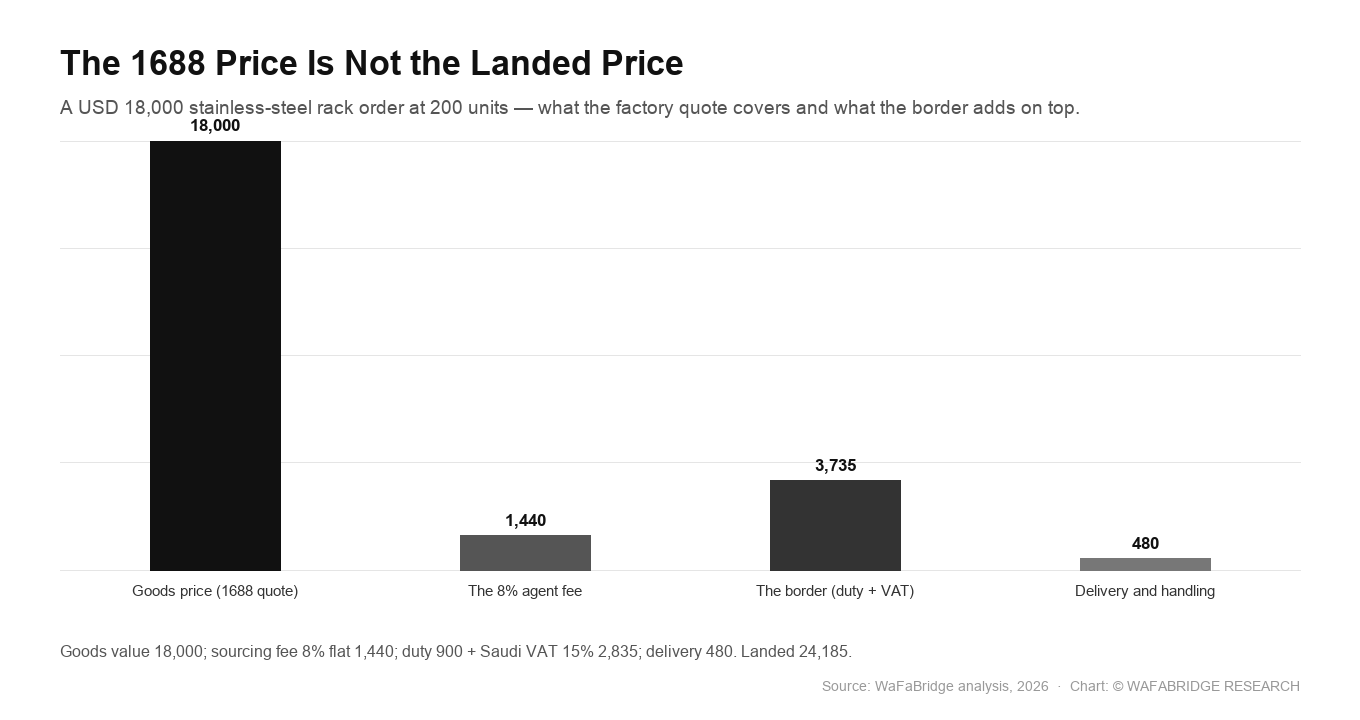
The chart above breaks a single order into the part the factory quote covers and the part the border adds, which is the difference between a cheap 1688 price and a landed one.
Frequently asked questions
Can I buy from 1688 directly from Saudi Arabia or the UAE?
Not effectively. 1688 transacts in RMB through Chinese payment systems, delivers only to Chinese addresses, and its suppliers do not handle international shipping or export documentation. Gulf buyers access the platform through a buying agent who pays suppliers locally, receives and inspects goods in China, and ships DDP to the door.
Why do I pay in USD if the supplier charges in RMB?
The agent operates both sides of the currency wall: you pay one USD price, and the agent’s China operation pays suppliers in RMB through domestic payment rails. This removes currency exposure, international transfer risk and the supplier-trust problem from your side of the transaction.
What does the 8% buying-agent fee cover?
The fee covers supplier payment handling, order management, warehouse inspection and consolidation, defect claims with suppliers, and coordination of export and DDP delivery — the work of a local buying team, priced proportionally to order value. Freight, duty and VAT are quoted separately or within the DDP total, depending on the service.
How do I know the goods match what I ordered?
A proper buying agent inspects at the Guangzhou warehouse before shipment: quantities against orders, goods against listings, photos of what actually arrived. Defects found at the warehouse are resolved with the supplier at supplier cost; defects found after arrival are your loss. Inspection records are the single most important thing to insist on.
Is DDP delivery to the Gulf worth it versus handling customs myself?
For buyers without a local import licence or customs experience, DDP is usually cheaper in total — customs bills, broker fees and storage on a mishandled self-clearance routinely exceed the DDP premium. Registered traders with import capability sometimes prefer DDU and their own clearance; most individual and small-business buyers should not.