Composite cases in this article are drawn from consignments we handle on the Guangzhou–Egypt, Guangzhou–Aqaba and Guangzhou–Umm Qasr lanes; names and figures are changed, the mechanics are not.
Egypt, Jordan and Iraq do not share one tax system, and a DDP quote built on Gulf assumptions will be wrong in all three: Egypt applies 5–40% duty plus 14% VAT on CIF plus duty, Jordan applies 4.0% average MFN duty plus 16% GST, and Iraq has no general VAT at all, so a quote carrying a VAT line for Iraq is overcharging you for a tax that does not exist. Quote each market on its own tariff architecture, not as a longer version of the Gulf.
The Saudi template that cost him 40%
Fahad runs a homeware business in Riyadh and buys through the Gulf routinely, so his Saudi DDP template was already built, already priced and already in his spreadsheet. In the spring he looked at Cairo and Amman as expansion markets — the same shelving and storage lines he was already importing, sold by two resellers who had asked him for terms. The product was identical. The resellers were credible. The template was the problem.
He sent the same carton against the same template three times, once for each market, and got three numbers back. The Egyptian quote landed 40% above what his Saudi cost model predicted, because the duty on his HS codes sat in a band the Gulf never has and the VAT base included the duty. The Jordanian quote came back higher than he wanted for a different reason: the duty was lower than the Gulf’s 5%, but a 16% GST replaced the 15% VAT and applied to a different base. The Iraqi quote came back with a VAT line he could not explain, on an invoice structure for a market that has no general VAT, and the freight and insurance on it looked like it had been priced for a country rather than a corridor.
None of those three numbers was a scam, and none of the buyers involved had done anything unusual. What had happened is that Fahad treated three separate tariff architectures as one extended Gulf, and the distance between them is measured in percentage points of landed cost. This article sets out what each market’s tax structure actually is, where the clearance chain runs, which documents each of them requires, and where the publicly available data on Iraq breaks down — which matters, because that is the market where a quiet gap in the paperwork will cost you most.
Three tax architectures, not one long Gulf
Start with the number that most often gets carried across borders by mistake: the tax itself. The Gulf applies a single 5% common tariff at the union border and then each member state’s own consumption tax on top. The three markets in this article each break that pattern, and they break it in different directions. The chart below lines up the headline structure of all of them.
Egypt is the outlier and the reason most buyers get this wrong. Its customs duty is not a single rate but a band running from 5% to 40%, which means the HS code decides your number and no general rate can be assumed. The MFN simple average across the schedule is 19.0% and the bound average is 36.8%, which tells you how wide the spread really is. On top of that, VAT at 14% applies, with the base being CIF plus the duty already paid — a two-step calculation that a template built on the Gulf’s CIF-only logic will understate. The 14% standard rate was retained under Law No. 149 of 28 July 2026, with a reduced 5% applying only to production machinery and medical equipment, so the headline is stable and the band underneath it is not.
Jordan is the mirror image of Egypt on the customs line and nothing like it on the tax line. Its MFN simple average duty is 4.0%, split between 10.7% on agriculture and 2.9% on non-agricultural goods, with a bound average of 16.2%. But the consumption tax is 16% and it is legally named general sales tax rather than VAT, and goods inside the ASEZA special economic zone are taxed at 7% instead. So a Jordan shipment can be the cheapest of the three on duty and still not the cheapest on landed cost, and whether the 7% zone rate applies depends on where the importer of record sits and how the stock is held.
Iraq breaks the pattern in a way that no template survives, because the assumption it breaks is the tax itself. There is no general VAT and no general sales tax in Iraq, confirmed directly in IMF Country Report 2024/129. What exists instead is a set of targeted sales taxes on specific goods: tobacco and alcohol at 300%, cars and airline tickets at 15% each, mobile phones and network services at 20%, and hotels and restaurants at 10%. If your cargo is none of these, there is no VAT line at all. If your cargo is one of them, the applicable tax is not 14% or 16% — it is a multiple, and the multiple is the number that decides whether the lane works.
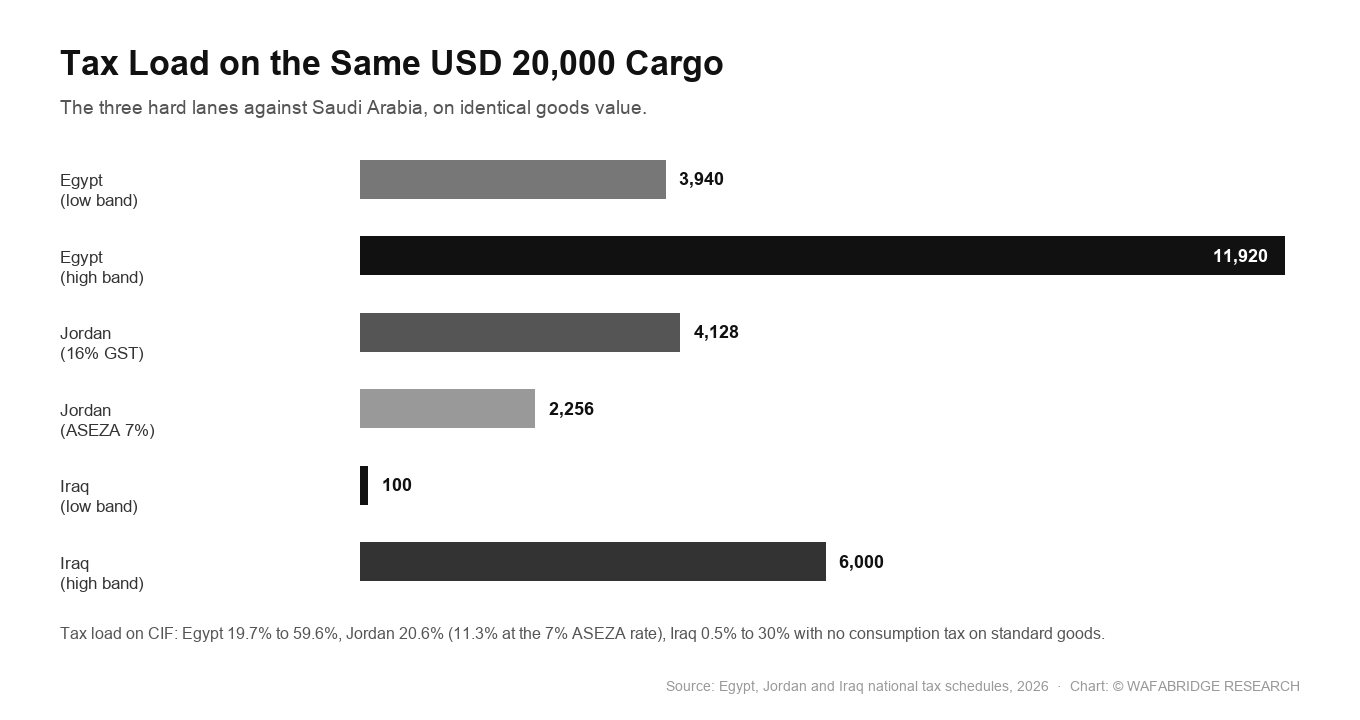
The chart above is the same USD 20,000 of goods taxed three different ways. Egypt is not a softer Gulf, and the spread inside its duty band is wider than the freight.
Egypt: two clocks running at once
Egypt’s port position in 2025 was 11,115,064 TEU of container traffic, up 24.3% year on year, of which 6.7 million TEU was transshipment. The distribution matters more than the total. Alexandria handled the largest import box volume in the country at 608,714 TEU, which makes it the working port for import cargo rather than the transshipment hub. East Port Said moved 4.91 million TEU but is primarily transshipment, so it is the place containers pass through on their way somewhere else rather than the place they come off. Sokhna, at 1.11 million TEU, sits at the Red Sea end of the network and carries a different risk profile from the Mediterranean ports above.
The two clocks are the reason an Egyptian DDP quote needs a specific arrival plan rather than a generic transit range. One clock runs on the canal: the Suez Canal bills by SCNT, not by container, with container ships charged 11.04 SDR per SCNT for the first 5,000 tonnes and tapering down to 2.88, and since 15 July 2026 container ships have carried an additional 12% surcharge on top. That clock is set by the sailing and it applies whether or not your box has anywhere to sit. The other clock runs on the box itself, and it starts the moment the container is discharged.
In Egypt the expensive clock starts before your paperwork is ready
A typical sea move from South China to Alexandria, with the two countdowns that run in parallel.
-
Day 0
Booking and export documents
Commercial invoice, packing list and certificate of origin are matched to the bill of lading before the container leaves the origin port.
-
Day 22–30
Arrival and the free-time clock starts
The demurrage and detention free period starts running the moment the box is discharged, and it does not wait for your clearance paperwork to be ready.
-
Day 23–32
Two clearance clocks run in parallel
The port free-time clock counts down towards demurrage, while the customs and conformity-certificate process runs towards release. Miss the first and you pay storage while you wait for the second.
-
Day 25–35
Customs release and delivery
Only once the certificate of conformity and the import declaration are both settled does the container get released for inland delivery.
-
Day 21+
Free time has already expired
Beyond the sixth day, detention starts accruing at the published rate for every additional day the box stays.
Egypt’s demurrage and detention schedule is where that second clock shows up on the invoice, and it is worth reading closely because the free period is short. CMA CGM’s published schedule, effective 20 August 2025, gives import containers six free days, then charges USD 45 on a 20-foot box and USD 65 on a 40-foot box for days 7 through 13, USD 50 and USD 85 for days 14 through 16, USD 70 and USD 130 for days 17 through 20, and USD 92 and USD 155 from day 21 onward. Maersk allows seven free days on import and ZIM nine, so across carriers the import free period is typically 5–7 days and each carrier sets its own. What that means practically is that an Egyptian DDP quotation is not really a price for a shipment. It is a price for a shipment plus a promise that the paperwork is finished before the free period runs out — and the margin between a clean clearance and a USD 155 demurrage bill on a 40-foot box is a few days of document readiness.
So the two clocks have to be managed together. The canal clock rewards booking a sailing that arrives when the destination paperwork is already in place. The demurrage clock punishes any delay in document completion after discharge. A buyer who treats Egyptian transit as a single 30-plus day number is ignoring the only part of the timeline he can actually influence, because the sailing schedule is fixed and the document readiness is not.
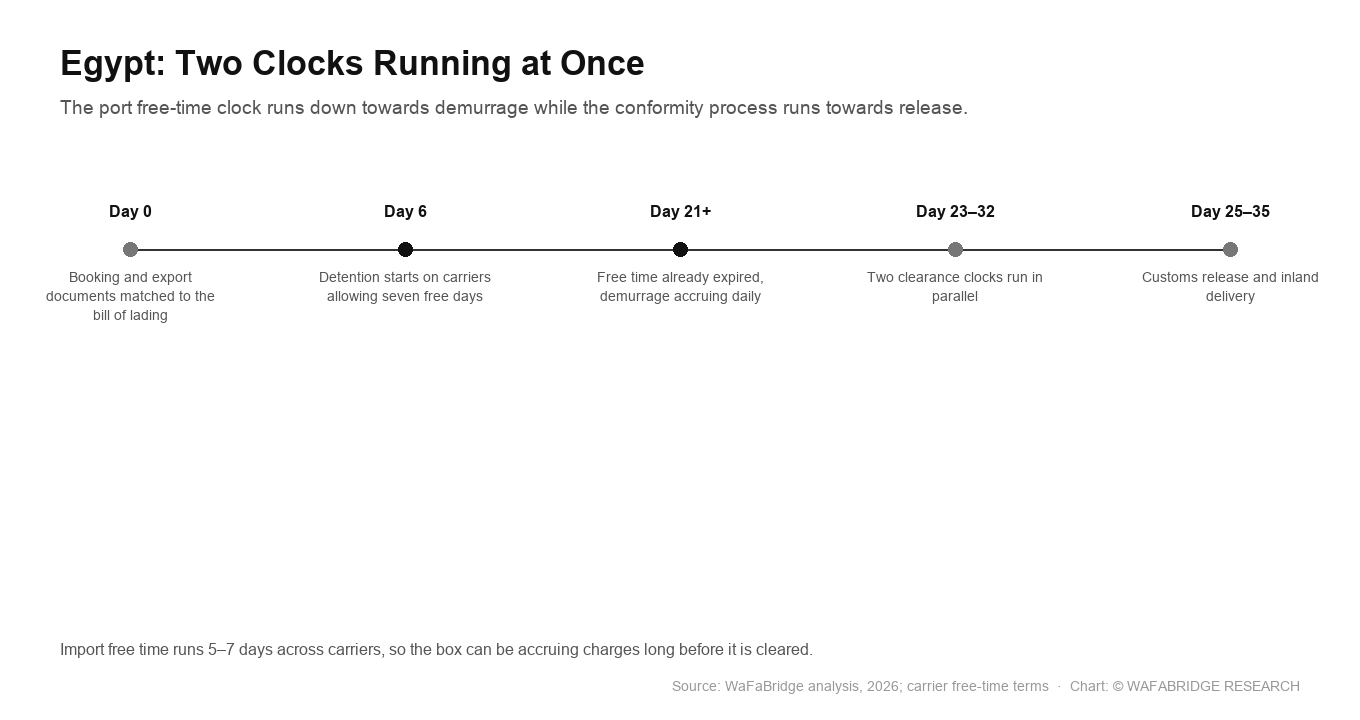
The chart above is the two clocks on the same axis. The box can be accruing demurrage long before it is clear for release.
Jordan: Aqaba is the only way in by sea
Jordan’s geography makes the routing question unusually simple and the port question unusually concentrated. Aqaba is Jordan’s only seaport, with annual handling capacity of 1.3 million TEU against actual throughput of roughly 850,000 TEU, and its concession runs to 2046. In the first seven months of 2026 it handled 574,582 TEU in total, up 3.2%, of which 80,235 TEU was transshipment, up 160.8% — and 37,182 of those transshipment boxes, up 933.1%, were headed for Iraq. Overland at the Karameh-Trebil crossing, truck movements reached 229,997, up 131.2%.
Those two figures explain each other. Jordan is a two-way land bridge as much as it is a destination, and the traffic through Aqaba is increasingly Iraqi cargo continuing north by road rather than Jordanian cargo discharging inland. For a buyer serving Amman, the practical consequences are that Aqaba’s congestion profile is partly a function of Iraqi transit demand, that the Trebil crossing is a genuine second route for the cargo rather than a theoretical one, and that Jordan’s low average duty of 4.0% arrives alongside a 16% consumption tax on a base that is not the same as Egypt’s.
The 7% ASEZA rate is the other number to hold in view, and it is a structural choice rather than a discount. Whether your cargo sits inside the special economic zone or outside it changes the consumption tax on the consignment, and that decision belongs with the importer of record in Jordan rather than with the freight quote. Ask for it before the goods sail, not after they land.
Iraq: where the data stops, and what does not
Iraq runs on a land bridge with a sea gate at the end of it. Umm Qasr is the country’s only deep-water port and handles effectively all seaborne import and export traffic, with Khor al-Zubair second. On the land side, the Arar crossing connects to Saudi Arabia, where Saudi statistics put 2025 bilateral trade with Iraq at roughly USD 1.7 billion, up 35%, and Trebil connects to Jordan. That structure means an Iraqi shipment can arrive by sea through Aqaba and then run north by road, which is exactly the pattern the 37,182 transshipment boxes through Aqaba reflect.
The tax picture has been moving. Iraq’s customs duty dates from the 2010 tariff law and was executed from 2016 with rates running from 0% to 80% across a dozen or more bands; that structure was simplified in 2018 to four bands at 0%, 10%, 15% and 30%; some bands were suspended in 2022; and a 2023 cabinet decision then moved Iraq toward a flat per-container charge assessed by container size. From early 2026, Decision 957/2025 sets rates between 0.5% and 30%, but parliament is co-signing a demand for its cancellation and its legal status is unsettled. For a buyer quoting Iraqi DDP today, that means the tariff line is provisional and must be confirmed at the moment of booking rather than assumed from any schedule you happen to be holding.
Then there is the gap, and it needs stating plainly rather than glossing. Iraq’s customs authority website does not return readable content, there is no official tariff query system, the 2026 duty schedule is available only through mainstream media reporting, and the customs duty rates used for rebuilt cargoes circulate as commercial website compilations rather than as published government tables. Every Iraqi duty figure in this article, and every similar figure you will be shown, is therefore an industry-compiled estimate rather than an official rate. Treat it as an indication of order of magnitude, not as a number to settle an invoice dispute over. This is also why the verification step at the end of this article matters more for Iraq than for Egypt or Jordan: with no official table to check against, the broker’s confirmation is the only published position you will get.
What is not in doubt is the absence of the tax line. No general VAT means no VAT on a DDP invoice for standard goods, and a quote that includes one is adding a cost that your consignee cannot recover and the tax authority will not collect. The goods that do carry a tax carry it by category — tobacco and alcohol at 300%, cars and tickets at 15%, phones and network services at 20%, hotels and restaurants at 10% — so the question to ask your supplier about Iraqi duties is not what the rate is, but whether your HS code falls into one of those categories.
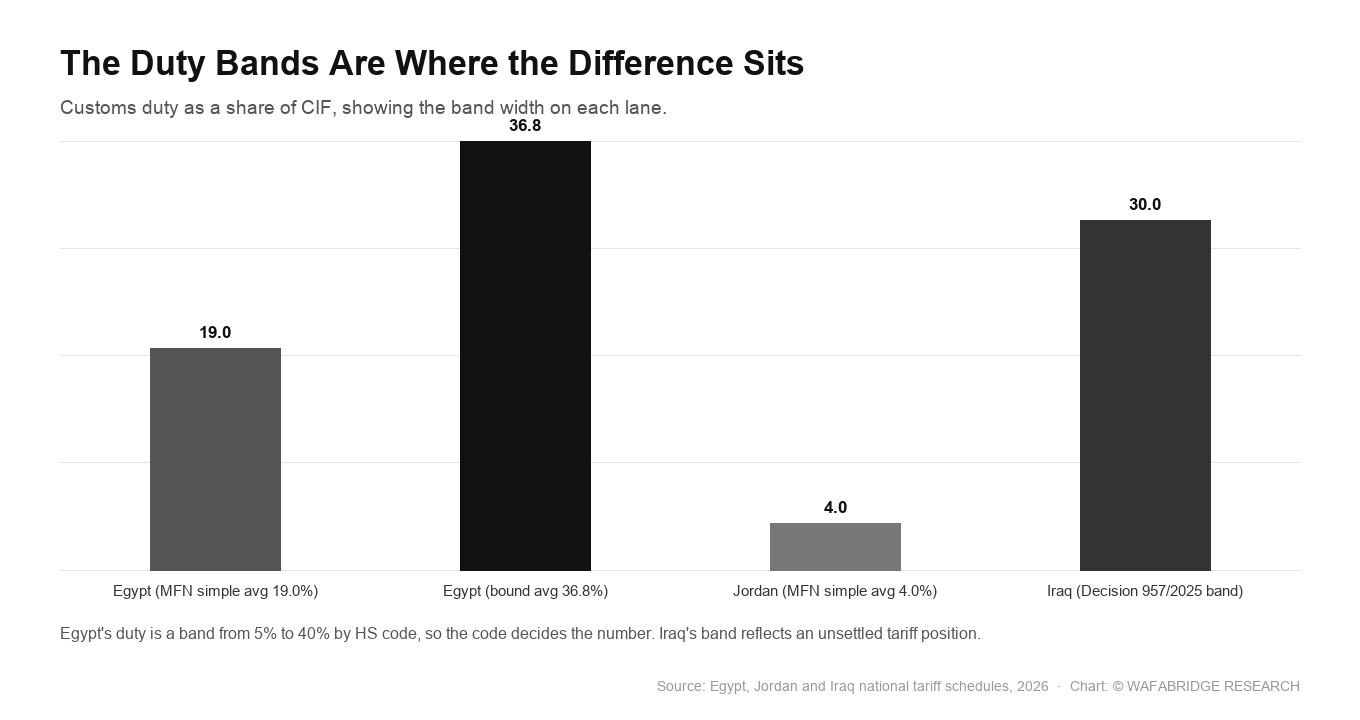
The chart above shows the duty bands on their own. Egypt’s is wide because the HS code decides the number; Iraq’s is wide because the tariff position itself is unsettled.
Who clears the goods, and which documents they need
The clearance chain is the part that differs most between the three markets, and it is the part a DDP quote is actually buying. What you are paying for is not the transport; it is the importer of record, the pre-departure document build, the customs entry, and the last mile. The chart below sets the parties and documents against each other.
| Saudi Arabia | Egypt | Jordan | |
|---|---|---|---|
| Importer of record | A licensed Saudi entity, TIN on the declaration | A local importer, or an agent under power of attorney | A registered importer or appointed agent |
| Product conformity | SABER PCoC then SCoC, plus FASAH pre-arrival filing | COSQC certificate of conformity | JSMO assessment where regulated |
| Consumption tax | VAT 15% on value plus duty | VAT 14% on value plus duty | Sales tax 16%, 7% in ASEZA |
| Duty | GCC tariff, 5% on most lines | 5% to 40% by band | MFN average 4.0% |
| Main port | Jeddah or Dammam | Alexandria or Ain Sokhna | Aqaba, the only seaport |
Egypt runs on the standard importer-of-record model with a 5% to 40% duty band assessed against the HS code and 14% VAT on CIF plus duty, with documents in Arabic prepared ahead of departure. Jordan runs the same model at 4.0% average duty with 16% GST or 7% inside ASEZA. Iraq is the one that demands more from you rather than less, and the document list is the reason: a commercial invoice and a certificate of origin, both requiring consular legalisation, plus the bill of lading, the packing list, and a certificate of conformity issued by COSQC. That last document is the item most likely to delay a shipment, because it is a conformity certificate for the product rather than a piece of transport paperwork, and it is obtained before the cargo moves rather than after it arrives.
Two further distinctions are worth making explicit because they change the routing rather than the paperwork. First, Iraqi cargo arriving by sea clears at Umm Qasr, which is a working port rather than a gateway hub, so the inland movement to the consignee’s warehouse is part of the lane rather than a local delivery. Second, the certificate of origin for Iraq needs consular legalisation, and a legalised document takes time that a standard certificate of origin does not — which is the difference between a sailing that works and one that does not, and it belongs in your booking timeline rather than in a to-do list for the week the container lands.
How to Quote Each of the Three Markets
Now the numbers side by side, on one indicative shipment. The worked example below is a USD 20,000 consignment of homeware and storage goods moving by sea LCL from Guangzhou, into Egypt through Alexandria, into Jordan through Aqaba, and into Iraq through Umm Qasr. Duty rates are applied as ranges where the band is wide, and every figure is indicative pending confirmation from the clearance broker for the specific HS codes and the specific sailing.
| Line | Egypt (Alexandria) | Jordan (Aqaba) | Iraq (Umm Qasr) |
|---|---|---|---|
| Goods value, CIF (USD) | 20,000 | 20,000 | 20,000 |
| Customs duty rate applied | 5%–40% band; 19.0% MFN simple average | 4.0% MFN simple average | 0.5%–30% under Decision 957/2025, status unsettled |
| Customs duty (USD, indicative) | 1,000–8,000 | 800 | 100–6,000 |
| Consumption tax rate | 14% VAT | 16% GST (7% inside ASEZA) | No general VAT |
| Tax base | CIF + duty | CIF + duty, assessed differently from Egypt’s | Not applicable |
| Consumption tax (USD, indicative) | 2,940–3,920 | 3,328 (1,456 at the 7% ASEZA rate) | 0 (unless the goods are in a taxed category) |
| Total tax load (USD, indicative) | 3,940–11,920 | 4,128 (2,256 at the 7% ASEZA rate) | 100–6,000 |
| Tax load on CIF | 19.7%–59.6% | 20.6% (11.3% at 7%) | 0.5%–30% |
| Route shape | Sea to Alexandria, direct discharge | Sea to Aqaba, with Trebil as a land alternative | Sea to Umm Qasr or land via Arar or Trebil |
| Documents beyond the standard set | Arabic document set | Arabic document set | Consular legalisation on invoice and certificate of origin; COSQC certificate of conformity |
| Timing risk | Demurrage from day 7 on some carriers; 12% container surcharge on the canal | Aqaba transshipment and Trebil crossing capacity | Tariff status unresolved; document lead time on legalisation |
| Status of the figures | Indicative, confirm with the broker | Indicative, confirm with the broker | Industry-compiled, not official; confirm with the broker |
The comparison line that matters is the tax load on CIF. Egypt lands anywhere between 19.7% and 59.6% depending entirely on where your HS code falls in the band, which means an Egyptian quote without a confirmed HS code is a range dressed as a price. Jordan lands between 17.8% and 20.6%, a narrow spread on a low duty base and a higher consumption tax. Iraq lands between 0.5% and 30% with no consumption tax at all on standard goods, and the spread there reflects the unsettled tariff position rather than any variation in your cargo. A buyer who takes only one thing from this table should take the Egypt HS-code dependency: it is the single largest variable in the whole comparison, and it is the one thing that can be nailed down before anyone buys anything.
Note what is deliberately absent from all three columns. Freight is not included, because the ocean rate to Alexandria, Aqaba and Umm Qasr moves independently of the tax structure and is quoted against a named sailing. Neither is the last mile, nor the importer-of-record setup in each market, nor the document legalisation time in Iraq. Those belong in the DDP quote; the table isolates the tax architecture so that the two are not confused with each other. What a WafaBridge DDP quote adds to the table above is a flat 8% sourcing fee, Arabic document sets prepared before dispatch, 30 days of free storage at the Guangzhou warehouse while a consignment waits for its sailing, quotes returned in 3–5 days, and last-mile delivery by Aramex, DHL, FedEx or UPS in the markets where those carriers operate.
Decision rules for each market
The first-time importer into Egypt: get the HS code confirmed before the quote, not after. With duty running 5–40% and VAT on top of CIF plus duty, the spread between a good code and a bad one is larger than the freight. Every other decision on this lane — port, mode, sailing — is secondary to confirming how your goods are classified, and the classification is the only part you can fix before the container leaves China.
The Jordan reseller with an ASEZA-capable partner: ask about the 7% zone rate before the goods sail, and compare Aqaba against Trebil as two routes rather than one. The 7% zone rate against 16% GST is a material difference on the same consignment, and the timing of that question matters, because moving stock into or out of the zone is not something that can be arranged at the port gate. Aqaba is also carrying increasing transshipment for Iraq, so treat your own clearance slot as a capacity question rather than a formality.
The buyer of standard goods into Iraq: reject any DDP quote that carries a VAT line, and budget the document lead time as part of the transit time. There is no general VAT, so a quote containing one is a cost you cannot recover and no one will collect. Ask instead what duty applies under Decision 957/2025 and whether it has been confirmed for your code at the date of booking, and get the legalisation and the COSQC certificate underway at the point of purchase, because those are the items that decide whether the sailing is usable.
Tariff bands, VAT and GST rates, demurrage schedules and canal surcharges all change; confirm the current position for your HS codes and your sailing with the clearance broker before you release a purchase order.
Internal links: the nine markets we ship to · DDP shipping explained end to end · Iraq and Egypt hard lanes · landed cost calculator
Sources: WTO World Tariff Profiles 2025 for Egypt’s 19.0% and Jordan’s 4.0% MFN simple averages and their bound averages (wto.org); WTO Trade Policy Review country profile for Egypt for the tariff band structure and the VAT base (ttd.wto.org); APM Terminals Aqaba for 2026 container throughput, transshipment volumes and Karameh-Trebil crossing movements (apmterminals.com); Egypt Law No. 149 of 28 July 2026 for the 14% VAT standard rate; CMA CGM demurrage and detention schedule effective 20 August 2025 for the six-day import free period and the daily rates beyond it; IMF Country Report 2024/129 for the absence of a general sales tax or VAT in Iraq; Saudi General Authority for Statistics for 2025 Saudi–Iraq bilateral trade. Iraqi customs duty figures are industry-compiled rather than official, because the customs authority website does not return readable content and no official tariff query system is available. Research and figures compiled by 亚觅出海集团 AMI Global.
Chart: © WAFABRIDGE RESEARCH
Frequently asked questions
How long does shipping from China to Egypt take, and which port should it go through?
Sea LCL door to door runs 30-plus days, and the two clocks that decide your landed date are the Suez transit and the box’s free time in port. Import containers typically get 5–7 free days depending on the carrier, with CMA CGM’s published schedule giving six free days and then USD 45 on a 20-foot box and USD 65 on a 40-foot box for days 7 to 13, rising to USD 92 and USD 155 from day 21. Alexandria is the working import port, with the largest import box volume in the country at 608,714 TEU in 2025, while East Port Said handles 4.91 million TEU but mainly as transshipment. Air DDP on the same lane runs 6–12 days.
Does Jordan charge VAT like the Gulf, and which port should I use for Aqaba?
Jordan’s consumption tax is 16% and it is legally general sales tax rather than VAT, with 7% applying inside the ASEZA special economic zone, so the tax line depends on where the importer of record holds stock. The customs duty is much lower than the Gulf’s 5%: the MFN simple average is 4.0%, split between 10.7% on agriculture and 2.9% on non-agricultural goods, against a bound average of 16.2%. On most general trade the landed tax load lands near 20% of CIF, close to Saudi Arabia despite the very different duty structure. Aqaba is Jordan’s only seaport, with capacity of 1.3 million TEU against roughly 850,000 TEU handled and a concession running to 2046, and the Karameh-Trebil crossing handles road cargo as a genuine second route. For Iraq, Umm Qasr is the only deep-water port and carries effectively all seaborne trade.
Does Iraq charge VAT on imports?
No. There is no general VAT and no general sales tax in Iraq, which IMF Country Report 2024/129 states directly. What exists is a set of targeted sales taxes on specific goods: tobacco and alcohol at 300%, cars and airline tickets at 15% each, mobile phones and network services at 20%, and hotels and restaurants at 10%. Any DDP quote for Iraq that includes a VAT line is charging you a tax that does not apply to standard goods.
Which ports do the three markets use, and can one shipment serve all of them?
Alexandria is Egypt’s working import port, with the largest import box volume in the country at 608,714 TEU in 2025, while East Port Said handles 4.91 million TEU but mainly as transshipment and Sokhna sits at the Red Sea end of the network. Aqaba is Jordan’s only seaport, with capacity of 1.3 million TEU against roughly 850,000 TEU handled and a concession running to 2046, and the Karameh-Trebil crossing handles road cargo as a genuine second route. For Iraq, Umm Qasr is the only deep-water port and carries effectively all seaborne trade. One consolidated sea consignment can be split at destination, but the duty, the tax base and the document set are quoted separately for each market, so there is no single landed price across the three.
What documents does Iraq require that the Gulf does not?
Iraq needs a commercial invoice and a certificate of origin with both documents given consular legalisation, plus the bill of lading, the packing list, and a certificate of conformity issued by COSQC. That certificate of conformity is the item that most often delays an Iraqi shipment, because it is a product document obtained before the cargo moves rather than a transport document produced after it arrives, so it belongs in your purchase timeline rather than in your arrival checklist.
How reliable are Iraqi customs duty figures right now?
They should be treated as an indication rather than an official rate. Iraq’s customs authority website does not return readable content, there is no official tariff query system, the 2026 duty schedule is available only through mainstream media reporting, and the customs duty rates circulating for rebuilt cargoes are commercial website compilations. Decision 957/2025 sets rates between 0.5% and 30% from early 2026, but parliament is co-signing a demand for its cancellation, so the position is unsettled. Confirm the rate for your HS code with the broker at the date of booking.