Composite cases in this article are drawn from consignments we handle on the Guangzhou–Jebel Ali and Guangzhou–Jeddah lanes; names and figures are changed, the mechanics are not.
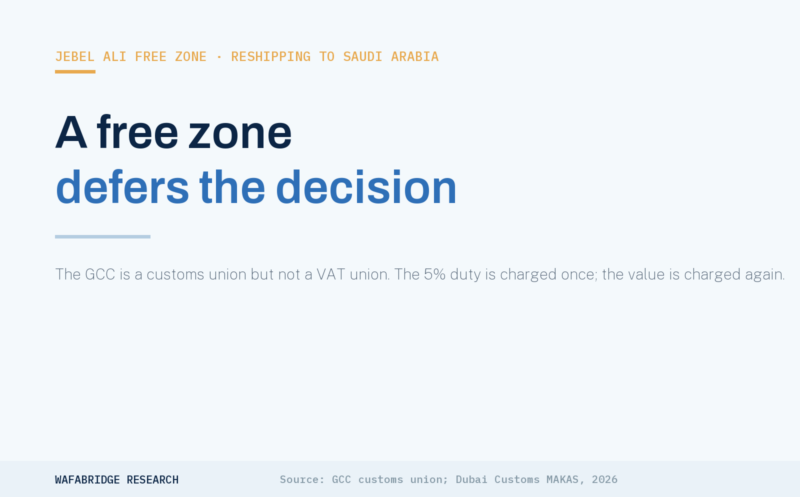
A free zone does not exempt your goods, it postpones the decision: the GCC is a customs union, so the 5% common external tariff is paid once at first entry, but it is not a VAT union, so each state levies its own VAT — Saudi Arabia at 15%, Bahrain at 10%, the UAE and Oman at 5%, and Qatar and Kuwait have not implemented one at all. Leaving Jebel Ali Free Zone for Saudi Arabia still means Saudi VAT at 15%. What the free zone actually buys is the right to decide later which market pays it.
Two hundred cartons and a plan built on the wrong tax
Khalid runs a distribution business out of Dubai, and he had 200 cartons of a mid-value household line sitting in a Jebel Ali free zone warehouse, already landed from China, already in stock, already his. He had three candidate markets open: Saudi Arabia, Bahrain, Oman. What he wanted was a simple rule for how to split them.
He built the plan the way most buyers build it — by asking which country has the lowest tax. Bahrain at 10% looked better than Saudi Arabia at 15%, and Oman at 5% looked better than both, so the instinct was to route the stock toward the cheapest VAT regime and treat the Gulf as one market with a rate attached.
The plan was wrong in a way that would have cost him money in both directions. The Gulf is not one market with a rate attached. It is a customs union with six separate consumption tax systems sitting on top of it, and the difference matters most in the direction he did not expect: the stock sitting in the free zone right now is not carrying Saudi VAT, Bahrain VAT or Omani VAT, and it will not start carrying any of them until it leaves. Every day the cartons sit there, the tax question is unanswered. That is not a weakness in the setup. It is the most valuable thing about it.
The Gulf is one tariff and six tax systems
The distinction that unlocks the whole question is between a customs union and a VAT union, and the Gulf is the first and not the second.
On the customs side the six states have genuinely pooled. The common external tariff runs at 5% on most foreign goods, with 417 items exempt and tobacco and alcohol at 100%, and it entered into force in January 2003 under the GCC common customs law. Duty is collected once, at the first point of entry into the union, and goods that have cleared move between member states without paying it again. That is why the same 5% line appears on every quote for Saudi Arabia, the UAE, Qatar, Kuwait, Oman and Bahrain alike, and it is why a re-export route cannot be used to dodge duty.
On the consumption tax side nothing has been pooled at all. Each state runs its own VAT on its own timetable: Saudi Arabia at 15%, Bahrain at 10%, the UAE at 5%, Oman at 5%, while Qatar and Kuwait have not implemented VAT. Because the electronic services systems that would make cross-border treatment workable are not in place, the states in practice treat one another as a third country for goods, and import VAT is collected country by country as the goods enter each market. The practical consequence is the one that matters for a stock sitting in Jebel Ali: the tax on it is not the tax of the union, it is the tax of whichever market it next enters.
It is worth being careful with a common shorthand here. “Six countries, one 5%” is wrong twice over: the 5% is the customs tariff and it is not the VAT rate, and the six states do not run a uniform VAT rate between them. Two of them run no VAT at all.
The regime did move recently, and the direction of travel is toward more integration rather than less. On 19 May 2026 Saudi Cabinet Resolution No. 887 amended the Unified VAT Agreement between the GCC states. Article 25 provides that member states tax according to their domestic legislation with a rate not below 5% — so what used to be a uniform 5% rate is now a floor, and each state is free to sit above it, which is exactly what Saudi Arabia’s 15% and Bahrain’s 10% do. Article 64 provides for import VAT to be paid at the first point of entry and transferred to the destination country through an automatic customs transfer mechanism. Article 12 adds a settlement mechanism between member states for amounts that follow, and Article 71 widens tax information exchange. The 2026 amendment makes the intra-GCC VAT plumbing more workable; it does not create a single Gulf VAT rate, and it does not change the fact that import VAT is charged market by market.
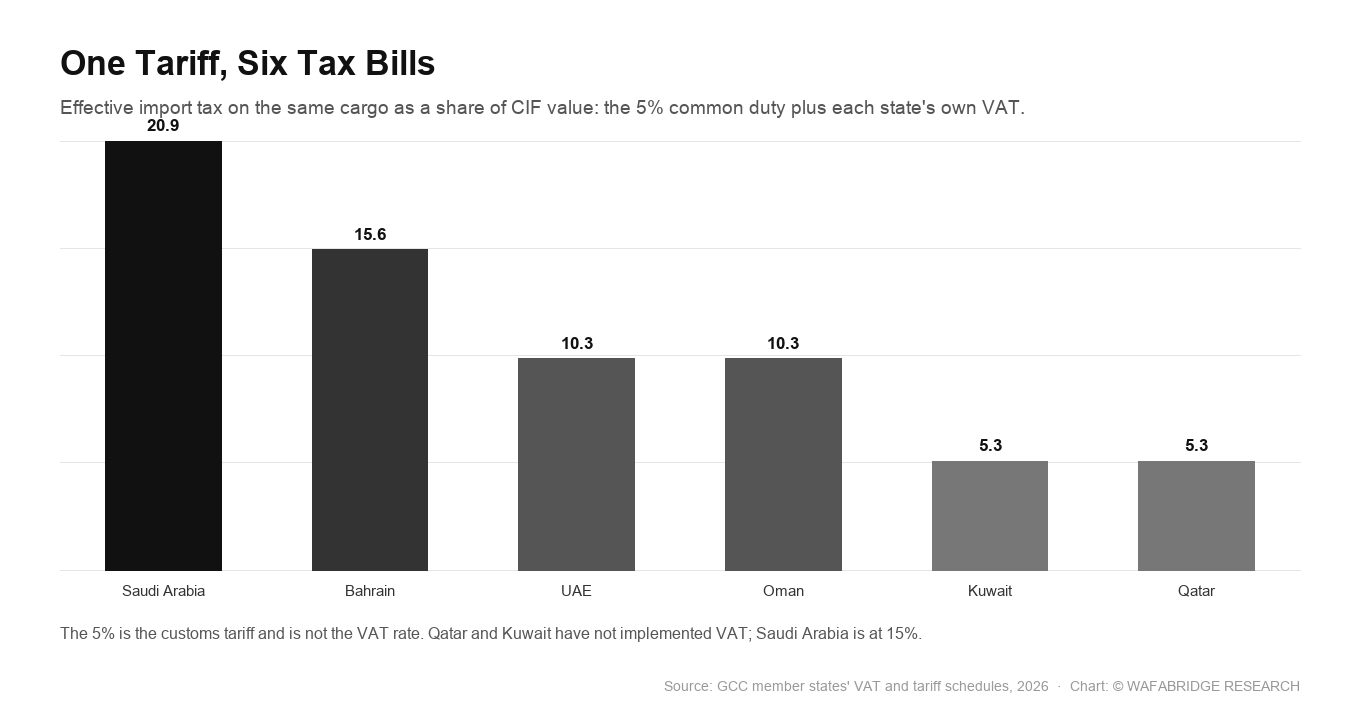
The chart above is the point the chapter is making: the 5% is the customs tariff, and it is not the VAT rate. Six markets, six VAT bills.
What the free zone does, and what it postpones
Jebel Ali Free Zone is a UAE VAT designated zone, and the mechanics of that designation are worth stating plainly, because they are where most misunderstandings live.
| Direct to Saudi Arabia | Via Jebel Ali free zone | |
|---|---|---|
| Duty assessed | At the Saudi border, on customs value | On leaving for Saudi Arabia, not in the zone |
| VAT applied | Saudi VAT at 15% on value plus duty | UAE VAT suspended in the zone; Saudi VAT at 15% on entry |
| What you save | Nothing to compare against | Timing, not tax. The GCC is a customs union, not a VAT union |
| Cash flow | Duty and VAT paid before sailing, if DDP | Duty and VAT deferred until you pick a market |
| Paperwork | Import declaration and conformity certificates | Re-export declaration plus a MAKASA due number |
| Real reason | Usually none | One inventory serving several markets |
Inside the zone, UAE VAT does not apply to the goods and customs duty is suspended. Goods remain in bond in the sense that matters commercially: no import tax has been triggered, no import VAT clock has started, and nothing has been declared into the UAE domestic market. Release into the UAE mainland is treated as an import, attracting the 5% common tariff and 5% UAE import VAT. And a re-export from the zone to a destination outside the GCC is zero-rated.
What that list does not contain is any exemption from Saudi Arabia, Bahrain or Oman. The moment a container leaves Jebel Ali for Jeddah or Riyadh, it is an import into Saudi Arabia and Saudi import VAT applies at 15%, with Saudi customs collecting it. The free zone defers the tax decision; it does not remove it, and the tax rate applied on exit is the rate of the market you exit into.
One point about origin is worth clearing up because it recurs. Transiting through Dubai does not make the goods Dubai-made. A certificate of origin covering a Jebel Ali re-export evidences that the goods transited Dubai, not that they were manufactured there, and the destination country applies its tariff and tax rates according to the actual country of manufacture. For Chinese-manufactured goods, that means the GCC common external tariff and the destination’s VAT apply, exactly as they would have without the stopover.
The scale is not the argument against the zone, and it is worth knowing what the numbers are. Jebel Ali port handled 15,552,000 TEU in 2025, up 0.1% on 15,536,000 TEU in 2024, inside DP World’s global 93.4 million TEU for the year. The free zone itself runs four container terminals, 19.4 million TEU of annual capacity, over 100 berths and 25 kilometres of shoreline, with more than 11,000 companies inside it and 190 billion dollars of trade in 2024. That is infrastructure you can rely on. It is simply not a tax position.
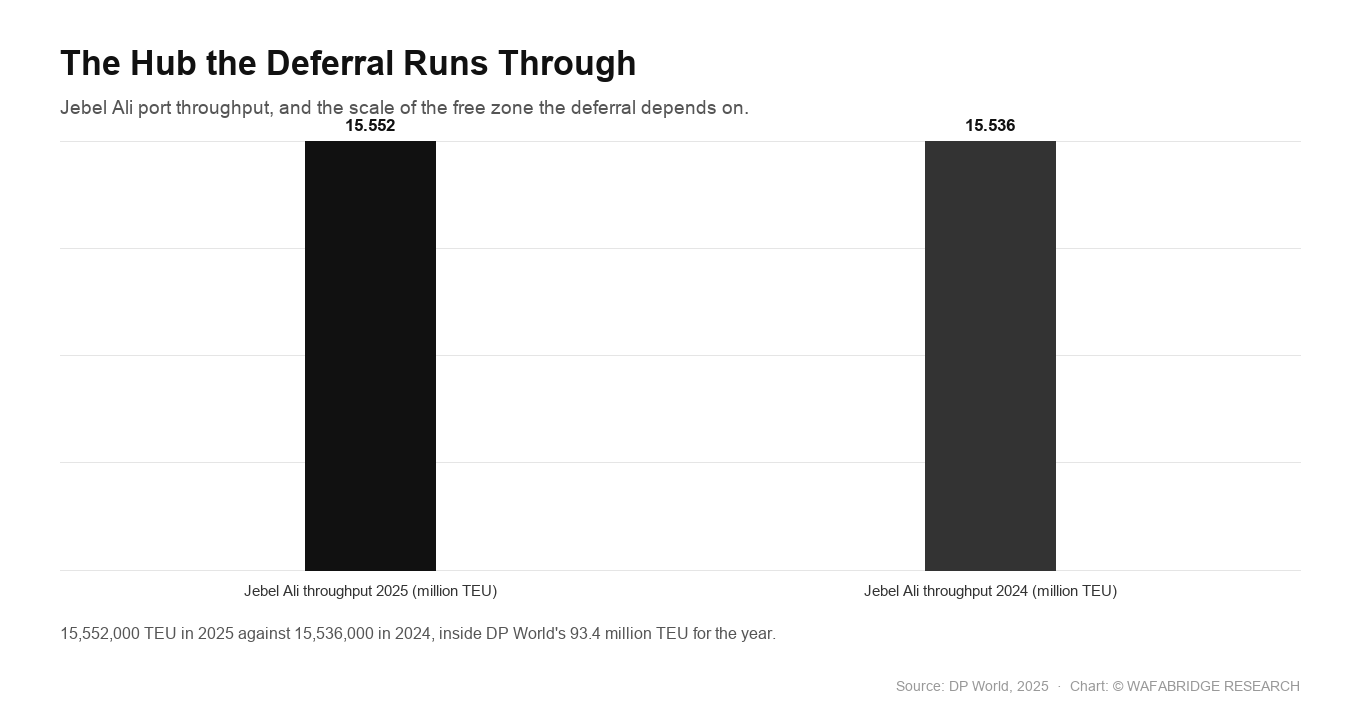
The chart above is the hub the deferral runs through, at the scale that makes the deferral operationally possible.
The paper route out of the zone
The compliance path for free-zone goods moving to Saudi Arabia has three steps, and the second one has a name buyers rarely recognise.
First, a Re-Export to GCC declaration. The cargo is declared on the Mirsal 2 system under a Re-Export to GCC heading, which is the entry that carries the goods out of the zone toward another member state rather than into the UAE domestic market.
Second, the MAKASA stamp. This is the step that matters, and it is the one that trips up first-time users. A MAKASA notification goes to Saudi customs stating that the goods originated outside the free zone, that Dubai collected no tax on them, and that the destination country will collect the duty and VAT. It is the document that stops Saudi customs treating your re-export as an undeclared import into the kingdom, and the mechanism Dubai Customs launched as a digital initiative. From 25 January 2026 the MAKASA process runs fully electronic, so the stamp is no longer a physical document to courier.
Third, the customs export certificate that allows the goods to physically leave. One practical note on that third step: for cargo going out through Jebel Ali Port under the FZ Transit Out procedure, the paper export certificate was abolished on 1 May 2021 and the electronic record is what the port works from. Anyone still asking for a paper certificate at Jebel Ali is working from a pre-2021 checklist.
There is one genuinely unsettled point on this route, and it is a money question rather than a paper one. Sources differ on whether cargo moving out of the free zone under this procedure needs a guarantee. One freight forwarder states that the free-zone route requires no bank guarantee at all. A law firm states that customs may require a guarantee equivalent to 5% of the duty, or a bank guarantee — on a consignment with a CIF value of AED 2 million, a guarantee of AED 100,000. Which of these applies to a given shipment depends on the specific declaration route and what customs asks for on the day, so treat the answer as one to be confirmed in writing with Dubai Customs for your own consignments rather than one to be assumed from a forwarder’s summary.
A second sourcing note, so nobody treats a broken link as evidence of a tax position: the official designated-zone list for the free trade agreements has been unreachable on the tax authority’s website at the time of writing. Jebel Ali’s designated-zone status is corroborated by four independent sources, which is why this article describes the treatment in substance rather than pointing at a list that is not currently retrievable. Confirm the current list with the FTA authority or Dubai Customs before a filing that depends on it.
Two paths, two sets of clocks
The reason to use a free zone is timing, so it is worth putting the two paths side by side in clock terms rather than tax terms.
A free zone does not remove the tax. It removes the decision
Two ways to land the same 200 cartons across three Gulf markets.
-
Path A
Direct: one container, one destination, one duty assessment
Order 200 cartons for Saudi Arabia. The container sails to Jeddah, Saudi duty and VAT are settled, and the boxes are delivered to Riyadh. Fastest and simplest, and the cost of the destination's tax is paid up front.
-
Path B step 1
Free zone: the container arrives and the duty clock does not start
The same container lands at Jebel Ali and moves into the free zone. The Saudi duty is not assessed while the goods sit inside the zone.
-
Path B step 2
Free zone: the order splits by market
Sixty cartons go to Saudi Arabia, forty to Bahrain, thirty to Oman. Each market's portion leaves the zone with its own re-export declaration and, for Saudi Arabia, a MAKASA due number.
-
Path B step 3
Free zone: each market is taxed on its own terms
Saudi Arabia pays 20.9% effective, Bahrain 15.6%, Oman 5.3%. The 5% duty is not charged three times, because it is a customs union and the goods entered the union once.
-
The trade-off
Free zone: more handling, more documents, more days
You gain the ability to serve several markets from one inventory without committing to one of them at the moment of import. You also add a transhipment leg, a re-export declaration and days at the terminal.
The direct path. Cargo moves China to Jebel Ali, or China to Jeddah, and enters a single market. Sea LCL runs 30-plus days door to door and air DDP runs 6–12 days, and once the goods are in the destination market, the import VAT and the duty are settled and the tax question is closed for that parcel. Fastest to a single shelf, and the tax decision is made at the moment of import — on the evidence available at that moment.
The free-zone path. Cargo lands in Jebel Ali in bond, or sits in the zone in bond, and the import tax question stays open. Nothing is paid on import into the UAE, the MAKASA process takes a few days, and the stock can be divided: part out to Saudi Arabia, part to Bahrain, part to Oman, part held, part re-exported to a non-GCC destination at zero rating. Slower to the first shelf in any single market, because you are buying an option rather than a delivery.
The most common way this route is mis-sold is by being described as a tax-saving route. It is not. The saving that appears in the arithmetic below comes from the demand actually splitting across markets, and if the demand does not split, the free zone has cost you money and bought you nothing but delay. The thing it reliably buys is the right to change your mind about the market after the goods have landed and before they have been taxed.
A worked example on 200 cartons
The comparison is easiest to see with a stock already in the zone. Take 200 cartons with a CIF value of USD 100,000, and assume illustrative demand that splits 120 cartons to Saudi Arabia, 50 to Bahrain and 30 to Oman — USD 60,000, USD 25,000 and USD 15,000 of customs value. The rates are the published GCC and national rates. The goods value is a stated example used to make the arithmetic concrete, and the freight, free-zone storage, handling and any guarantee are quoted locally and are not included in these lines.
| Line (USD, indicative) | Direct: all 200 cartons into Saudi Arabia | Direct: three separate shipments, 120 / 50 / 30 | Via the free zone: split decided after landing |
|---|---|---|---|
| Duty at 5% common external tariff, once on the goods | 5,000 | 5,000 | 5,000 |
| Saudi import VAT at 15% on customs value plus duty | 15,750 | 9,450 | 9,450 |
| Bahrain import VAT at 10% on customs value plus duty | 0 | 2,625 | 2,625 |
| Oman import VAT at 5% on customs value plus duty | 0 | 787.50 | 787.50 |
| Total import tax paid on the same 200 cartons | 20,750 | 17,862.50 | 17,862.50 |
| Import VAT paid at the moment of import | 15,750, on all 200 cartons, before the first carton is sellable | 12,862.50 in total, paid per shipment as each lands | 0 at the point of entry — 12,862.50 becomes due tranche by tranche as each exits the zone |
| Extra cost the route carries | None beyond the single shipment | Three import files, three importer arrangements, three certificate paths | Free-zone storage and handling, the re-export declaration, the outbound leg from Jebel Ali, and a possible guarantee, all quoted locally |
| If the split turns out wrong once the stock is on the ground | VAT already paid on all 200 cartons; the stock sits in Saudi Arabia | VAT already paid on all three tranches; the stock sits in three markets | Only the tranches actually released attract import VAT; stock still held in the zone stays untaxed and can be re-allocated, re-timed or redirected to a non-GCC destination at zero rating |
Read the table along the first two rows and the middle column looks like a tax saving of 2,887.50 dollars. It is not a saving from the free zone. It is the arithmetic of a stock that genuinely split across three markets instead of all landing in the highest-VAT one, and you could achieve the same 2,887.50 by shipping three separate consignments directly — at the cost of having to know the split before you ship anything.
The last row is where the free zone earns its keep, and it is the row the tax comparison misses entirely. In the third column, the import VAT attaches only to the tranches that actually leave the zone, so a consignment held in bond has not been taxed into Saudi Arabia, Bahrain and Oman at once — it is still a decision. If demand disappoints in the Gulf, that stock can be re-allocated to whichever market absorbs it, held longer, or redirected: a buyer in Egypt, Jordan or Iraq can take it at zero rating on a re-export outside the GCC. In the first two columns, the same stock was taxed before anyone knew it would sell.
Two things are missing from the table and both belong in any real decision. The free zone is not free: storage, handling, the re-export declaration and the outbound leg all cost money, and they are quoted locally rather than published, so they have to be obtained before the route is chosen rather than discovered afterwards. And for a registered importer, import VAT is recovered through the return, so the VAT lines above are cash occupation first and cost second — which makes the timing column the one that matters, and the recovery timetable the one to check against your own filing cycle.
One open question on this route deserves a flag rather than a paragraph. The 2026 amendment’s first-entry-point mechanism for import VAT and its automatic transfer to the destination country changes how intra-GCC flows are settled, and how a free-zone exit routed through one member state into another interacts with that mechanism is not something to be assumed. Ask your clearing broker, in writing, which treatment a given routing attracts before the cargo commits, because the answer determines whether the exit into Saudi Arabia is the only VAT event or the first of several.
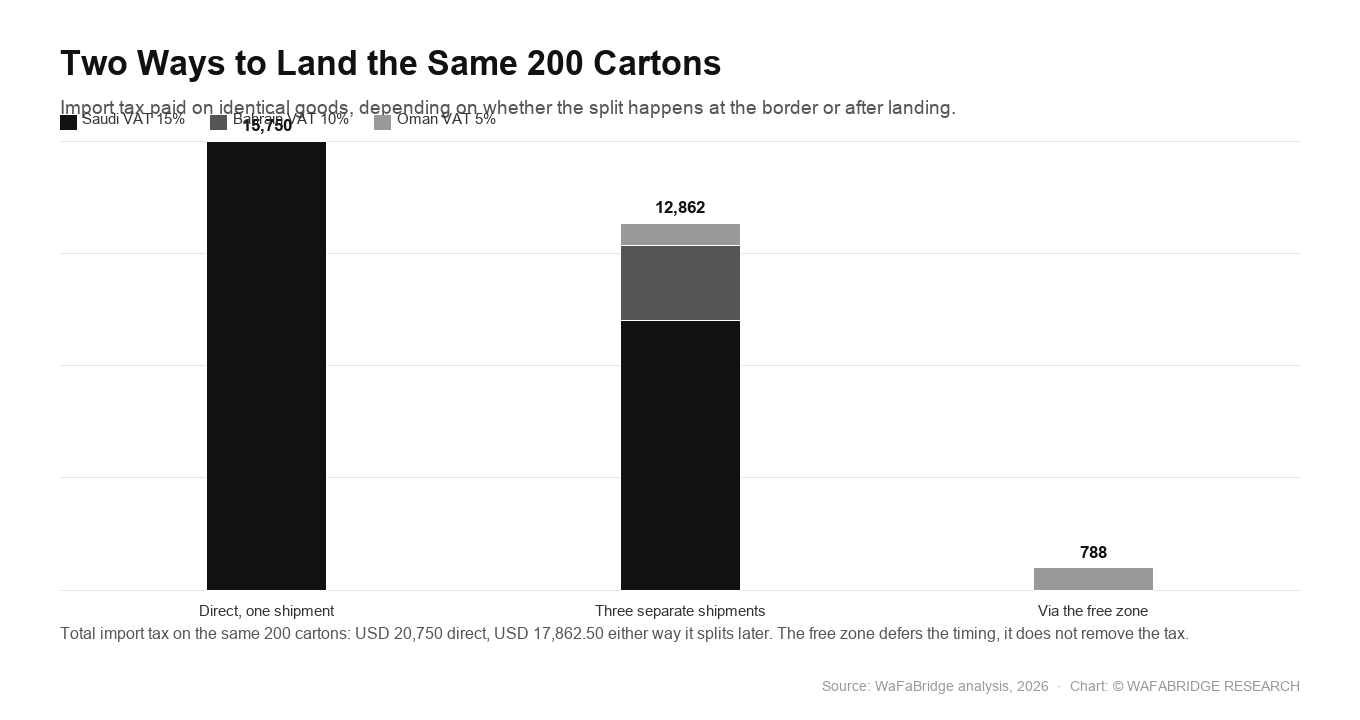
The chart above is the same 200 cartons landed three ways. The free zone does not remove the tax; it moves when you pay it and keeps it optional.
Four decision rules, by buyer type
Single-market sellers: go direct and skip the zone. If every carton is going to one market and you already know which one, the free zone adds a leg, a declaration and a delay to buy an option you will never exercise. The direct route in the table above costs 2,887.50 dollars more in tax, and the free-zone route still has to recover that from storage, handling and the outbound leg before it is worth anything at all.
Multi-market distributors with a genuinely uncertain split: use the zone as a decision window, and give it a deadline. The value is entirely in the optionality, and optionality that runs indefinitely becomes storage. Set a maximum dwell period for the stock in the zone and a written trigger for re-planning — a date by which the split is decided or the stock moves out to the market that will take it. A free zone used without a clock is just a warehouse with a tax advantage nobody collects.
Sellers serving markets outside the GCC: the free zone is at its strongest. Re-export to a non-GCC destination is zero-rated, and Egypt, Jordan and Iraq sit outside the GCC entirely. Where the alternative is a domestic import with its own VAT and certification path, the re-export route is not a tax manoeuvre — it is the shorter road.
Anyone treating a free-zone transit as a way around duty or around origin: stop there. Duty is collected once at the first point of entry into the union and a free zone does not defer it, and a Jebel Ali re-export does not make Chinese goods Dubai-manufactured for tariff purposes. The zone gives you time and a choice of destination. It gives you neither a lower duty nor a better certificate.
Tariff lines, VAT rates, designated-zone lists and free-zone charges all move with regulation and with local pricing. Confirm the current duty and VAT treatment for your own HS codes and the current free-zone charges with Dubai Customs and your clearing broker before you commit stock to the zone.
Internal links: UAE versus Saudi Arabia import costs compared · nine markets on one standard · Guangzhou consolidation and repacking · landed cost calculator
Sources: UAE Federal Customs Authority (ICP), the GCC Customs Union — free zone goods treated on release as imports and duty collected at first entry (icp.gov.ae); GCC General Secretariat, the common customs law in force since January 2003 — 5% common external tariff on most goods, 417 items exempt, tobacco and alcohol at 100% (gcc-sg.org); Dubai Customs, launch of the digital MAKASA initiative, phase one, and full electronic operation from 25 January 2026 (dubaitrade.ae); IMF and Baker McKenzie, June 2026 — the GCC is a customs union but not a VAT union, with Qatar and Kuwait yet to implement VAT; Saudi Cabinet Resolution No. 887 of 19 May 2026 as summarised by Deloitte Saudi and Baker McKenzie, June 2026 — Article 25 rate floor of 5%, Article 64 first-entry-point payment with automatic transfer, Article 12 settlement mechanism, Article 71 information exchange; Jebel Ali Port and DP World container throughput for 2024 and 2025; JAFZA zone capacity and 2024 trade figures; Saudi VAT rates across GCC member states. Freight, free-zone storage, handling and guarantee figures in the worked example are local quote bases rather than published tariffs and are indicative. Research and figures compiled by 亚觅出海集团 AMI Global.
Chart: © WAFABRIDGE RESEARCH
Frequently asked questions
Does moving goods through Jebel Ali Free Zone avoid Saudi VAT?
No. Jebel Ali is a UAE VAT designated zone: UAE VAT does not apply inside it and duty is suspended, but releasing the goods into Saudi Arabia is an import into Saudi Arabia and Saudi import VAT at 15% applies, with the base being customs value plus duty. What the free zone provides is time — the tax rate is decided by the market the goods next enter, and nothing is taxed while they wait.
Is the GCC a single VAT market with one rate?
No. The six states are a customs union with a 5% common external tariff collected once at first entry, but VAT is national: Saudi Arabia at 15%, Bahrain at 10%, the UAE and Oman at 5%, and Qatar and Kuwait have not implemented VAT. The 2026 amendment to the Unified VAT Agreement replaced the previous uniform 5% rate with a floor of 5% that member states may exceed, so the six rates are free to diverge further rather than converge.
What is MAKASA and why does the route depend on it?
MAKASA is the notification to Saudi customs that the goods originated outside the free zone, that Dubai collected no tax on them and that the destination country will collect the duty and VAT — which is what stops a re-export being treated as an undeclared import into the kingdom. It is filed against a Re-Export to GCC declaration on Mirsal 2, and the process has run fully electronic since 25 January 2026. For cargo leaving through Jebel Ali Port under FZ Transit Out, the paper export certificate was abolished on 1 May 2021.
Does shipping through Dubai change where my goods are from?
No. A certificate of origin for a Jebel Ali re-export evidences that the goods transited Dubai, not that they were manufactured there, and the destination country applies its tariff and VAT rates according to the actual country of manufacture. For Chinese-manufactured goods the common external tariff and the destination’s VAT apply exactly as they would have without the stopover, so the free zone changes neither your duty position nor your certificate position.
Is a free zone worth it for a single-market seller?
Generally not. The tax comparison favours routing through the free zone only when demand genuinely splits across markets with different VAT rates, and the gain there is worth 2,887.50 dollars on a 200-carton, USD 100,000 CIF example, which has to be recovered from free-zone storage, handling, the re-export declaration and the outbound leg. With one market and no uncertainty about it, the direct route is simpler and cheaper.
Do you ship to Egypt, Jordan and Iraq through the same routes as the Gulf?
Not the same. Egypt, Jordan and Iraq sit outside the GCC, so a re-export from Jebel Ali to them is zero-rated and follows different lanes and clearance arrangements from the GCC destinations. Duty and VAT for those markets are confirmed against the HS code by the destination broker rather than assumed from a GCC rate.