Composite cases in this article are drawn from consignments we handle on the Guangzhou–Gulf corridor; names and figures are changed, the mechanics are not.
A DDP landed-cost quote from China to the Gulf contains seven lines — goods value, the 8% sourcing fee, China domestic freight, international freight, customs duty, import VAT, and delivery — and understanding each one is the difference between comparing quotes and comparing illusions. The line items are not bureaucracy. They are the anatomy of your margin.
The quote that looked expensive, and the invoice that wasn’t
A Riyadh buyer — call her Noura — requested quotations for 300 cartons of home goods and got two offers that made no sense next to each other: a DDP door-to-door quote in the low five figures, and a “freight-only” quote from a forwarder at less than a third of it. The forwarder’s number was real. It was also answering a different question — it moved cartons across the ocean and stopped there, leaving duty, VAT, clearance, storage risk and delivery as surprises Noura would meet in person, in riyals, at the worst possible moment: with the goods already in the country and the money already spent.
She took the DDP quote. When the final statement arrived — the total matching the quotation to the riyal, every line printed — she asked the question this article answers: what am I actually paying for in here? Unpacking that question, line by line, is the most useful financial literacy a Gulf buyer can acquire, because every buying decision — what to reorder, which supplier to drop, whether air is worth it, whether the UAE or Saudi market fits better — is downstream of knowing where the money in a landed cost actually goes.
Line one and line two: the goods, and the fee that runs them
Goods value is the supplier’s price — the 1688 number, the factory quote, the only line most comparisons ever look at. It is typically the largest line, and it is the line where the most money is won and lost: a unit price 10% lower from an unverified factory is the most expensive discount in this trade if what arrives doesn’t match the order.
The sourcing fee — 8% of goods value, flat — is the price of the operation that makes the other six lines safe to spend: paying suppliers in RMB through domestic rails, managing orders, inspecting goods at the Guangzhou warehouse before shipment, chasing defects while the supplier can still be made to answer for them, consolidating cartons so the freight line shrinks instead of multiplying. Our piece on what a 1688 buying agent actually does carries the full anatomy; the short version for a cost sheet is this: the 8% is not a freight markup. It is a local team, priced proportionally to order size, and it is the line that keeps the goods-value line honest.
There is a discipline hiding in the flat structure: because the fee is a percentage and not a negotiated variable, it cannot be gamed in either direction. It does not grow when the shipment gets complicated, and it does not get discounted into opacity on a large order. On a cost sheet, flat lines are readable lines — and readability, on this trade, is money.
Line three: the metres before the ocean
China domestic freight — supplier to warehouse — is the line buyers forget exists and the one that quietly shapes sourcing strategy. China is not a port; it is a continent of factories, and a supplier in Yiwu, one in Ningbo and one in Shenzhen each add a domestic leg to the same consolidation. This is why warehouse location matters (a Guangzhou hub sits inside the Pearl River Delta’s supplier density) and why consolidation at one address — twenty suppliers feeding one warehouse, repacked into a fraction of the volume — is not a convenience but a cost lever. Every carton that avoids a duplicate domestic trip is margin that never leaves the building.
Line four: the ocean or the sky
International freight is the line with the widest range and the most arithmetic behind it, because it is really a family of decisions: sea LCL or air (our air-versus-sea article carries the decision framework), volumetric reality of the cartons (light bulky goods pay a volume penalty in air; dense goods fly cheap), the seasonal calendar (pre-Eid space is sold, not allocated), and the corridor’s living variance — the Red Sea rerouting and the growth of the Jebel Ali hub have kept rates and schedules moving in ways that make standing freight assumptions worthless within a quarter. On the cost sheet, this line deserves neither love nor fear, just honesty: it is the price of physics and scarcity, it moves, and it is quoted, not guessed.

Lines five and six: the border
Customs duty is assessed by the destination country on the goods’ classification — the HS code — and its rate varies from a few percent to double digits depending on what the cartons contain. The HS code is the highest-leverage judgement in the whole cost sheet: it moves the duty line, the conformity requirement (SABER in Saudi Arabia, ECAS in the UAE), and the documentation risk simultaneously. A duty rate quoted without an HS code is not a quotation; it is a hope.
Import VAT is the line that changes meaning depending on who you are — 15% in Saudi Arabia, 5% in the UAE and the differences across the other Gulf markets in the chart above — and for a VAT-registered trader it is recoverable input tax, a cash-flow line rather than a cost; for an unregistered buyer it is a final cost, and the difference between the Gulf’s tax regimes becomes a real pricing gap (our UAE-versus-Saudi comparison works a full example). Paid before shipment under DDP, it is also the line that prevents the worst experience in cross-border buying: the carrier demanding cash at the door before releasing your cartons.
Line seven, and the sheet that came together
Delivery — clearance handling and the last mile to the door — is the smallest line and the most disqualifying when absent. A quote that stops before delivery has not finished the sentence; the last mile on this corridor runs through named networks (Aramex, DHL, FedEx, UPS across most Gulf markets), and its cost is known, fixed and small next to what it closes out.
Put all seven together on Noura’s shipment — 300 cartons, $18,000 of goods at supplier prices, sea LCL to Riyadh — and the sheet reads like this (indicative figures):
| Line | Amount (USD) | What it buys |
|---|---|---|
| Goods value (supplier prices) | 18,000 | The goods |
| Sourcing fee (8%, flat) | 1,440 | RMB payment, orders, inspection, consolidation |
| China domestic freight | 380 | 11 suppliers → 1 warehouse |
| Sea freight LCL, Guangzhou → Riyadh | 2,150 | The ocean, DDP terms |
| Customs duty (HS-classified) | 900 | The border’s tax |
| Saudi VAT 15% (prepaid before shipment) | 2,835 | Release, no cash at the door |
| Clearance handling + last-mile delivery | 480 | Port → her shop door |
| Landed, delivered | 24,185 |
≈ USD 24,185 — against $18,000 of goods: a landed multiplier of about 1.34, every line of it named. That multiplier is the number to compare across suppliers, across product lines, across markets — not the freight quote, not the goods price. A buyer who knows her landed multiplier can answer, in one calculation, questions that rivals debate by feel: whether the cheaper factory 400 km further inland is cheaper at all (domestic freight says often not), whether air is survivable this quarter (multiply the freight line, not the total), and what a 15% versus 5% VAT regime does to her Dubai-versus-Riyadh economics (recoverability decides).
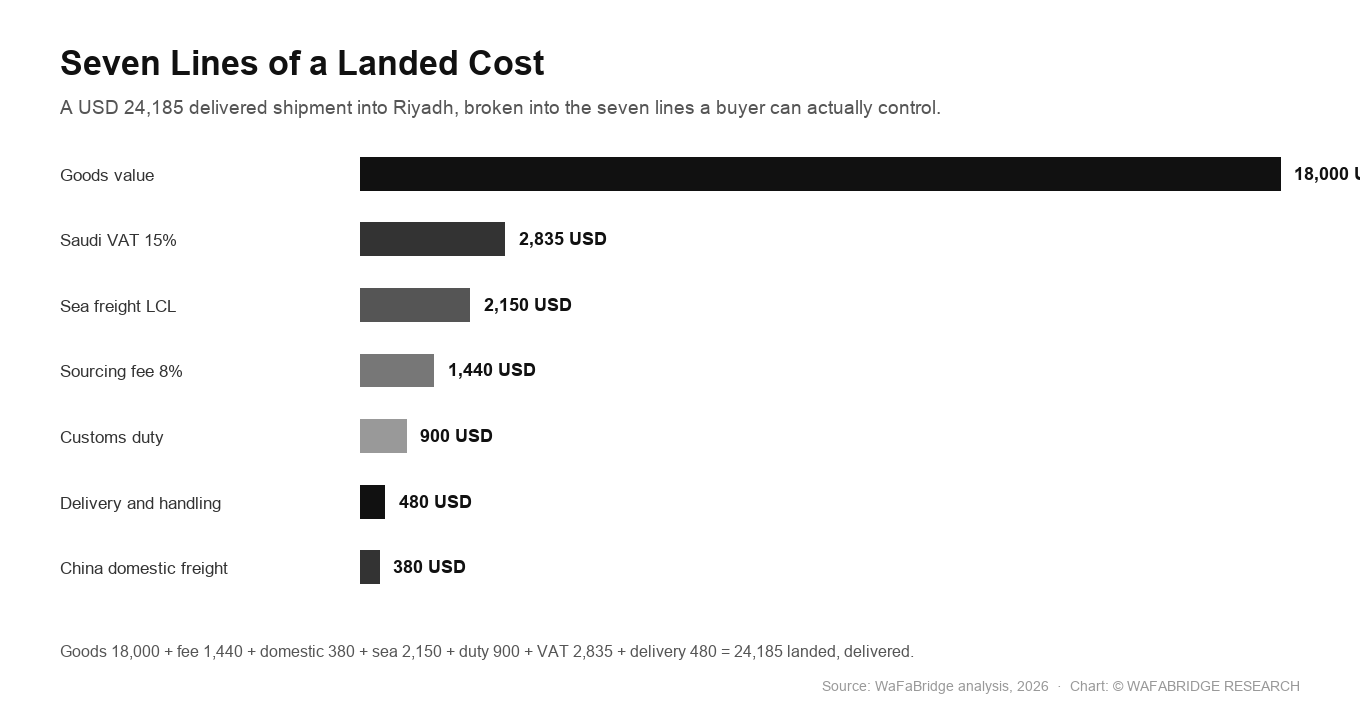
The chart above is the sheet as seven lines. Read it in order of what you can control, and the order changes what you optimise first.
The air version of the sheet
The same cartons, flown instead of sailed, show how the sheet isolates the decision. Noura’s 300 cartons run about 2,400 kg actual and, at roughly 9 cbm, a much larger volumetric figure — air charges on the greater. On indicative numbers, the freight line jumps from $2,150 to somewhere in the $7,000–9,000 band, and the transit drops from five weeks to under two. Everything else on the sheet barely moves: same goods, same 8% ($1,440), same domestic leg, same duty by HS code, same VAT by destination, same delivery network. The sheet makes the trade-off surgical: the air decision is a $5,000–7,000 decision on one line, not a re-price of the whole order — and that is exactly why it should be made against the calendar (does five weeks of earlier arrival earn more than $6,000 on this stock?) rather than against the frightening-looking total.
| Line | Sea LCL | Air DDP |
|---|---|---|
| Goods + 8% fee + domestic | 19,820 | 19,820 |
| International freight | 2,150 | ~8,000 |
| Duty + VAT (same HS, same rates) | 3,735 | 3,735 |
| Delivery | 480 | 480 |
| Landed, delivered | 24,185 | ~32,000 |
| Door-to-door | ~35 days | 6–12 days |
A multiplier of 1.78 against 1.34 — the honest price of twenty-eight days. For replenishment stock with cover on the shelf, it is money burned. For stock whose selling window is twenty-one days long, the sea sheet is the expensi ia export growth, 2022–2024″ src=”https://wafabridge.com/wp-content/uploads/2026/11/chart-a1-cnkSA-flows.png” />
What this means depending on who you are
If you are comparing quotations, compare sheets, not totals: a DDP quote with seven named lines is a different product from a cheap number with three vague ones. The cheap quote is not wrong — it is unfinished, and the missing lines arrive later as invoices at your address.
If you are running margins on reorders, build your own landed-cost sheet per product line and update the two volatile lines — freight and VAT treatment — each quarter. The goods line you negotiate once; the landed line you manage continuously. The traders with the best margins on this corridor are rarely the best negotiators; they are the ones whose sheet is current.
If you are new to the corridor, the seven lines are your due diligence checklist in reverse: ask any provider to itemise all seven before you commit. What refuses to be itemised is not a discount; it is a place where a surprise is being stored.
Three expensive myths the sheet kills
The landed-cost sheet is powerful precisely because it is boring — it murders, one line at a time, the three myths that cost this corridor’s buyers the most.
Myth one: the cheapest factory wins. On the goods line, maybe. On the sheet, the factory 400 km further inland adds a domestic-freight line, a day of transit risk, and often a thinner documentation file — and a factory whose test reports don’t exist adds the certification line in full. Buyers who run the whole sheet rather than the goods line discover, regularly, that the “expensive” factory near the warehouse is the cheaper one landed. The sheet is how the sourcing conversation stops being a price negotiation and becomes a systems comparison.
Myth two: freight-only quotes are a bargain. They are a different product: three lines of seven, with duty, VAT, clearance and delivery deferred to a second bill that arrives with the goods already hostage. Noura’s comparison at the top of this article is the archetype. The sheet’s lesson is not that freight-only providers are bad — it is that comparing a finished sentence to a clause is a category error, and the corridor charges for it at the worst possible moment.
Myth three: duty can be guessed from the last shipment. Duty lives on the HS code, and the HS code lives on the product — not on the supplier, the category, or “what we shipped last time.” A product-line change that quietly crosses into a different code family moves duty, VAT treatment and conformity simultaneously. The sheet forces the classification question at every order; the buyer who skips it is not saving time but deferring the classification decision to a customs officer, at the officer’s convenience and the buyer’s cost.
The quarterly rhythm
A landed-cost sheet is not a document; it is a habit on a schedule. Two of its seven lines are volatile — freight, which moves with capacity and the calendar, and VAT treatment, which moves with your own registration status and the destination’s tax law — and a sheet older than a quarter is a photograph of a corridor that no longer exists. The working rhythm we see among the corridor’s best operators: re-quote the freight line against live rates each quarter and before each seasonal window; re-check the VAT and duty treatment whenever the product mix or registration status changes; and reconcile every final statement against its quotation, because the reconciliation habit is what keeps the sheet honest. The buyers whose margins hold through rate cycles are not forecasting better than the market. They are simply re-reading their own sheet at the frequency the corridor demands.
What the 8% does not cover
Honesty about a cost sheet includes its boundaries, and the 8% fee’s boundaries are worth writing down because buyers occasionally expect them to hold more than they do. The fee covers the operation: supplier payment handling, order management, inspection, consolidation, defect claims, coordination. It does not absorb the pass-through costs it manages — supplier prices, freight, duty, VAT, conformity certificate fees — which appear on the sheet at cost, itemised, with nothing hidden inside the percentage. That separation is deliberate and it is the buyer’s protection: a fee that “included” duty and freight would be a fee nobody could audit. The flat structure means the operation is priced the same whether the month is easy or brutal; the pass-throughs mean the market’s costs arrive exactly as the market charged them, receipt attached.
Two harder boundaries sit at the edges. Conformity certification — SABER in Saudi Arabia, ECAS in the UAE — is a third-party cost (testing bodies, certification platforms) that varies by product family and certificate; it is quoted per product before anyone commits, not averaged into the fee, because a flat-fee structure that silently averaged a $200 certificate with a $2,000 one would be overcharging the majority to subsidise the few. And the genuinely uninsurable — the buyer who changes the order after production starts, the supplier who fails entirely, the season that shifts under finished goods — is not a fee line at all; it is what inspection gates, deposit discipline and calendar planning exist to prevent. The fee’s honest promise is narrow and valuable: a team on the ground, priced proportionally, keeping every other line on the sheet as clean as the corridor allows. Expecting it to be a warranty on the entire world is how buyers end up disappointed by good service.
The sheet is the strategy
Nothing in a landed-cost sheet is exotic: goods, fee, legs, border, door. What separates buyers is not access to the numbers — it is whether the numbers are visible before commitment. The entire DDP proposition compresses into that visibility: seven lines, one currency, one total, priced before a single carton moves. Noura’s final statement matched her quotation to the riyal not because the corridor became gentle, but because the sheet had already absorbed its roughness. That is what a landed cost is for.
Rates, tax rules and duty classifications change; verify current figures for your HS codes and destination, or ask us to build the full sheet for your specific order before you commit.
Internal links: Cost Calculator · 1688 Buying Agent · UAE vs Saudi Arabia · Air vs Sea
Sources: Destination-country tariff and VAT schedules (ZATCA, UAE Federal Tax Authority); quotation data on the Guangzhou–Gulf corridor, 2025–2026.
Chart: © WAFABRIDGE RESEARCH
Frequently asked questions
What lines make up a DDP landed cost from China to the Gulf?
Seven: goods value, sourcing fee (8% flat), China domestic freight, international freight (sea or air), customs duty (by HS code), import VAT (by destination — 15% Saudi Arabia, 5% UAE), and clearance plus last-mile delivery. A quote missing any line is unfinished, and the missing cost arrives later as a surprise invoice.
Is the 8% sourcing fee negotiable or variable?
It is flat and proportional to goods value — 8% of the supplier price, whatever the shipment’s complexity. That structure is deliberate: the fee cannot be gamed upward on complicated orders or discounted into opacity on large ones, and it funds supplier payment handling, inspection, consolidation and defect claims.
Why is VAT paid before shipment under DDP?
Prepaying destination VAT before departure means the goods cross the border fully tax-cleared — no carrier demanding cash at delivery, no storage while taxes are arranged. For VAT-registered traders the amount is recoverable input tax either way; for unregistered buyers, prepayment converts a door-step risk into a known line.
What is a good landed-cost multiplier?
It varies by product, mode and destination — sea DDP to the Gulf on mid-value consumer goods commonly lands around 1.3–1.5× goods value including 8% and VAT; air adds a larger freight line. The multiplier is a comparison tool: track yours per product line and the anomalies — not a universal benchmark — are where the money hides.
Which line should I optimise first?
The goods-value line moves the most absolute money, but the HS-code decision moves the most structure — duty rate, conformity requirement and documentation risk all hang off it. Get the classification right first, negotiate goods second, and let the freight line be managed by mode choice and calendar rather than negotiation.