Since 2026, most China–Saudi container cargo no longer passes through the Red Sea. Carriers rerouted Asia–Gulf services around the Cape, so door-to-door DDP transit runs 45–60 days against 28–40 on the standard routing, 10–14 days more on the water than a Suez passage, and 5–7 more if the container is inspected. Rates rose 30–50% when four carriers moved together in May 2026, so the surcharge stack decides the bill. Cargo clears via Khor Fakkan or Fujairah, bonded by road through the Hatta green channel. WafaBridge builds one plan per sailing.
The change is easy to describe and hard to plan around. The cargo still arrives, but later, through a different port, with a longer chain of custody and a different set of charges on the invoice. In May 2026 four carriers moved together on the affected trades and lifted rates 30–50%, and the surcharge stack now decides the invoice rather than base ocean freight. This guide sets out the new geography, compares the three gateways that matter, shows how to read a quote without being surprised by the final bill, and covers the operational work between booking and delivery.
Five questions that keep a rerouted shipment inside your budget
- Ask which gateway the cargo actually enters through, not just where the vessel departed, because it determines the inland leg and the number of customs handoffs.
- Build the schedule on the rerouted transit time first, then add the transshipment days.
- Compare the surcharge stack line by line, because ocean freight is no longer the largest number on the quote.
- Break a large shipment into two consignments when the delay risk on one load outweighs the consolidation saving.
- Re-quote immediately before booking, because Middle East surcharges reprice within weeks.
Why the Route Changed, and What It Costs in Time
The viewpoint this chart carries: The Cape reroute is not a small detour added to a normal sailing; it changes which mode wins. The chart lines up door-to-door numbers against port-to-port numbers, and what it shows is that the fastest sea option, 18–24 days port to port, no longer describes the sea leg you are buying. Once the route runs south of the Cape, door-to-door DDP stretches to 45–60 days, roughly double a standard sea movement. Pick a mode against your delivery date, because here the mode choice is a schedule decision first.
The Red Sea has been the shortest sea route between Asia and Europe for decades, and the Bab el-Mandeb Strait at its southern end determined how quickly a vessel could move. When the risk of transit through that corridor rose sharply in 2026, carriers suspended calls there and rerouted, and most Asia–Gulf services now swing south of the Cape. Hormuz matters on the other end: it sits on the Gulf approach, so escalation there changes how a vessel is routed, insured and cleared. The commercial response was collective. In May 2026, MSC, Maersk, CMA CGM and Hapag-Lloyd moved together, raising rates 30–50% across four carriers.
On war risk insurance, sources disagree. Figures run from around 0.25% of vessel value before the conflict to between 1% and 10% during it, and one published source says 3%. There is no authoritative comparable basis, so treat the carrier’s quote for your sailing date as binding. For the same reason no container freight rates are quoted here: published ranges contradict each other and come mostly from forwarder marketing pages. The transit ranges and surcharge categories below are what you can act on; the rate itself has to come from a named sailing.
| Mode | Range | Note |
|---|---|---|
| Courier | 3–5 days, door to door | Document limits |
| Air | 6–12 days, door to door | Fastest option |
| Sea FCL | 18–24 port to port; 28–40 DDP | Standard routing |
| Sea LCL | 25–35 port to port | Add consolidation |
| Sea via the Cape | 38–48 at sea; 45–60 door to door, double clearance and tax included | Plus 5–7 days if inspected |
| Aqaba | 42–52 days | Land bridge |
| Rail via Central Asia | 18–25 to the border, plus 10–18 to the Gulf | Not a shortcut |
Two entries carry the most operational weight. The Cape line shows a door-to-door DDP movement at 45–60 days with double clearance and tax included, which is the number to build a delivery plan on, plus the note that an inspection adds 5–7 days. The Aqaba line at 42–52 days is the Jordan land bridge, worth a look for cargo destined for Jordan rather than Saudi, because Aqaba is a different clearance chain and a different final delivery. The rail line prices a different risk rather than a faster route.
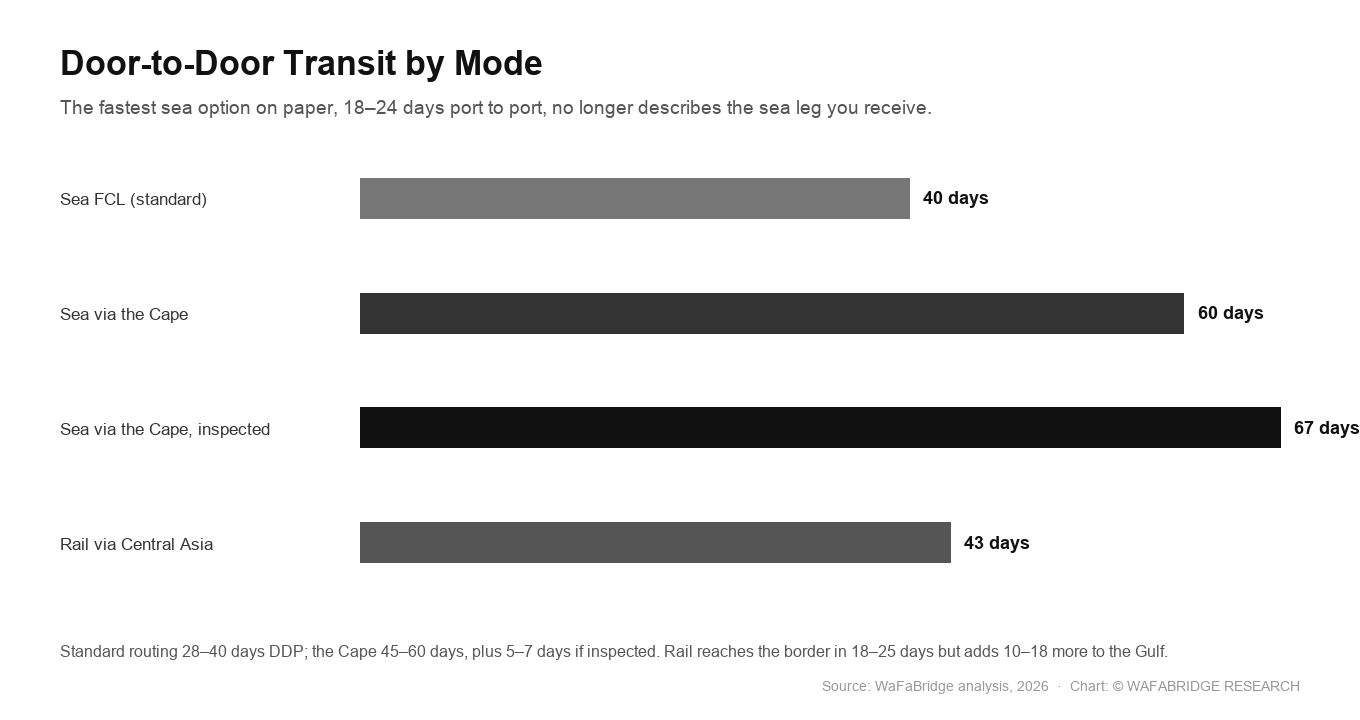
The chart above sets the door-to-door figures against the port-to-port ones, because the fastest sea option on paper no longer describes the sea leg you receive.
The New Geography: Khor Fakkan, Fujairah and the Bonded Land Bridge
The sea leg changes least. The queue and the land bridge are where the weeks go.
Where the delay actually happens on the rerouted lane
-
Book
Booking confirmed
Space and surcharge locked at booking
-
Export
China export clearance
Customs release at origin
-
Load
On board
The date the clock really starts
-
Transship
Singapore or Tanjung Pelepas
Second vessel, second schedule
-
Gateway
Khor Fakkan or Fujairah
Transshipment queue, the usual delay
-
Land bridge
Bonded road to Dubai
Hatta green channel, customs again
-
Declare
FASAH declaration
Filed before the goods arrive
-
Deliver
Final delivery
Last mile to the buyer
The viewpoint this chart carries: The chart maps the handoffs, and the number of handoffs is the finding. A rerouted China–Saudi shipment now passes through a chain of custody points — export declaration in China, loading, transshipment at Singapore or Tanjung Pelepas, transshipment again at Khor Fakkan or Fujairah, bonded road haulage, green channel entry at Hatta, FASAH declaration, customs clearance, then final delivery — and each point is where a container can be held, re-examined or sit. Count how many parties can add days to your delivery, then budget waiting days at each rather than treating transit as a single number.
When a service can no longer use the Red Sea, the Asian–Gulf routing reorganises around the north-western Indian Ocean. Khor Fakkan and Fujairah are the two anchors. Both sit outside the Strait of Hormuz on the Gulf of Oman side, which is why they work for rerouted services: a vessel can call there without entering the strait. Sohar in Oman offers the same logic with a smaller port and a shorter haul into Saudi. The reroute pushed the middle of the chain to the UAE, and that is why a large share of China cargo bound for Saudi Arabia now passes through the Emirates first.
Most China–UAE cargo follows this pattern: transship at Khor Fakkan or Fujairah, then move bonded by road and enter through the green channel at Hatta into Dubai, under the arrangements described in Dubai Customs Notices 03/2026 and 06/2026. The bonded land bridge is the part most buyers do not understand. Cargo discharged in the UAE can move by truck under bond without entering general UAE free circulation, wait in a bonded facility if the Saudi paperwork is not ready, and only then be declared into Saudi customs. That is valuable when clearance hours are short, and it means the delivery date can be managed on land rather than on water, provided the arrangement is in place before the vessel sails. Our background on how the disruption reshaped Jebel Ali flows covers the detail.
The planning consequence is that the sea leg and the land leg run on different clocks, managed by different parties. The ocean leg is set by sailing rotation and transshipment connection. The land leg is set by green channel capacity, bonded facility space and the Saudi declaration. A buyer who treats the booking date as the delivery date will be wrong on a lane where the last 30% of the journey is a road move. The date to protect is the appointment at the Saudi border, set earlier than the vessel arrival because the truck slot has to exist before the container does.
Jeddah, Dammam and Jebel Ali: Choosing the Right Gateway
| Jebel Ali (Dubai) | Jeddah (Red Sea) | Dammam (Persian Gulf) | |
|---|---|---|---|
| Typical routing | Via Khor Fakkan or Fujairah, then bonded road | Around the Cape | Persian Gulf routing, varies by service |
| Surcharge stack | Ocean, war risk, peak season, transshipment, road, green channel, delivery | Ocean, war risk, peak season, Saudi local charges | Ocean, war risk, peak season, Saudi local charges |
| Clearance route | FASAH plus Dubai green channel | Saudi direct clearance | Saudi direct clearance |
| Overland to Riyadh | About 1.5 to 2 hours from Jebel Ali to Dubai, then inland | Jeddah to Riyadh is close to 1,000 km, one to two days by road | About one day by road |
| Best for | Multi-country orders, consolidation and split delivery | Riyadh and the western region | The eastern region and Kuwait direction |
The viewpoint this chart carries: The three gateways are not interchangeable, and the differences show up in inland days and surcharge lines rather than in the port name. The chart sets them side by side on rerouting, surcharges, clearance, inland distance and the cargo each suits. Choose on total inland days rather than on which port your forwarder mentions first, and check how many days the container waits for paperwork on the far side of the border. The row that decides most decisions is the inland leg: for Riyadh, Jebel Ali is 1.5–2 hours by road with inland charged separately, Jeddah is near 1,000 km at about 1–2 days, and Dammam is about a day.
Jeddah is the Red Sea port; with the Red Sea closed to most services it now receives cargo that has travelled the long way round, which makes it reasonable for western destinations only when the routing still works. Dammam on the Persian Gulf serves the eastern corridor and can, on certain routings, be reached without the Cape detour. Jebel Ali is the transshipment hub: most of its China services now arrive via Khor Fakkan or Fujairah, so the cargo is already in the UAE when it reaches the Saudi border. Multi-country consolidation is where Jebel Ali earns its surcharge stack: one inbound movement can serve Dubai, Riyadh and a second GCC destination without a second crossing.
For Saudi-only cargo, the calculation is narrower. A Jeddah gateway adds one and a half to two days of road transit to Riyadh on top of the sea leg, charged separately from the ocean freight. A Dammam gateway suits eastern Saudi and Kuwait but is not the default for Riyadh or Jeddah. A Jebel Ali gateway means the cargo is in the UAE before it is in Saudi, so declaration and green channel work happen in sequence rather than in parallel with the discharge, and the number of customs handoffs goes up. That is acceptable when cargo is consolidated across destinations, and a cost to count rather than absorb otherwise.
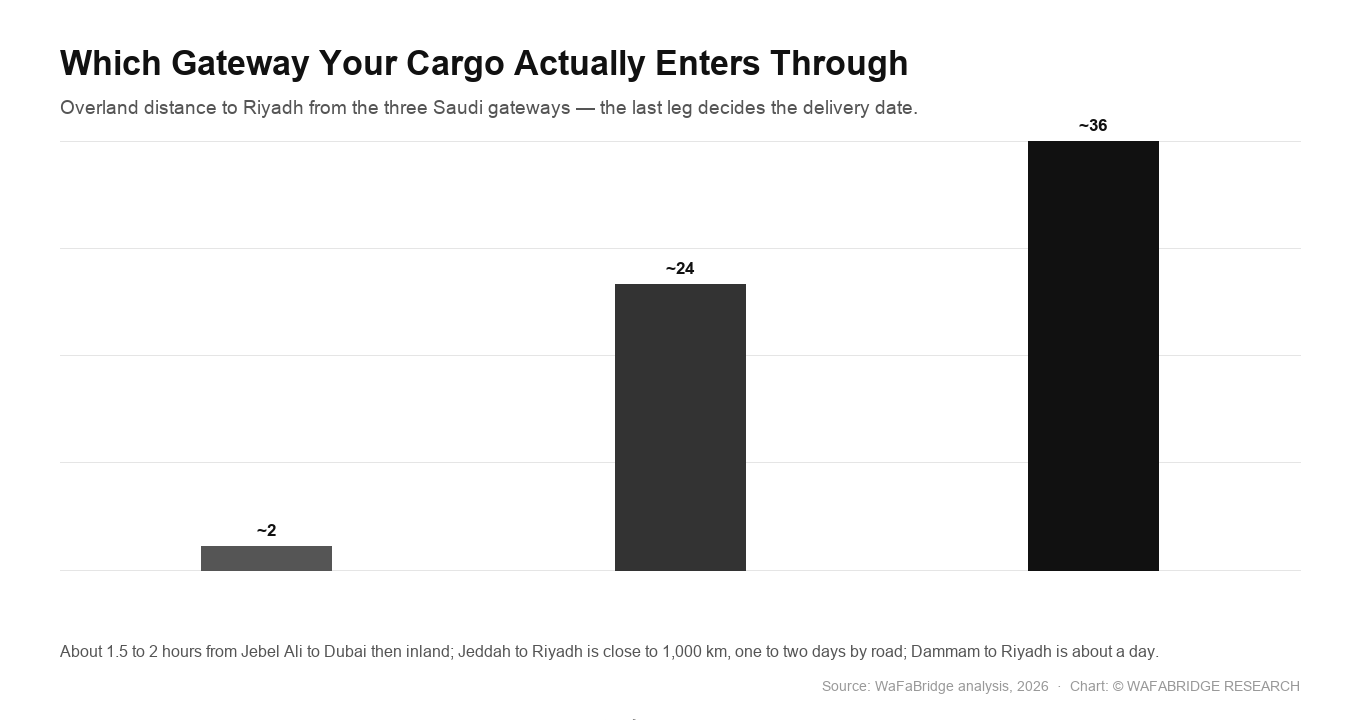
The chart above is the last leg of each gateway, and it is the part that decides the delivery date rather than the sailing date.
Surcharges That Decide Your Invoice
On a rerouted lane, ocean freight is no longer where the money sits. The invoice is decided in the surcharge stack, which is why line-by-line comparison matters. The items to insist on seeing separately are these: base ocean freight; war risk surcharge, quoted as a percentage of vessel value or a fixed sum per container; peak season or congestion surcharge; transshipment handling, charged once per point; the UAE or Saudi local charges at the gateway; the green channel or bonded facility fee if the cargo moves under bond; inland road haulage; and last-mile delivery. A quote that bundles these into a single shipping line is not comparable to one that itemises them.
Two further lines deserve attention. Demurrage and detention are not surcharges, but they behave like them, and a rerouted sailing into a congested port is exactly when free time runs out before the paperwork does. Detention at the origin is the mirror problem: a container that cannot be loaded on the booked vessel because it was not ready sits at the Chinese terminal while the booking ages. Both are avoidable, and only if you ask before booking. Rerouting also changes the transshipment count, and because handling is charged once per point, a second leg adds a charge a quote written on an old routing may not show.
How to Read a Quote That Looks Too Good
When a China–Saudi quote comes back materially under the published range for that mode, the reason is almost always in the exclusions..
First, the transit time. If the quote says 18–24 days port to point, ask whether it assumes a Red Sea routing. If it says door-to-door DDP at 28–40 days, ask which gateway the cargo enters through, and whether a service currently calls there. Second, the war risk surcharge. A quote with no war risk line on a rerouted lane is either using a pre-conflict rate or treating the cargo as outside the affected trade, and both need explaining. Third, the customs line. “Customs clearance included” often means duty and VAT are excluded and billed on arrival, which moves your cash position without changing the invoice total. Fourth, the inland leg, particularly for Jeddah, where the road move to Riyadh is a genuine day and a half rather than a formality. And fifth, the validity date. Middle East surcharges reprice within weeks, so a quote dated a month ago is a historical document.
That last point is why the habit is to re-quote immediately before booking and record the quote validity in your own calendar. Ask your forwarder to state in writing the sailing the price is based on and how long it is held, then compare the full stack against a second quote itemised the same way. Two quotes that both say “all in” are not comparable, and neither is a rate card that omits which surcharges are included.
How We Run a Rerouted Lane Day to Day
The reroute is not a single event a buyer absorbs once. It changes the work at every stage, and most of it is coordination, not negotiation.
Routing and booking. We confirm which service actually calls at the gateway that suits your destination before booking, rather than accepting a routing that adds a transshipment the cargo does not need. On a lane where the sailing rotation and the transshipment connection both determine the arrival, the booking sequence matters as much as the rate. Capacity is confirmed four weeks ahead on the lanes that tighten around the Eid rush, and the booking note records sailing, routing and quote validity together, so an expired price is visible before use.
Consolidation and bonded storage. Where cargo moves under bond through the UAE, the bonded facility arrangement has to exist before the vessel sails. That is the most common failure point on this lane: a container that arrives without a confirmed bonded arrangement cannot move inland on schedule and waits for paperwork nobody has produced. We prepare the Saudi declaration set and the bonded movement instruction in the same window as the commercial documents, and keep the cargo in one consolidated consignment where the volume allows, so the green channel entry is one movement with one document pack.
Clearance and the delivery appointment. The delivery appointment at the Saudi border is booked against the inland plan rather than the vessel arrival, because the truck slot has to exist before the container does. We sequence the work this way: discharge at the gateway, bonded move, green channel entry at Hatta, FASAH declaration and clearance, then the final delivery leg. Each step depends on the one before, and an appointment renegotiated in peak season means waiting for the next slot rather than a same-day fix.
Handling the delay when it happens. When a sailing rolls or a container is held for inspection, the decision is whether to move it through a second gateway, split the load, or send part by air. We make that call against the sell-through date rather than the freight rate, because the goods have to arrive on the day a buyer can sell them. Our air versus sea comparison for Gulf DDP sets out the criteria, and where a delay comes from a routing constraint rather than documentation, sea-air on a shortened routing is usually the cleanest recovery.
Worked Example: One USD 120,000 Container, Three Routing Options
The clearest way to see what the reroute costs is to hold the cargo and the value constant and change only the routing. The example uses a single container of general merchandise with a goods value of USD 120,000 moving China to Riyadh. No freight rate is shown, because published ranges for this lane contradict each other; what the table measures is how much of the buyer’s money is tied up in cargo in transit. The routing days come from the transit table above.
| Line | Standard routing | Via the Cape | Via the Cape, inspected |
|---|---|---|---|
| Goods value (USD) | 120,000 | 120,000 | 120,000 |
| Door-to-door transit | 28–40 days | 45–60 days | 50–67 days |
| Extra days against the standard routing | Baseline | +5 to +32 days | +10 to +39 days |
| Goods value in transit (USD × days) | 3,360,000 – 4,800,000 | 5,400,000 – 7,200,000 | 6,000,000 – 8,040,000 |
| Additional USD-days of tied-up capital | Baseline | 2,040,000 – 2,400,000 | 2,640,000 – 3,240,000 |
| Ocean freight effect of the May 2026 collective increase | +30% to +50% if re-routed | +30% to +50% | +30% to +50% |
| Clearance method | Direct in the Saudi zone | Bonded road move, Hatta green channel, FASAH | Bonded road move, Hatta green channel, FASAH, inspection |
| Cost of delay not visible in the freight quote | — | USD 2.04m–2.40m of extra goods value in transit | USD 2.64m–3.24m, plus 5–7 days of inspection |
Read the USD-days row as working capital rather than a charge. The same USD 120,000 of goods sits in the supply chain for 28–40 days on the standard routing and 45–60 days on the Cape routing, which is 2.04m to 2.40m additional USD-days of tied-up value before a single extra dollar of freight is counted. If the container is then inspected, the figure rises to 2.64m–3.24m USD-days. For a distributor whose next purchase order falls due before the first sells down, that is the number that decides whether the routing is affordable, and it never appears on the freight invoice.
The freight row carries the other half of the cost, and the reason a rerouted quote is hard to compare. The May 2026 collective increase of 30–50% applies on the affected trades whichever routing you use, so the absolute rate decides whether the stack is tolerable, not the percentage on its own. Two things decide whether the stack works. The first is whether the quote itemises war risk, peak and transshipment handling separately, because a service with one more transshipment point carries one more handling charge a legacy quote may not show. The second is whether it names the gateway and the green channel movement, because a delivery date that depends on a bonded facility cannot be committed until the facility is confirmed. If the quote cannot be made comparable on those points, the number on it is not one you can plan against.
One caution on the table. The transit days are planning ranges for the lane rather than measured outcomes on your cargo, and the USD-day figures are the arithmetic consequence of those ranges applied to the order value. The method is what transfers: fix the cargo value, pull the days for each routing, multiply, and the difference between the columns is what the delay costs before you add freight, duty and VAT.
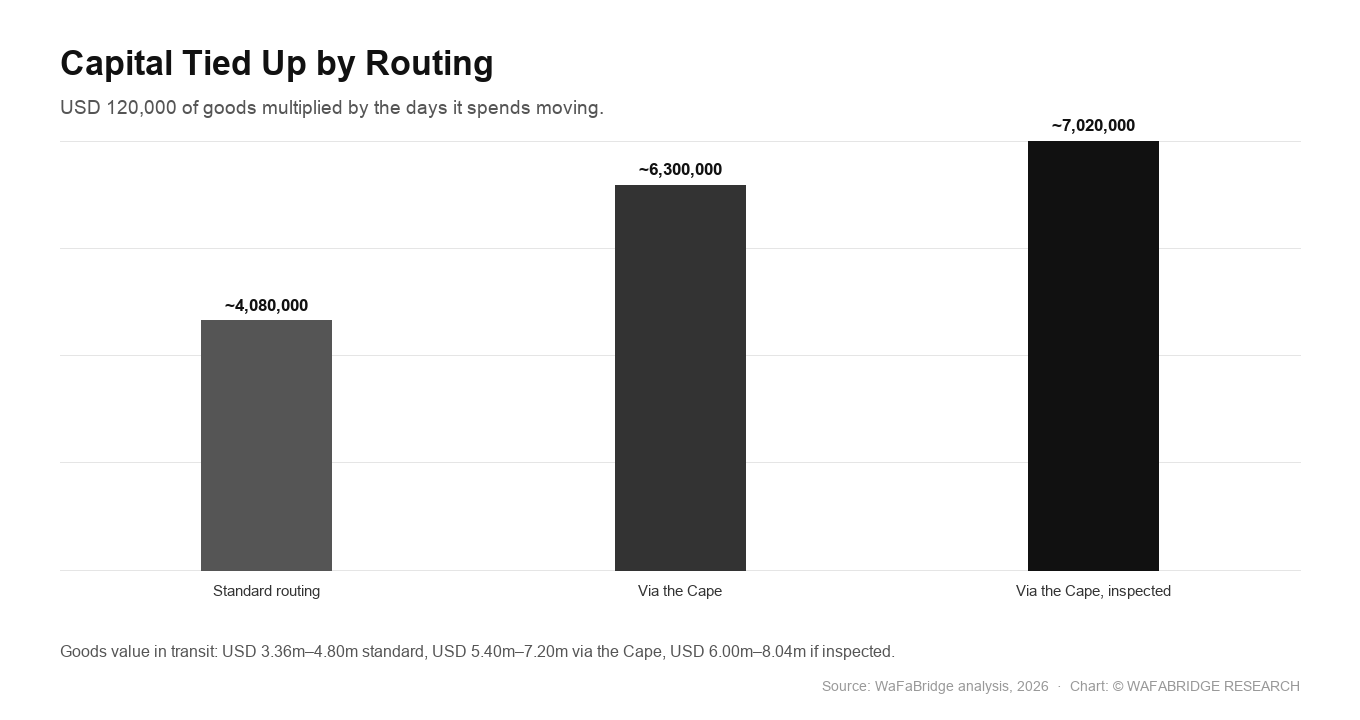
The chart above holds the cargo and the value constant and changes only the routing, because that is the variable a buyer can still move.
FAQ: Questions Buyers Ask About the Reroute
How much longer does shipping from China to Saudi Arabia take now?
Door-to-door DDP on a Cape-routed service runs 45–60 days, against 28–40 on the standard routing, with a further 5–7 days if the container is inspected. The at-sea leg alone is 38–48 days, 10–14 days longer than a Suez passage would have added. Air freight at 6–12 days remains the fastest option when the date cannot move.
Which gateway does my cargo actually enter Saudi Arabia through?
On most China–Saudi services the cargo transships at Khor Fakkan or Fujairah, moves bonded by road, and enters through the green channel at Hatta into Dubai before declaration into Saudi, under Dubai Customs Notices 03/2026 and 06/2026. Ask which gateway the cargo enters through rather than which port the vessel departed, because it determines the inland leg and the number of customs handoffs.
Is the 30–50% rate increase permanent, or will it come back down?
It is a carrier decision taken collectively in May 2026 across four lines, and it moves with the security situation rather than with seasonality. We do not publish lane rates or war risk percentages, because the sources contradict each other, and the only figure that binds you is the carrier’s quote for your sailing. Re-quote before booking and check the validity date.
Should I split my shipment into two consignments?
Splitting makes sense when a single held container would hold the whole order, when the category is seasonal, or when one inspection risk would otherwise apply to everything on the lane. The consolidation saving is real but bounded, while the cost of one missed season is not. Where the delay comes from documentation rather than routing, splitting does not help.
Does rail through Central Asia beat the Cape?
No. The rail option runs 18–25 days to the Central Asian border plus 10–18 onward to the Gulf, roughly five weeks to a month and a half against 45–60 days for a Cape-routed door-to-door DDP movement, and it adds border transits rather than removing them. It prices a different risk rather than a faster route, and is worth evaluating only when the security profile of the sea lane rules out alternatives.
Send us your routing, the cargo split and the delivery dates you need to hit, and we will build the gateway options, transit assumptions and full surcharge stack in one comparable view. Talk to the WafaBridge team for a lane plan before you book the sailing, or run the numbers through the landed cost calculator.
Sources
- Lloyd’s List — shipping intelligence on Red Sea routing decisions, carrier suspensions and Asia–Gulf service changes.
- Dubai Customs — Notices 03/2026 and 06/2026 on the green channel and bonded movement procedures for cargo entering through Hatta.
- ZATCA (Saudi Arabia) — Saudi customs and FASAH requirements on the Saudi side of the border, including import and clearance procedure.
- Transit ranges are planning figures for the lane rather than measured outcomes on a named sailing. No container freight rate or war risk percentage is quoted, because published sources conflict and the carrier’s quote for your sailing date is binding.