Composite cases in this article are drawn from consignments we handle on the Guangzhou–Gulf corridor; names and figures are changed, the mechanics are not.
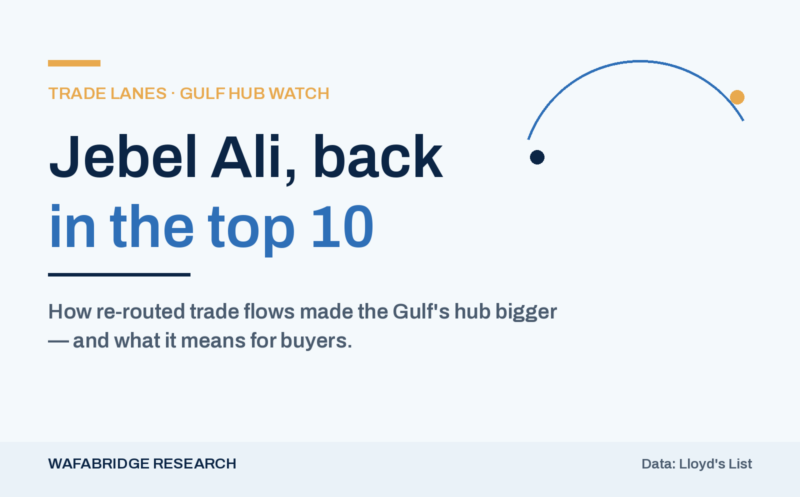
The Red Sea crisis rerouted global shipping around the Cape of Good Hope, added 10–14 days to Asia–Europe transits, and pushed displaced volume and feeder traffic into the Gulf’s hub — Jebel Ali absorbed the shift and handled about 15.5 million TEU in 2024, up roughly 7% and back inside the global top ten. For buyers on the China–Gulf lane, the story is not the geopolitics. It is what a bigger, busier hub does to their schedule, their space and their price.
The week the maps changed
In late 2023, commercial vessels began avoiding the Bab el-Mandeb Strait and the Suez Canal — the shortcut that carries the majority of container traffic between Asia and Europe — after attacks on shipping in the Red Sea corridor. The alternative was geography’s old answer: sail around Africa. Roughly 3,500 extra nautical miles, ten to fourteen additional days per Europe-bound voyage, and a global container system that had spent two decades optimising around Suez suddenly re-planning at once.
The China–Gulf lane sits inside this story in a way that is easy to misread. The direct China–Gulf services largely kept running — the Gulf is not Europe, and the western Indian Ocean approach remained workable with security adjustments. What changed around the Gulf was everything that connects to the lane: Europe services that used to transit Suez now sailing the long way; the Gulf’s own feeder and transhipment patterns adjusting; carriers re-deploying vessels; and above all, schedules that had been reliable for years turning variable in a season.
Our buyer files tell the operational story better than the news did. A Kuwait trader — call her Huda — had a replenishment cycle she could set a watch by: Guangzhou consolidation, 21 days to Kuwait, customs, done, for three consecutive years. From early 2024, the same cycle ran 24 days, then 19, then 27, then 22 — the ocean itself still worked, but the variance had doubled. Nothing about her goods had changed. The map around them had.
The hub that grew
Here is where Jebel Ali enters, and why a Dubai port deserves its own article in a series about buying from China.
When long-haul schedules turned unreliable, the container system did what it always does under stress: it consolidated into hubs. Carriers needed flexible points where cargo could be re-worked, transhipped and re-timed without waiting for the next long-haul string. The Gulf already had one of the world’s great machines for exactly this — Jebel Ali, purpose-built as a transhipment hub, sitting at the junction of Asia, Europe and Africa trades with dozens of weekly feeder connections into the Gulf states, the Red Sea, East Africa and the Subcontinent.
Through 2024 the traffic came. Jebel Ali handled approximately 15.5 million TEU for the year — up about 7% on 2023’s 14.5 million, recovering fully from the dip years and returning the port to the global top ten by throughput, per Lloyd’s List data. Growth like that during a global shipping crisis is not luck. It is the market choosing a reliable node when the network around it wobbles.

The context matters as much as the number. The Gulf’s trade with China was hitting records in the same period — $161.2 billion of GCC imports from China in 2024, up 15.5% in a year, per GCC Statistics Center data. The hub’s growth is not a statistical accident; it is the containerisation of that trade wave, landing on one se s from China, 2017–2024″ src=”https://wafabridge.com/wp-content/uploads/2026/11/chart-b1-gcc-china.png” />
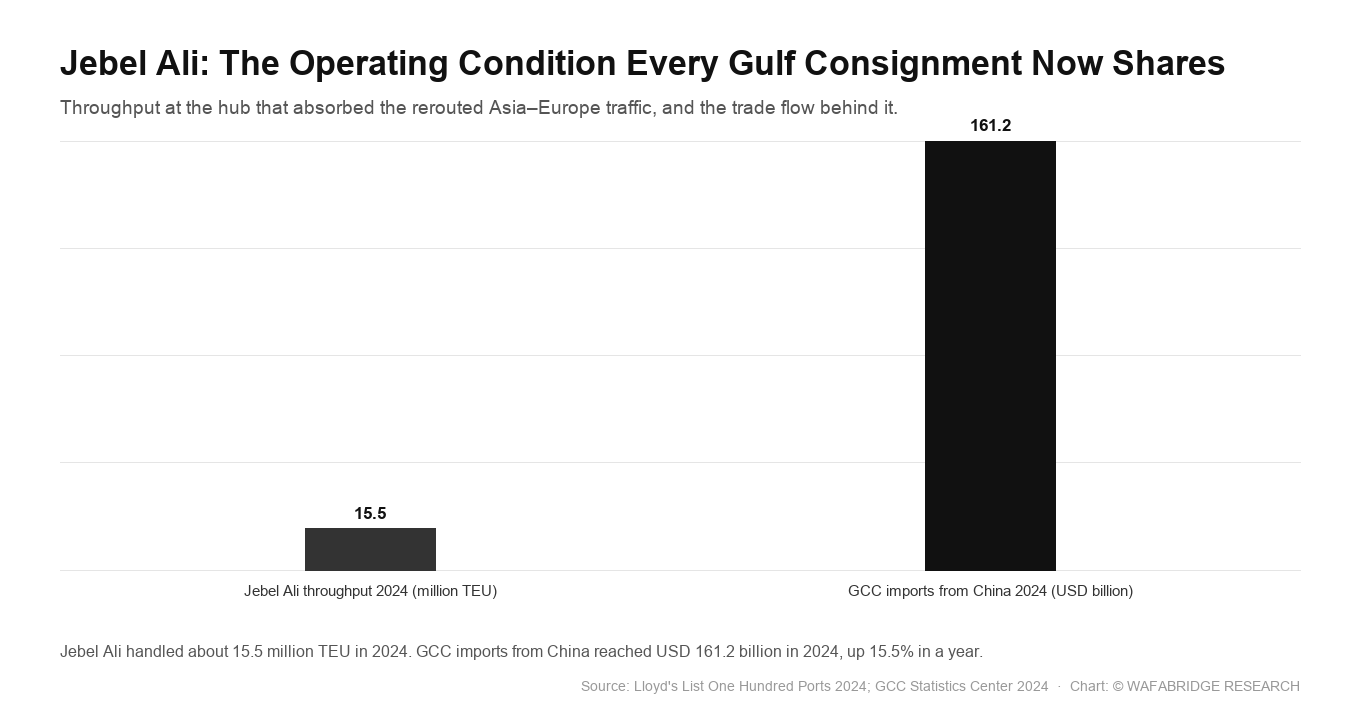
The chart above puts the hub’s throughput next to the trade volume it carries, because both are now the operating condition every Gulf consignment shares.
What a bigger hub means for your carton
A busier Jebel Ali sounds like a technical story. For a buyer shipping from China, it lands in four very practical places.
Schedule variance is the new normal. The direct lane to the Gulf mostly ran — but the ecosystem around it re-timed. Vessel strings were re-deployed, port calls re-sequenced, feeder connections re-cut. A buyer who memorised “21 days” in 2023 is calibrating against a dead number; the honest 2024–2026 baseline is a range, wider than before, and quotations that pretend otherwise are selling certainty nobody can deliver.
Hub capacity is shared capacity. Every extra TEU of displaced or transhipped cargo through Jebel Ali competes for the same cranes, yards and feeder slots as your consignment. Through the crunch windows — pre-Eid above all — the hub’s congestion pricing transmits directly into Gulf freight rates and into the space crunch we describe in the Eid calendar article. The hub’s strength is the region’s strength; its queues are the region’s queues.
The hub is also the region’s insurance. The other side of concentration: when a Gulf-bound direct service is late, the feeder network out of Jebel Ali is how the region’s smaller markets — Kuwait, Qatar, Oman, Bahrain, up the Red Sea — stay supplied. A strong hub converts a long-haul miss into a week of delay; a weak one converts it into a stockout. Buyers in the smaller GCC markets have, in effect, been riding Jebel Ali’s resilience for years, and the crisis period proved the design.
Rates move with the map, not with your carton. The rerouting absorbed vessels, stretched effective capacity (each Europe round voyage now consumed ~15% more ship-time), and repriced the entire Asia–MENA rate structure. Your China–Gulf quote in any given quarter is downstream of a map you cannot influence — which is why we re-quote rather than assume, and why standing freight assumptions on this corridor have a shelf life measured in weeks during disruption.
How the hub reshapes sourcing decisions
The hub’s rise is usually written as a shipping story, but its deepest effects show up in sourcing decisions — where Gulf buyers buy, how they consolidate, and what they hold. Three shifts are worth naming.
First, the hub rewards consolidation density. When schedules wobble, the buyer whose order is one well-packed consolidation moving through one hub connection absorbs variance far better than the buyer whose order is twelve scattered parcels negotiating the network independently. The Guangzhou warehouse model — many suppliers, one address, one engineered shipment — is not merely a cost play; it is variance insurance, and a busier hub raises its value.
Second, the hub changes what “local” means. A buyer in Kuwait or Qatar choosing between suppliers in China is, operationally, choosing between different hub routings — different transhipment patterns, different feeder connections, different exposure to the same congestion. Two factories an hour apart in Guangdong can reach the Gulf on different strings with different reliability records. The corridor’s best buyers now ask freight-reliability questions at supplier-selection time, not after: which port does this factory feed, which string, what did that string’s variance look like this quarter?
Third, the hub makes the Gulf’s inventory geography a real decision. Stock positioned in the UAE — inside the hub’s shadow, with the region’s deepest warehousing and its most flexible re-export rules — can serve the smaller markets on feeder timelines measured in days. Traders increasingly hold the master inventory in Dubai and feed Kuwait, Qatar and Oman from it, accepting the double-handling in exchange for conversion of long-haul variance into short-haul certainty. That trade — days of certainty bought with a handling fee — is exactly the trade the hub’s growth makes cheap, and it is redrawing where the region’s stock physically lives.
The other gateway: what the crisis did to Jeddah
The hub story risks flattening the region into one port, and the Red Sea coast deserves its own line on the map — because the crisis touched its gateways differently. Jeddah Islamic Port, the Kingdom’s primary container gateway, sits at the mouth of the waterway the crisis closed; its direct China services adjusted as the Gulf’s did, but its context changed more: Suez transits — which Jeddah historically serviced as the Red Sea’s last-call port for Europe-bound feeders — collapsed, and the port’s role in the regional network re-cut around the new geography.
For buyers, the practical reading is about redundancy. The Gulf’s inbound system now runs on two distinct gateways with distinct risk profiles: the eastern hub, whose exposure is congestion and feeder timing, and the Red Sea coast, whose exposure is the security condition of the waterway at its door. A consignment routed through one carries that gateway’s risk alone; the corridor’s professional practice — visible in how forwarders quote and how serious traders plan — is to treat the two gateways as complementary levers. Eastern markets default through Jebel Ali; western and central Saudi volume leans on Jeddah; and when either system’s calendar tightens, the other absorbs what it can.
This is also why “which port does my shipment use?” has become a buyer’s question rather than a forwarder’s detail. The gateway determines the feeder pattern, the clearance office, the inland leg’s length and the crunch windows the consignment inherits. Two Saudi-bound quotations with identical delivery promises can carry entirely different risk if one rides the hub and the other rides the coast — and the buyer who knows which is which can match his stock’s urgency to the gateway whose risk profile suits it. In a network that spent two years re-drawing itself, knowing your carton’s gateway is no longer trivia. It is the first line of the risk plan.
The air shadow and the insurance layer
The rerouting’s effects did not stay at sea. Two quieter markets moved with it, and both show up in buyers’ invoices.
The first is the air shadow. When ocean schedules widened, part of the corridor’s traffic decided not to wait: buyers with seasonal exposure, high-margin launches and stockouts pending moved cartons into the air market — and the air market prices marginal demand. Air rates out of South China into the Gulf ran above their pre-crisis baselines through much of the disruption period, not because the airplanes moved, but because the alternative had become less reliable and reliability is what air sells. The standing lesson for buyers: air pricing on this corridor is partly a function of ocean variance. When the sea gets wobblier, the air gets dearer — which is one more reason the standing air option (booked early, at planned rates) beats the panic air option (bought in a stockout, at whatever the market asks that week).
The second is the insurance layer, invisible until quoted. Sailing through or near a designated high-risk area adds war-risk premiums to the vessel’s cost stack — a per-vessel charge that insurers re-price as conditions change, sometimes sharply. The cargo buyer does not see a line called “war risk,” but the premium travels: into the rate the carrier quotes the forwarder, into the rate the forwarder quotes the buyer, spread across every container that shares the string. It is a small percentage that became a permanent resident of Gulf freight pricing during the crisis years, and it is worth knowing it exists — because it explains why a “return to normal” never quite brings rates all the way back, and why two quarters with identical fuel costs can still quote differently.
Reading the hub’s signals
A buyer does not need a shipping intelligence subscription to read this market; the useful signals are public, and the discipline is checking them on a schedule rather than when a shipment is already late. Four are worth building into a quarterly rhythm.
The throughput number. Jebel Ali’s monthly and quarterly TEU figures are published, and their direction is the simplest congestion gauge in the region: sustained growth means busier cranes, tighter feeder slots and the crunch windows arriving earlier than the calendar suggests. The 15.5 million TEU of 2024 is not just a milestone; it is the operating condition every Gulf-bound consignment now shares.
The rate direction, not the rate. Spot freight indices for Asia–Gulf lanes move weekly. The level matters less than the slope: rising spot rates over three consecutive readings mean capacity is tightening ahead, and quotations will shorten their validity windows — book early. Falling rates with soft schedules mean the trough is real — buy the reorders now.
Schedule reliability by string. Carriers publish on-time performance by service loop, and the spread between strings on the same trade is the corridor’s quietest arbitrage: two services into the Gulf can differ by double-digit percentage points on reliability while quoting within a few percent on rate. This is why, at supplier-selection time, the serious buyers now ask which string a factory feeds — and why consolidation through one warehouse, onto the best-performing string, beats scattering cartons across whoever sailed that week.
The event calendar. Eid windows, Chinese New Year, and any active security advisory — each one re-times the network around a date that is known months ahead. The buyers who mark these on the same calendar as their selling seasons are the ones whose stock never negotiates with congestion; the ones who treat logistics dates as the forwarder’s problem rediscover, every year, that they are also the buyer’s problem, priced.
What this means depending on who you are
If you are a Gulf buyer shipping steady replenishment, build the wider variance into your inventory cover rather than into your promises: the buffer that felt generous in 2023 is the new baseline. The buyers hurt most by the crisis period were not those whose goods sailed late — it was those whose reorder points assumed the old ocean.
If you are a smaller-market buyer (Kuwait, Qatar, Oman, the Red Sea ports), understand your dependency honestly: your line runs through the hub, and the hub’s crunch windows are your crunch windows. Book around them — earlier, and with confirmed feeder space rather than “subject to connection” — and treat Jebel Ali congestion news the way farmers treat weather forecasts: as your operating condition.
If you are an e-commerce or seasonal seller, the crisis period’s lesson is structural, not episodic: this corridor now carries permanent variance, and the two levers that neutralise it are mode diversification (air as the standing emergency lever, not a panic purchase) and calendar discipline (our eight-week Eid template exists precisely because the ocean no longer forgives late planning). Neither lever costs money sitting ready. Both cost fortunes absent.
The map redraws; the discipline holds
The Red Sea crisis will end as a chapter — reroutes revert, capacity rebalances, rates normalise, and the map redraws again toward whatever the next disruption is. What does not revert is the structural lesson for buyers on this corridor: the trade runs through a handful of hubs, those hubs are growing because the China–Gulf wave keeps growing, and the system’s variance — not its average — is what separates buyers who keep their promises from buyers who explain their misses. Jebel Ali’s 15.5 million TEU is the region’s strength. Planning as if it were infinite is the region’s oldest mistake.
Routing, schedules and rates respond to security and capacity conditions; confirm current lane status and re-quote before committing, or ask us to plan your consignments against live schedules.
Internal links: DDP Shipping · Air vs Sea · Gulf Eid Calendar · UAE
Sources: Lloyd’s List One Hundred Ports 2024 (Jebel Ali throughput, global ranking); GCC Statistics Center (GCC–China trade 2017–2024); published carrier advisory data on Red Sea rerouting.
Chart: © WAFABRIDGE RESEARCH
Frequently asked questions
Did the Red Sea crisis stop shipping from China to the Gulf?
No. Direct China–Gulf services largely continued with security adjustments; the crisis rerouted most Asia–Europe traffic around the Cape of Good Hope, adding 10–14 days to those lanes. The Gulf felt the crisis mainly through schedule variance, re-deployed capacity and repriced rates — not through a lane closure.
Why did Jebel Ali grow during the disruption?
As schedules turned unreliable, carriers and forwarders consolidated around reliable transhipment hubs. Jebel Ali — purpose-built for transhipment, with dozens of weekly feeder connections across the Gulf, Red Sea and East Africa — absorbed displaced volume and handled about 15.5 million TEU in 2024, up ~7% and back in the global top ten (Lloyd’s List).
Does the Red Sea situation affect my transit time to the Gulf?
Yes, through variance. Direct-lane averages shifted less than Europe lanes, but the network’s re-timing widened the realistic range around any published schedule. Plan inventory cover against a range rather than a single number, and re-quote rather than reuse standing assumptions.
Is shipping through Jebel Ali risky because it’s concentrated?
Concentration cuts both ways. A strong hub means a direct-service miss becomes a feeder delay of days rather than a stockout, and congestion pricing is visible and manageable with early booking. The risk is real in crunch windows — pre-Eid above all — and is managed by booking around them, not by avoiding the hub.
Will rates return to pre-crisis levels?
Rate cycles on this corridor now move with the map — security conditions, capacity absorption, seasonal demand. Rather than waiting for a “normal” that keeps moving, build re-quoting into the buying rhythm and treat standing freight assumptions as having a shelf life of weeks during any active disruption.