Composite cases in this article are drawn from consignments we handle on the Guangzhou–Gulf corridor; names and figures are changed, the mechanics are not.
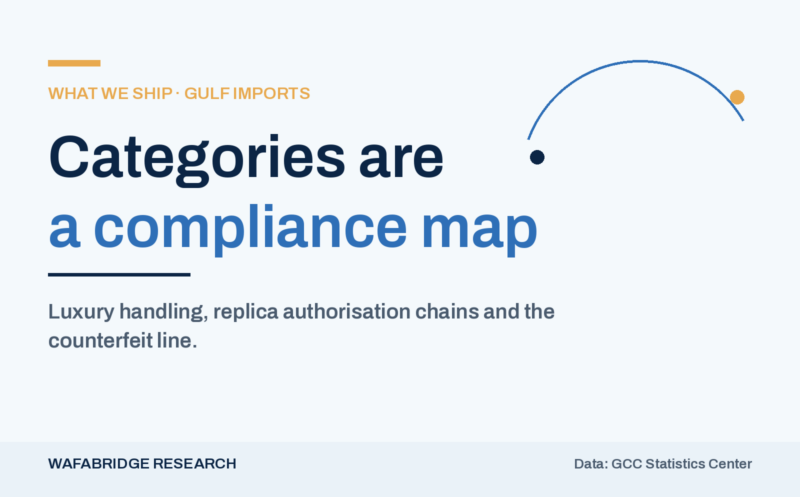
We refuse replica and counterfeit goods outright, and we carry branded luxury only through a documented authorisation chain — not as a moral posture, but because the Gulf’s customs regimes treat both categories as enforcement targets, and a refused carton costs the buyer one order while a seized one costs the buyer the business. Category policy is not a list of rules. It is a map of where the border’s risk actually lives.
The order that was never going to arrive
A new customer — call him Tariq — sent us a 1688 link in his first inquiry: “designer handbags,” listed on the platform at prices that announced exactly what they were. Eleven hundred riyals for a bag that retails in Riyadh for twelve thousand. He was candid about it when we asked, as most buyers are: replicas, high quality, “1:1,” for his Instagram shop. Everyone else ships them, he said. Why won’t you?
The answer is not a paragraph about ethics; it is an arithmetic about risk, and it deserves to be written out, because buyers who understand the arithmetic make better decisions about everything else they ship.
A replica consignment is not cargo with a compliance gap. It is cargo that is contraband by design — its brand, its packaging, its “1:1” claim are precisely what the customs systems of Saudi Arabia and the UAE are trained, resourced and publicly committed to intercept. Both markets run active brand-protection enforcement at the border: Saudi customs operates under an intellectual-property regime with documented seizure and penalty procedures, and the UAE — through Dubai Customs in particular — runs one of the region’s most active anti-counterfeit operations, with brands’ own enforcement teams working directly with customs to flag shipments. The goods are not at risk of being caught. They are on a list.
And the seizure cascade is not symmetric to the upside. When a replica consignment is intercepted, the goods are typically destroyed or forfeited; penalties attach; the importer of record — in a DDP arrangement, the service provider whose licence carried the shipment; in a self-clearance, the buyer — carries the enforcement consequence; and the seller’s channel, the Instagram shop, inherits the reputational version of the same event. Tariq’s upside on the order was perhaps $2,000 of margin. The structure of the downside had no ceiling written on it. That trade — small certain gain against open-ended certain-if-caught loss — is why the answer is no, and why it is not a close call.
The categories, honestly sorted
Category policy on this corridor sorts into four honest tiers, and knowing which tier a product sits in before ordering is most of the compliance game.
Tier one: unrestricted general cargo. The enormous middle of the 1688 catalogue — home goods, textiles, hardware, kitchenware, toys, accessories without brand claims — moves with standard documentation: HS classification, destination conformity where applicable (SABER in Saudi Arabia), and nothing more. This is what the corridor’s volume is made of: the Gulf imported a record $161.2 billion from China in 2024, and the overwhelming share of it is exactly this tier.
Tier two: regulated goods. Electrical products, cosmetics, food-contact items, children’s products, telecom equipment — categories with destination-country technical regulations attached. These ship fine, but only with their conformity routes respected: certification before shipment, HS codes checked against the regulated list, and no assumptions that a product legal in China is shippable anywhere. Our SABER article covers the Saudi machinery in depth; the principle is universal — the border moved inward, and tier two is where it now sits.
Tier three: branded goods with a chain. Genuine branded products — a real watch, an authentic designer bag, branded electronics — are not contraband; they are goods whose provenance must be provable. The operative concept is the authorisation chain: documentation connecting the goods to a legitimate supply source — an authorised distributor invoice, a brand authorisation, purchase records that survive scrutiny. We carry branded luxury under exactly this discipline: the chain is verified before the goods are accepted, the goods travel as what they are, declared at their real description and value, and the paperwork shows the goods are what the box says. What we decline is not the category but the absence — branded goods whose source cannot be documented, which in practice means goods whose authenticity exists only as a claim.
Tier four: refused outright. Replicas and counterfeits in all their spelling variants (“1:1,” “mirror quality,” “dupe,” “high version”) — plus the small list of things no responsible corridor service touches: prohibited items by destination law, and goods whose declaration would require falsifying either description or value. The refusal is absolute and non-negotiable, for the arithmetic Tariq met above.

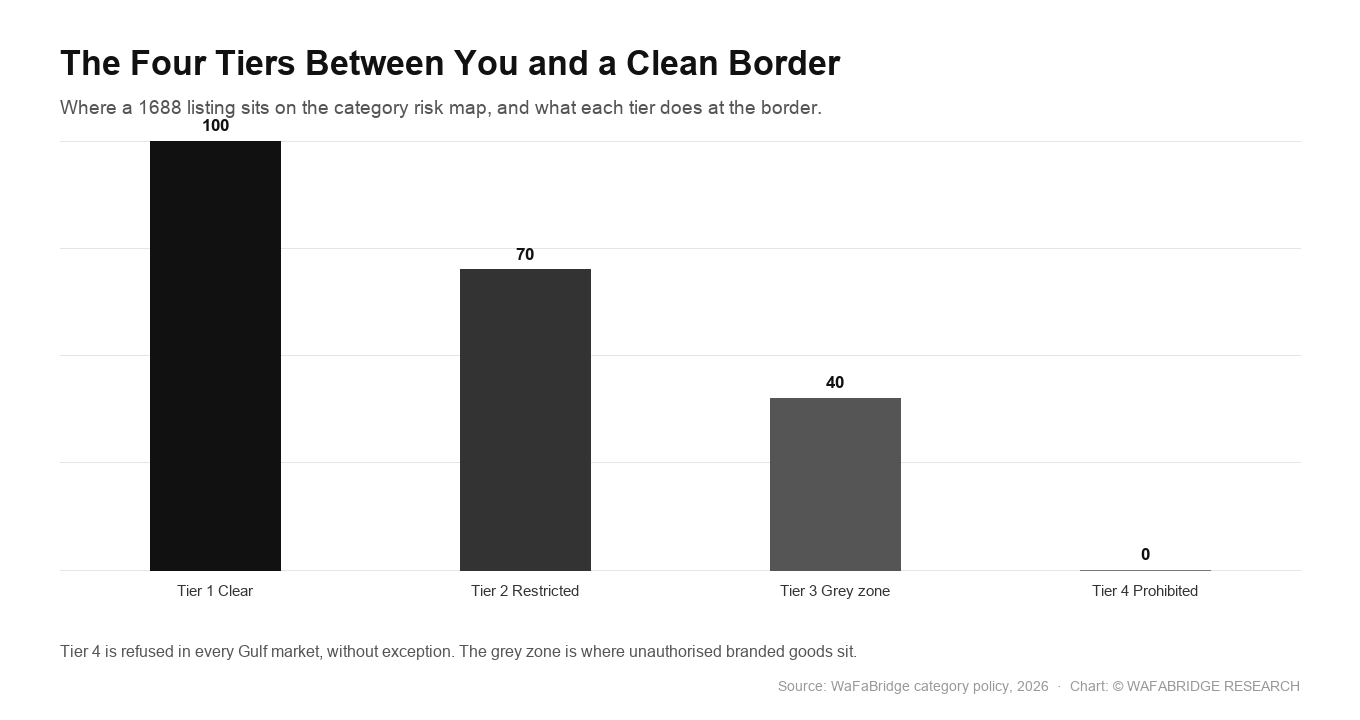
The chart above is the tier map. It is worth reading before you read a supplier’s answer, because the answer usually names a tier without saying so.
The grey zone that isn’t
Every corridor has its evangelists for the workaround — the “unbranded packaging” trick, the “split the branded items across cartons” trick, the “declare it as generic” trick. They should be priced, not moralised, because each one has the same architecture: a compliance fiction that converts a tier-three or tier-four good into a tier-one declaration, while the physical goods remain what they are.
The fiction fails at the exact point it is needed. Unbranded packaging does not change the brand inside when the carton is opened at inspection — and branded goods from unauthorised channels are precisely what inspection targets. Split consignments do not change the enforcement data model, which works on importer patterns, supplier patterns and route patterns rather than on single-carton luck. And a false declaration is not a paperwork infraction that resolves with a fee: it is the category of offence that converts a shipment problem into a legal problem, attaches to the importer of record, and closes accounts — ours, and more importantly, the buyer’s future shipments — while it is being resolved.
The deeper point for a DDP service is structural: our importer capability, our customs relationships and our inspection records exist to carry legitimate commerce across a border efficiently. Every grey-zone consignment added to that pipeline puts the infrastructure itself — the licence, the lanes, the trust — at risk for every other customer using it. A responsible operator declines not only because the individual shipment is a bad bet, but because the pipeline is the product, and the pipeline only works if what flows through it is clean.
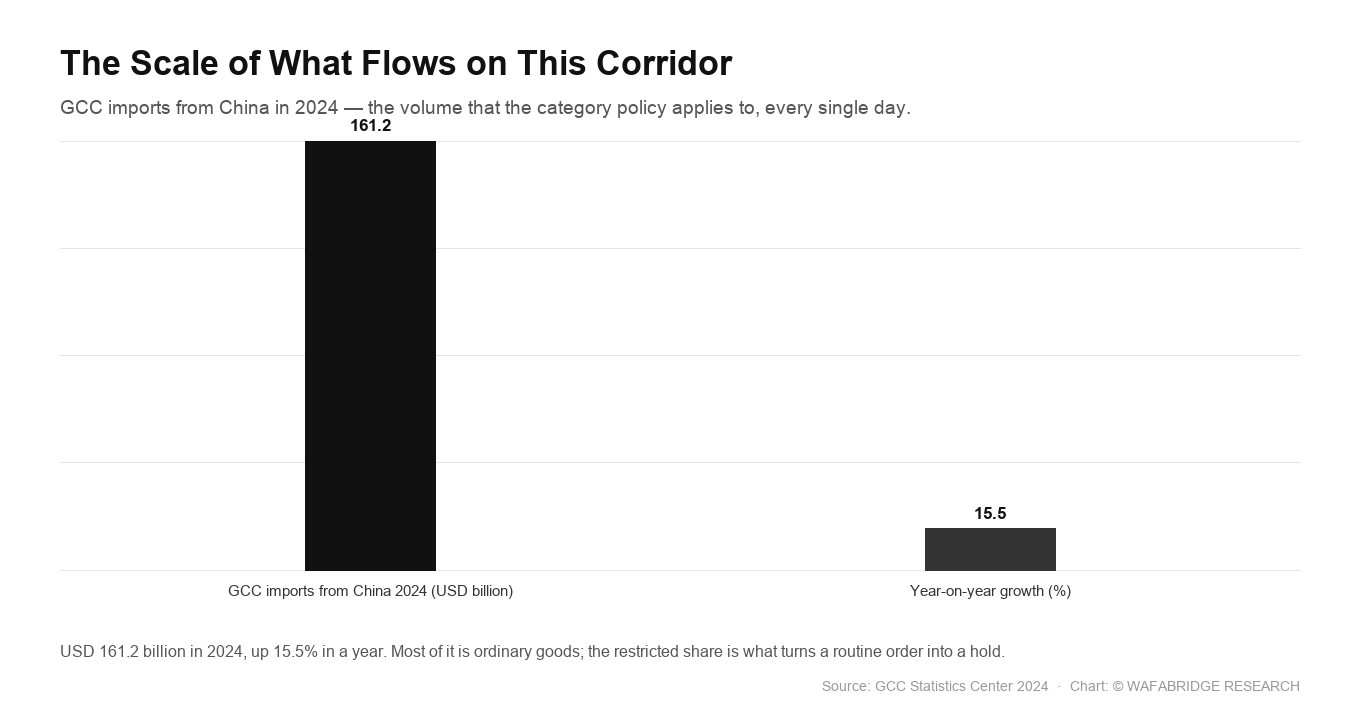
The chart above is the scale of what moves on this corridor. Most of it is ordinary goods; the restricted share is what turns a routine order into a hold.
What this means depending on who you are
If you are a general-cargo buyer — the tier-one majority — category policy is mostly reassurance: your goods are nowhere near the border’s risk map, and the policy exists to keep it that way for everyone sharing the lanes. Your obligations are the ordinary ones: accurate descriptions, real values, conformity routes where your product family requires them.
If you are a branded-goods trader buying authentic stock from Chinese authorised channels — official brand stores, authorised distributors — the authorisation chain is not a hurdle but your asset: it is what distinguishes your goods from the grey market’s, at the border and in your customers’ hands. Keep the chain papered from day one; a provenance file built over time is worth more than any single invoice, and it is the difference between tier three and the grey zone in the eyes of every customs officer you will never meet.
If you are tempted by the replica market, the useful framing is not “will I get caught this time” but the cascade: goods forfeited, penalties attaching to the importer, the channel’s reputation — and, for anyone building a real business, the fact that the entire operation now rests on a supply chain that cannot be audited, insured, scaled or defended. The margins that look fat in a replica price list are the compensation for carrying exactly that. The corridor’s legitimate infrastructure exists so you don’t have to.
What the border actually does with these categories
It is worth being concrete about how the enforcement machine works, because “customs checks brands” undersells both its reach and its selectivity. The Gulf’s regimes do not inspect all cargo for counterfeits equally; they profile. Brand-protection units work from risk models fed by rights holders — the brands’ own enforcement teams file records of known counterfeit sources, routes, consignee patterns and declaration styles, and customs applies that intelligence to select which containers open. A consignment of unbranded kitchenware from an established exporter pattern rarely warrants a second look. A consignment whose profile — supplier, product family, destination, declaration language — matches a known counterfeit pattern gets opened almost as a formality.
This selectivity is precisely why the grey-zone tricks fail: they alter the declaration, not the profile. Splitting a branded order across cartons doesn’t change that the supplier is a known replica source; “unbranded packaging” doesn’t change the model number inside. And when a profiled carton is opened and the contents confirm the pattern, the consequence chain is documented procedure, not improvisation: seizure, destruction under supervision, penalty assessment against the importer of record, and — for repeat patterns — the escalation that turns a shipment problem into a trading-permission problem. The buyer imagining a lucky draw should picture instead a system that has already seen this exact shipment shape a thousand times.
Category policy as buyer protection
There is a reading of category policy that buyers discover only after their first year on the corridor: the refusal list protects them more than it protects the carrier. Consider what the policy filters out on the buyer’s behalf. The supplier whose “designer” goods would have embroiled the buyer’s name in an enforcement file — filtered at the inquiry stage, before money moved. The electrical product whose conformity paperwork would have failed at the Saudi border — routed to certification before the deposit, when it costs weeks instead of the shipment. The “great price” on branded electronics with no source chain — the single most common profile of goods that were never what the listing claimed, at any price.
On a corridor where the buyer cannot see the factory, touch the goods or question the inspector, the policy functions as a pre-commitment device: it binds the service to a standard that is expensive to keep and impossible to fake selectively. A buying service that ships everything advertises only its prices. One that refuses, documents and verifies is telling you something no quotation can: that its lanes are clean enough to survive scrutiny — which, in the long arithmetic of this trade, is the feature every other term depends on.
How to read a supplier’s answer
Between the tiers sits a skill most first-time buyers never learn: reading what a 1688 supplier’s answers mean about category risk. The platform’s sellers are not compliance officers, and they answer the questions they wish they were asked. Three conversational patterns are worth learning before the first deposit.
The listing’s vocabulary is the first document. “1:1,” “high version,” “export quality,” “OEM welcome” — each phrase carries a position on the tier map. “Export quality” from a factory with its own brand and test reports is usually tier one or two with a conformity path. “1:1” and “mirror” are tier four wearing a costume. “OEM/ODM welcome” is genuinely useful — it signals a factory that builds to order and can, with the buyer’s brand and paperwork, produce goods that are legitimately what they claim. The buyer who learns to read listings saves the entire category conversation.
The authorisation question sorts everything. One question, asked plainly — “can you provide a brand authorisation or distributor invoice for these?” — produces the most diagnostic answer in Chinese wholesale trade. A genuine authorised channel answers with documents, sometimes puzzled that anyone asked. A grey-market seller answers with reassurance: “no problem, many customers, very safe” — which is not an answer about the goods; it is a statement about who absorbs the risk, and the answer is you. And a factory that can produce unbranded equivalents of the same item at tier-one compliance is often the best answer of all: same quality, no chain needed, the buyer’s own brand on the box.
The price is a category signal. Genuine branded goods have a floor set by their supply chain; replicas have a floor set by their factory. When a “branded” price sits far below the product’s visible market price, the discount is not negotiation room — it is the market pricing the missing chain. Tariq’s eleven-hundred-riyal handbag was telling him what it was the whole time. The buyers who survive this corridor learn to treat price anomalies in branded categories not as opportunities but as declarations.
What happens to goods the border refuses
The refusal arithmetic in this article deserves its final scene: what physically happens to a consignment the border stops. The outcomes are fewer than buyers imagine, and none of them is good.
Seizure and destruction is the counterfeit path: goods documented into forfeiture, destroyed under supervision, with destruction costs and penalties assessed against the importer of record. Nothing comes back; the photographs in the enforcement file outlive the goods. Re-export is occasionally available for non-counterfeit refusals — regulated goods without certificates, valuation disputes unresolved — but re-export from a Gulf border means paying storage while the option is arranged, paying freight twice, and explaining to a supplier in Guangzhou why the cartons are on a vessel back to origin three months after they left. Abandonment — the quiet third path — happens when the storage bill approaches the goods’ value and the importer of record walks away; the goods are auctioned or destroyed by the port, the penalties stay attached, and the trading history that made future shipments possible is gone with them.
The scene matters because the seizure cascade is usually described in abstractions — “penalties,” “consequences” — that a buyer’s optimism can discount. Concretely: the cartons Tariq would have shipped had a willing operator existed had three possible futures, and in all three the goods were gone, money was lost, and a paper trail attached itself to a name. Against that, the $2,000 of upside he was chasing. There is no version of that ledger worth balancing, which is why the honest operators on this corridor spend their category conversation on the question before the deposit — what tier is this, what chain does it need, can it ship at all — instead of managing the wreckage after it.
The line is the business
Category policy reads, from the outside, as a list of no’s. It is actually one yes with edges: yes to everything the border’s systems are built to process — general cargo, regulated goods with their routes respected, branded goods with their chains documented — and no to the categories that turn the border from a checkpoint into a courtroom. The Gulf’s enforcement of brands and counterfeits is public, resourced and tightening. The buyers who build lasting businesses on this corridor are, without exception, the ones whose cartons never give the border a reason to look twice.
Destination rules and enforcement practice evolve; confirm current restrictions for your specific products and destination, or ask us to check your 1688 links before you order.
Internal links: Cost Calculator · SABER Guide · DDP Shipping · 1688 Buying Agent
Sources: GCC Statistics Center (import composition); Saudi customs and UAE/Dubai Customs published enforcement frameworks on counterfeit goods.
Chart: © WAFABRIDGE RESEARCH
Frequently asked questions
Do you ship replica or “1:1” designer goods to the Gulf?
No — replicas and counterfeits are refused in all variants, without exception. Gulf customs regimes actively enforce brand protection with seizure, penalties and destruction, and the importer of record carries the enforcement consequences. The refusal is arithmetic, not moral: small certain margin against open-ended certain-if-caught loss.
Can I ship authentic branded products from China?
Yes, through the authorisation chain: documentation connecting the goods to a legitimate source — authorised distributor invoices, brand authorisations, verifiable purchase records. The chain is verified before acceptance, goods are declared at true description and value, and the paperwork matches the goods. Branded goods without a documentable source are declined.
What happens if branded goods are shipped without authorisation documents?
They enter the grey zone: at best, a clearance query the goods cannot answer; at worst, seizure, penalties attaching to the importer of record, and loss of the shipment. Because a DDP provider’s licence carries the shipment, responsible providers verify the chain before the goods are accepted — protecting every customer who shares the pipeline.
What are restricted items for Saudi Arabia and the UAE?
Beyond counterfeits: products failing destination technical regulations without certification (SABER in Saudi Arabia, ECAS in the UAE), items prohibited by destination law, and goods requiring falsified declarations. Regulated categories — electronics, cosmetics, food-contact, children’s products — ship fine with their conformity routes completed before shipment.
How do I check if my product can ship before ordering?
Send the 1688 or supplier link before paying: product family, brand status and HS-code family determine the tier in minutes. Checking before the deposit costs nothing; discovering a category problem after production is the most expensive kind of learning on this corridor.