Composite cases in this article are drawn from consignments we handle on the Guangzhou consolidation lane for Gulf and Egyptian buyers; names and figures are changed, the mechanics are not.
Sixty parcels shipped one at a time cost USD 51.50 a piece landed; the same goods consolidated fifty at a time cost USD 25.78 a piece, because consolidation does not lower the freight rate — it lowers the number of chargeable units you pay for, and the saving only holds if your cartons compress. Measure the packed carton before you commit to a lane.
Sixty parcels, and a freight bill larger than the goods
Rashid, a Dubai trading buyer, assembled a flat-pack shelving line on 1688 over three evenings: drawer baskets, brass hooks, felt trays, cable clips, two sizes of storage box. Sixty pieces in all, none of them the same product, bought from sellers who had no idea they were being bought together. Every seller shipped their own parcel, because that is how 1688 works — the platform is a marketplace between small factories and small orders, and the parcel is the unit of everything.
Then the invoices arrived, and the arithmetic did not survive them. A single piece shipped on its own carried USD 22 of freight and insurance against USD 20 of goods. Rashid had effectively been asked to pay more to move an item than the item was worth, and he had sixty of them. The instinct was to find a cheaper forwarder. That instinct was pointing at the wrong number.
He was not overpaying a rate. He was paying for sixty shipments’ worth of fixed cost — sixty origin handlings, sixty export lines, sixty destination handlings, sixty last-mile movements — where the goods he had actually bought could have travelled in one. Consolidation is not a discount on freight; it is a reduction in the number of things freight gets charged on. Once you frame it that way, the question stops being who quotes cheapest and becomes whether your cartons survive the arithmetic, which is a different question with a different answer for every product line.
What the freight is actually billed on
Two numbers decide most of this, and both are unfamiliar to a buyer who has only ever shipped whole cartons. The first is the chargeable weight. Air bills the greater of actual and volumetric weight, with volumetric weight calculated as length × width × height in centimetres ÷ 6,000 under IATA rules. Sea LCL bills on cubic metres, where one cubic metre of space counts as 1,000 kg, subject to a one WMU minimum — one CBM or 1,000 kg, whichever is greater, under Maersk’s LCL terms. The second number is the count of chargeable units in the consignment: for a consolidated shipment that is one ocean booking, one export declaration, one clearance and one delivery appointment, however many individual cartons sit inside it.
The curve below plots the first effect of removing the second. It is a per-unit freight index, with a single piece shipped by air set at 100, and it follows sea LCL to Jebel Ali with duty and VAT excluded so that only freight is being compared.
Five pieces index at 46, ten at 31, twenty-five at 19, fifty at 12, a hundred at 9. The shape is the point: the first ten pieces remove most of the fixed cost, and each later doubling removes less than the one before. The curve never reaches zero, and it never could, because some components of freight grow with the order rather than being spread across it. Goods value accumulates per piece. Volume accumulates per piece. The saving comes from the fixed elements, and the fixed elements are finite.
Two consequences follow for how a buyer reads a quote. A per-unit freight index that ignores duty and VAT describes freight only, so it will always look more dramatic than a landed-cost figure, which carries the tax line as well. And a curve that flattens means the decision about where to consolidate is not the same decision as how aggressively to compress the cartons. Get the first one wrong and you overpay on the freight line; get the second one wrong and the freight line was never the problem.
The arithmetic of consolidation
The table below prices the same basket in three shapes: one piece alone by air, ten pieces consolidated by sea LCL, fifty pieces consolidated by sea LCL. Goods value is held at USD 20 a piece so that only the shipment structure changes. The freight and insurance line is indicative — it is a quote against a named sailing, and the duty and VAT line is indicative in the same way, confirmed by the destination broker against your HS code rather than assumed from a table.
A single parcel pays freight twice; fifty of them pay it once
Landed cost to Riyadh for identical units. Goods value stays flat per unit; freight is what changes.
(air)51.5
(sea LCL)277.6
(sea LCL)1289
| Line | One piece, air | Ten pieces, sea LCL | Fifty pieces, sea LCL |
|---|---|---|---|
| Goods value (USD) | 20.00 | 200.00 | 1,000.00 |
| Sourcing fee at 8% | 1.60 | 16.00 | 80.00 |
| Domestic freight | 0.60 | 6.00 | 30.00 |
| Freight and insurance (indicative) | 22.00 | 26.00 | 31.00 |
| Duty and VAT (indicative, assessed by the destination broker) | 7.30 | 29.60 | 148.00 |
| Total landed (USD) | 51.50 | 277.60 | 1,289.00 |
| Landed cost per piece (USD) | 51.50 | 27.76 | 25.78 |
| Freight and insurance per piece (USD) | 22.00 | 2.60 | 0.62 |
| Duty and VAT per piece (USD) | 7.30 | 2.96 | 2.96 |
One row carries the whole argument. The freight and insurance line moves from USD 22 for a single piece to USD 26 for ten pieces to USD 31 for fifty. The shipment cost barely moves at all. The piece count behind it multiplies by fifty, so the freight carried per piece falls from USD 22 to USD 0.62. That is not a negotiation outcome or a carrier concession; it is what happens when one ocean booking replaces fifty air movements.
The same table read the other way gives the number Rashid needed. Fifty pieces shipped as fifty separate air parcels would have cost 50 × USD 51.50 = USD 2,575 landed. Consolidated, the same fifty pieces cost USD 1,289. Half the money, on a lane that takes 30-plus days by sea instead of 6–12 by air. The trade is time against freight, and for a shelving line with no launch date attached to it, that trade is usually worth making.
Then look at the improvement between the last two columns, because it is where buyers misjudge their own decision. Per-piece landed cost falls only about 7% from ten pieces to fifty (USD 27.76 to USD 25.78), even though per-piece freight falls 76% over the same step (USD 2.60 to USD 0.62). The reason is that by the tenth piece, the fixed freight has already been spread thin. What remains per piece — USD 20 of goods, USD 1.60 of sourcing fee, USD 0.60 of domestic freight, USD 2.96 of tax — does not move with consolidation at all. Consolidation is finished by the time you reach ten or so pieces, and after that the lever changes hands from the freight line to the volume inside each carton.
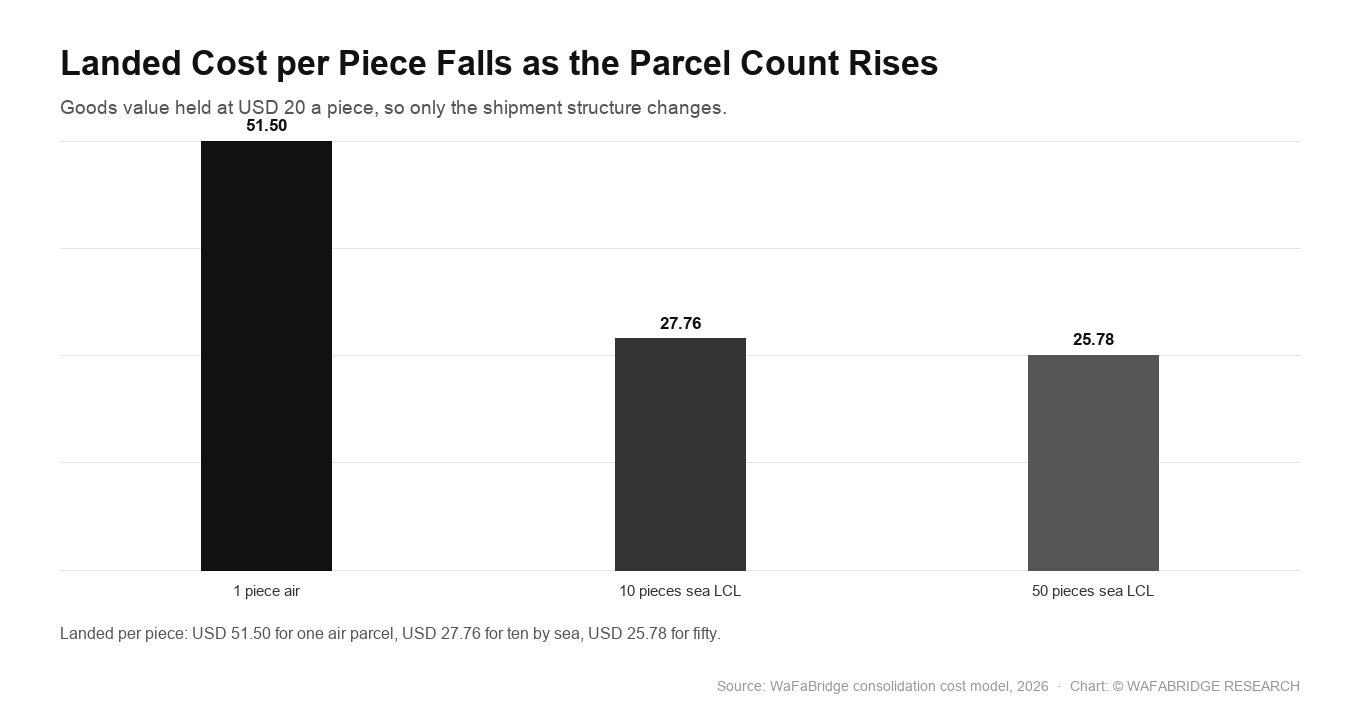
The chart above is the whole argument in one picture: as the parcel count rises, the landed cost per piece falls and then flattens, because what does not move with consolidation is the part you cannot optimise.
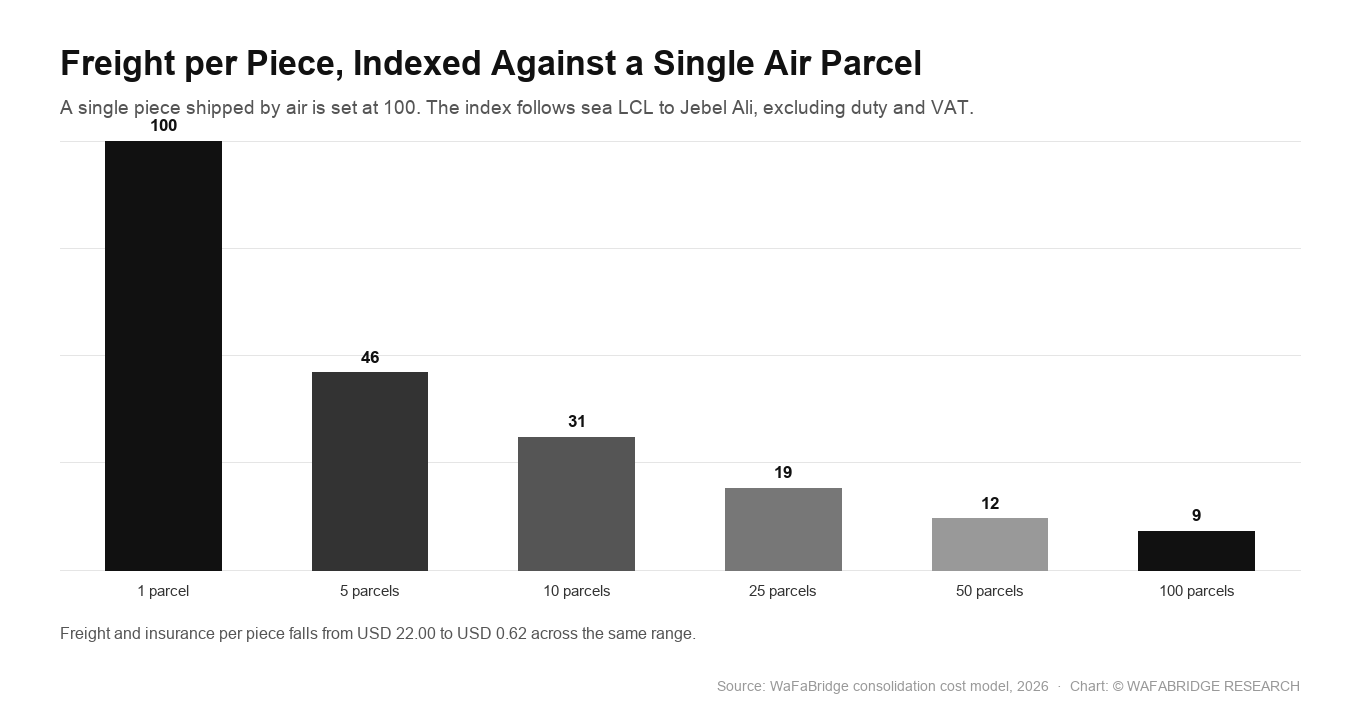
The chart above indexes the freight line alone against a single air parcel at 100, because that is where the saving comes from and where it stops.
Volumetric weight is the number that writes the air bill
Chargeable weight is where the second decision lives, and it is the one that quietly decides whether a consolidation is worth anything. Air divides the length, width and height of the packed carton in centimetres by 6,000 to get the volumetric weight, then bills the greater of that figure and the actual weight on the scale. Take a packed carton measuring 50 × 30 × 50 cm. That is 75,000 cubic centimetres, which divided by 6,000 gives 12.5 kg of chargeable weight, and the number does not move when the contents change. Note what is being measured: carriers bill the packed carton, void fill and outer protection included, so the figure that reaches the invoice is rarely the one the product box would give you. Loaded with 6.0 kg of metal fittings, air billed 2.1 times the actual weight. Loaded with 1.2 kg of light textiles, air billed 10.4 times. Same box, same rate, ten times the freight for a third of the weight.
| Actual weight | Volumetric weight | Which one the carrier charges on | |
|---|---|---|---|
| Air freight | Weighed on a scale at the terminal | L × W × H in cm ÷ 6,000, so a 50 × 30 × 50 cm carton bills 12.5 kg | The greater of the two (IATA rules) |
| Sea LCL | Weighed on a scale at the terminal | 1 m³ of space = 1,000 kg, measured as CBM | The greater of the two, minimum 1 CBM per shipment |
| A packed carton of 50 × 30 × 50 cm | 6.0 kg of dense metal fittings | 12.5 kg of air chargeable weight | Volumetric, at 2.1× the actual weight |
| A packed carton of 50 × 30 × 50 cm | 1.2 kg of light textile goods | 12.5 kg of air chargeable weight | Volumetric, at 10.4× the actual weight |
| What consolidation changes | Denser packing raises kg per CBM | Less wasted air and less wasted floor space per unit | Charges per CBM, and the number of units inside it |
This is why the goods that punish you are not always the light ones. Light goods in small boxes are fine. It is light goods in large boxes that destroy an air margin, and boxes get large for reasons that have nothing to do with the product: oversized retail packaging, a carton chosen for the seller’s shelf rather than the buyer’s pallet, void fill added to stop a light item rattling, and a stack of mixed sizes that will not interlock. The box is often larger than the goods require, and the freight pays for the box.
Sea inverts the logic, which is why the same consolidation can look cheap by sea and expensive by air. One cubic metre bills as 1,000 kg, so a cubic metre of feathers costs the same as a cubic metre of bolts, until the weight term takes over and the bolts start costing more per cubic metre than the feathers. For the first cubic metre of most consumer cargo, weight is simply not the sea number. CBM is. That asymmetry is the whole reason consolidation works: you are buying space once, and the space is measured by the carton, not by the scale.
The practical test is a ratio, not a rule of thumb to memorise. Measure the packed carton externally, weigh it gross, and compare volumetric weight to actual weight. Where volumetric weight runs more than double the actual weight, the air bill is being written by the box rather than by the goods, and the consolidation and repacking work in the next section is where the money is. Where actual weight leads comfortably, sea LCL at 1,000 kg per cubic metre becomes the cheap answer on volume alone, and the only question left is whether you can afford 30-plus days.
There are four cases where gathering the parcels stops being the cheaper answer. The first is a line whose cartons bill far more on volume than on weight: warehousing and repacking are charged per carton and per day, so the freight saved can be smaller than the handling bought. The second is the one WMU minimum, one CBM or 1,000 kg whichever is greater, so a consignment too small to fill it pays for the unit either way. The third is a wide SKU spread, where cartons from different sellers do not share a footprint and each mismatch is cubic dead space. The fourth is declaration: one consignment carries one document set describing many seller invoices to reconcile.
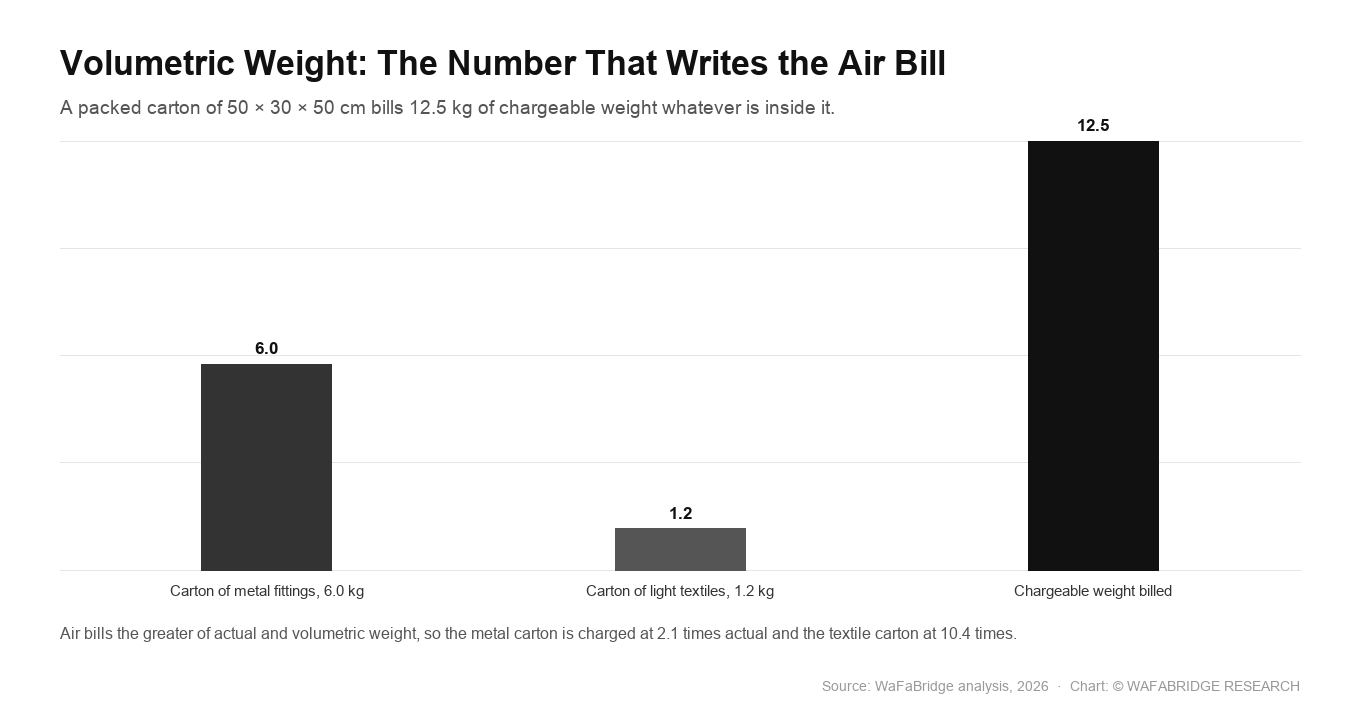
The chart above is the same carton in three states. The weight on the scale changes; the weight on the invoice does not.
What consolidation covers, and what it does not
The service side is easier to state than the freight side, and worth stating precisely because the line items get confused with each other. WafaBridge charges a flat 8% sourcing fee. For comparison, 1688 agency commissions in the industry are commonly quoted at 5–10% on the same work, and the platform’s own fee structure is separate again: an order service fee of 0.6%, capped at ¥18 per sub-order, with no such extra charge on off-platform cross-border orders, according to 1688’s own 2026 documentation. On top of the sourcing fee, the operating costs a buyer should plan for are domestic parcel freight at ¥5–20 a parcel and QC at ¥50–200 a batch, both industry quote bases rather than published tariffs. None of these lines is the freight, and none of them is the destination’s duty.
The 8% is worth reading carefully, because it is the number most often mistaken for a consolidation discount. It is a percentage of goods value, not a charge per parcel, and it does not move when a basket is consolidated: sixty pieces and one consignment of sixty pieces carry the same fee. What changes is the freight line underneath it. The table above makes it visible: freight and insurance per piece falls from USD 22.00 to USD 0.62 while the sourcing fee per piece stays at USD 1.60 throughout. So the saving a buyer sees per piece is fixed cost spread across more units of goods, not a lower rate.
What the consolidation service does cover is the coordination between them: receiving parcels from many sellers at the Guangzhou warehouse, counting and photographing them, QC on the batch, repacking into a consolidated consignment, the export declaration, one booking against one sailing, and DDP clearance and delivery on the far side. That booking carries 30 days of free storage, which is the line that makes consolidation practical rather than theoretical — a consignment that has been repacked can wait for its sailing without a warehousing bill running. Quotes for the whole basket come back in 3–5 days, and last-mile delivery in the Gulf is handled by Aramex, DHL, FedEx or UPS.
What it does not cover is equally worth naming. Duty and VAT are the destination’s charges, assessed on the CIF value under the destination’s own rules, and they differ by market: Saudi VAT at 15% is settled before dispatch, and each of the nine markets we cover carries its own structure. Product certification, where a destination market requires a conformity document for your category, is quoted separately. The air premium, if you decide to move a launch quantity by air rather than wait for the sailing, is a deliberate addition and not part of the consolidation. And the 30-day storage clock starts when the parcels are in the warehouse, which is the point at which the domestic freight line has already been spent.
Repacking sixty cartons into two pallets
Consolidation is a physical job, not a booking job. Sixty cartons arriving from sixty sellers carry sixty sizes, and mixed footprints do not stack: they bridge over each other and leave cubic dead space in every layer. That dead space is billed at 1,000 kg per cubic metre, so the gap between your cartons and your bill is directly financial.
Sixty cartons at 40 × 30 × 25 cm hold 1.8 cubic metres of product before anything is done about it, and a packed carton of 50 × 30 × 50 cm bills 0.075 cubic metres each, so 60 of them bill 4.5 cubic metres. The repacking levers, in the order they return value, run like this. Unify the footprint first, so cartons of one size stack into one another and the pallet holds a clean column rather than a stepped one. Second, remove what the goods do not need in transit: a printed sleeve, a plastic insert, a foam pad and a retail hang tag all occupy volume and none of them is on the purchase order. Third, nest rather than stack where the geometry allows — trays, baskets, lids and shallow frames fit inside each other and the parcel count falls without the goods moving. Fourth, fill the voids so nothing shifts in transit, which protects the goods and protects the carton from being crushed into a shape that changes its dimensions. Fifth, and this is the one people get wrong: do not over-compress textiles. Compressed fibre springs back, and a carton that has been pressed flat for four days returns to a larger box than the one that left the factory, with the freight already spent.
Two pallets is a deliberate target rather than a flourish. A load that fits two pallets can be measured in one pass against the packing list, weighed once, and verified once, which is what makes the manifest and the bill checkable at the far end. It also keeps the consolidation inside a single measured volume block, so the CBM on the booking is the CBM you packed rather than the CBM of a loose stack that the truck happened to build.
Every one of those steps happens in the same thirty days of free storage that carries the consignment while it waits for its sailing. That is the operational point of the warehouse: the saving does not come from a cheaper rate negotiated with a carrier, it comes from holding the goods in one place long enough to make them travel as one shipment, and the storage that makes that possible is already inside the quote.
The warehouse is also where a consolidation changes shape, because the work there is a sequence rather than one event, and each step carries a cost. Parcels arrive separately and on their own schedule, so the first job is receiving them: check each carton against the order, count it, photograph it, record what arrived. Then sorting, deciding which SKU goes on which pallet, which carton is repacked and which is already shippable, because consolidation is decided per SKU, not per consignment. Repacking is where the labour sits, measured in hours against the 30-day window rather than in the freight rate. The free storage runs from the point the parcels are in the warehouse, so the clock runs while the slow seller is still shipping. Where the sailing window closes before the missing pieces arrive, sending the ready portion separately beats holding the whole basket.
One thing the index does not show is the time cost of waiting for the basket to fill. Air DDP on this lane runs 6–12 days and sea LCL runs 30-plus, and those are transit figures measured from departure. Consolidation adds a window in front of them, because the consignment cannot leave until the last seller’s carton is in the warehouse, counted, sorted and repacked. A basket that gathers over ten days therefore arrives ten days later than the transit figure suggests. This is the drift a per-piece freight index cannot express, and why a consolidation is not always the same decision as a faster mode. The arithmetic that looks best on paper is paid for in days, counted against a launch date or a restock cycle. Where the arrival date matters more than landed cost, splitting the basket into two shipments can beat one sailing.
Three decision rules, by buyer type
Multi-seller, multi-SKU orders: consolidate, and measure the packed carton before you commit. The per-unit freight index falls from 100 for a single piece to 31 at ten and 12 at fifty, so a basket of sixty parcels consolidated into one consignment is buying a genuinely different cost structure. The rule that decides it is the carton measurement, because a basket that ships at index 12 and bills volumetric weight at 10.4 times actual has consolidated the wrong thing — you have built one big box of air and shipped it once.
Dense, heavy, low-value-per-kilo goods: sea LCL on volume, and compress before you pack. When actual weight comfortably exceeds volumetric weight, sea bills at 1,000 kg per cubic metre and the weight term never bites, so a cubic metre of tools travels at the same freight as a cubic metre of anything else. The air comparison is worse than useless here, because air will charge you on the scale and the scale is the heavy part. Compression is still the lever that matters, since volume is the sea number.
Goods with a launch date, a promotion or a seasonal window: air the launch quantity, sea the reorder. Sea LCL runs 30-plus days and air DDP 6–12, and a consolidated sailing cannot be compressed at the last minute. The launch cartons pay the air rate because the early arrival is what earns it; the reorder volume consolidates and takes the index 12 line. Buyers who put a launch inside a 30-day sailing have chosen a delivery date, and they did not choose it.
Freight, duty and VAT on this lane move with sailing, season and HS code; confirm the current figures for your own cartons and codes with the destination broker before you release a purchase order.
Internal links: Guangzhou consolidation and repacking · 1688 sourcing and buying agent service · buying on 1688 and paying in USD · landed cost calculator
Sources: IATA air cargo tariffs and rules knowledge hub for the volumetric weight divisor of 6,000 (iata.org); Maersk LCL terms for the one WMU minimum billing unit (terms.maersk.com); 1688 official documentation for the 0.6% order service fee and the ¥18 sub-order cap (wiki.1688.com). Agency commission, domestic parcel freight and QC figures are industry quote bases rather than published tariffs; freight, duty and VAT are indicative and are confirmed against a named sailing and your HS code by the destination broker. Research and figures compiled by 亚觅出海集团 AMI Global.
Chart: © WAFABRIDGE RESEARCH
Frequently asked questions
How much does consolidating 1688 parcels save per unit?
The per-unit freight index falls from 100 for a single piece to 46 at five pieces, 31 at ten, 19 at twenty-five, 12 at fifty and 9 at a hundred, on sea LCL to Jebel Ali with duty and VAT excluded. In the worked example above, landed cost per piece falls from USD 51.50 on single-piece air to USD 27.76 on ten consolidated pieces and USD 25.78 on fifty, with freight and insurance per piece dropping from USD 22 to USD 0.62. All figures are indicative.
Is sea LCL always cheaper than air for 1688 orders?
No, and the deciding number is volumetric weight rather than the mode itself. Air bills the greater of actual and volumetric weight, so a carton packed to 50 × 30 × 50 cm billed 12.5 kg of chargeable weight whether it held 6.0 kg of metal fittings or 1.2 kg of light textiles, while sea LCL bills one cubic metre as 1,000 kg and ignores weight below that ceiling. If the packed carton bills more than about twice its actual weight, air is charging you for the box, and repacking that carton usually beats changing the mode.
What does the consolidation service include, and what does it cost?
The sourcing fee is a flat 8%, with quotes for the full basket returned in 3–5 days and 30 days of free storage in Guangzhou while the consignment waits for its sailing. Domestic parcel freight at ¥5–20 a parcel, QC at ¥50–200 a batch, and 1688’s own 0.6% order service fee capped at ¥18 per sub-order are separate items on industry quote bases. Duty and VAT belong to the destination market and are confirmed against your HS code rather than assumed.
How many parcels should I consolidate before it stops paying?
Most of the saving is taken by the tenth piece, because that is where the fixed freight has already been spread thin: per-piece landed cost improves only about 7% between ten and fifty pieces in the worked example, even though per-piece freight falls 76% over the same step. Past that point the lever changes from freight to volume, so the next decision to make is how much air you can take out of each carton rather than how many more parcels you can gather.
What is the difference between CBM and actual weight when shipping from China?
For sea LCL, one cubic metre bills as 1,000 kg with a one WMU minimum — one CBM or 1,000 kg, whichever is greater — so a cubic metre of feathers costs the same as a cubic metre of bolts until the weight term takes over. For air, the chargeable weight is the greater of actual and volumetric weight, with volumetric weight calculated as length × width × height in centimetres ÷ 6,000. That is why a carton packed to 50 × 30 × 50 cm bills 12.5 kg of chargeable weight against 1.2 kg of textiles on the scale.
Do you deliver consolidated 1688 orders to all nine markets?
Yes — the six GCC states plus Egypt, Jordan and Iraq, on one standard, with Arabic document sets prepared before dispatch and last-mile delivery by Aramex, DHL, FedEx or UPS. Consolidation decides the freight line; each destination market’s own duty and VAT structure decides the rest of the landed figure, and those structures differ enough between the Gulf and the Levant that they belong in separate spreadsheets.