Chinese New Year 2027 falls on 6 February, and Ramadan 2027 runs from roughly 7 February to 8 March, so the factory shutdown and the Gulf clearance slowdown overlap almost completely, 11 days earlier than 2026. Plan February arrivals at +21 to +45 days against standard transit. Sea LCL runs 30+ days, air DDP 6–12 days, the buying fee is a flat 8% with 30 days of free warehousing, and every shipment clears DDP door to door. WafaBridge maps your order book against capacity, sailing windows and Eid dates first.
The most expensive mistake in Gulf sourcing is treating a Chinese holiday calendar and a Gulf holiday calendar as two separate problems. In 2027 they sit on top of each other, and a shipment that clears in eleven days in October can take six weeks to become sellable stock in February.
Five decisions that determine whether your 2027 orders land on time
- Mark the two shutdown windows on a 2027 calendar before you commit to a purchase order, so the dates are a planning input, not a surprise.
- Lock factory production before mid-January, because output tapers from mid-January and stops entirely in mid-February.
- Add three weeks of clearance buffer to every order that lands during Ramadan, when Gulf government offices work five to six hours a day and document releases queue behind a shorter day.
- Move a third of your order value into the November and December slots, where the calendar still works in your favour and drift is measured in days rather than weeks.
- Book ocean and air capacity four weeks ahead of the Eid rush, when space, drayage and delivery appointments tighten together.
The 2027 Overlap: Where Factory Output Meets Gulf Clearance
Chinese New Year and Ramadan overlap again, eleven days earlier than 2026
The window where neither side is at full capacity is roughly six weeks wide
-
Jan 15
Factories slow down
Production cuts begin in China
-
Feb 6
Chinese New Year
Factories closed, 11 days earlier than 2026
-
Feb 7
Ramadan begins
Government offices cut to 5-6 hours a day
-
Mar 8
Ramadan ends
Clearance backlog clears slowly
-
Mar 12
Eid al-Fitr
Three to five dead days at the port
-
Mar 20
Production resumes
Return to work ramps up over two weeks
The viewpoint this chart carries: The two lines trough at the same point, and that crossing is the useful output. One line tracks effective China factory output through the first quarter, the other tracks Gulf clearance capacity, and both bottom out in mid-February rather than on a single shared holiday date. Read it as a statement about coincidence: the production loss and the clearance loss cannot be mitigated separately, because the weeks your factory is quiet are the same weeks your container is sitting at Jebel Ali or Jeddah waiting for a signature. Plan backwards from that crossing.
On the China side, the shutdown is not a single lost day. Factories do not stop on the eve of the holiday and resume on the seventh day of it. Output tapers from around mid-January as workers begin travelling home, lines go quiet through mid-February, and production rebuilds in early March. Return-to-work rates in the first weeks of the year are commonly put at 60–70% of normal capacity, a figure from supplier and forwarder experience rather than an official statistic, so treat it as a planning assumption.
On the Gulf side, Ramadan 2027 runs from about 7 February to 8 March, and its effect on cargo is a reduction in working capacity rather than a closure. Government offices shorten to five or six hours a day for the month, and customs authorities run on correspondingly thinner staffing. Terminals, trucking and forwarding continue to operate, but every step needing a signature, an inspection slot or a document release takes longer. For DDP shipments into Saudi Arabia the pressure lands on the clearance chain: FASAH declarations submitted late in the month queue behind a shorter working day, and once cargo is discharged, the bonded road move into the green channel at Hatta, the declaration step and the delivery appointment each inherit the same compressed hours. The result is rarely a refusal, but a container discharged longer than the same cargo would have in October.
Eid al-Fitr then adds a standstill of three to five days across the Gulf, and Eid al-Adha closes Saudi customs for its own period. The cost of those windows is not measured in transit days, because the cargo keeps moving. It is measured in what stops moving around it: bookings, inspections, document releases and delivery appointments all pause, so a consignment that would have cleared on a Thursday waits for a working Tuesday. Eid al-Fitr is also when Gulf retail demand for food, gifting and household replacement peaks, and importers need seasonal stock on a shelf, not a quay.
What makes this worth acting on is that the damage compounds instead of adding up. A factory that loses a week of output does not hand that week back in March; it hands it back in March, and the vessel meant to carry that production has already sailed without it. In February 2027 the next sailing competes for the same space, drayage slots and delivery appointments as everyone else’s cargo. Treat the shape of the output line as reliable and the scale as indicative, since it is calendar-derived rather than measured. The clearance side is firmer, because working hours are set administratively and published in advance. One point the calendar does not settle: the shutdown is supplier-specific, so ask for the holiday schedule and restocking date in the same message as the production slot.
| Date | Event and impact point | Effect on your order |
|---|---|---|
| Mid-January | Factories scale down | Production windows shorten |
| 6 February | Chinese New Year, Goat year | Full shutdown; 11 days earlier |
| 7 February | Ramadan begins, Gulf offices | Working day cut to 5–6 hours |
| Mid-February | Full factory shutdown | No production; paperwork slows |
| Early March | Production restarts | Output rebuilds slowly |
| 8 March | Ramadan ends, Gulf customs | Normal working hours resume |
| Mid-March | Return-to-work normal | Capacity restored; recovery ends |
| Eid al-Fitr | 3–5 day standstill | Bookings and collections pause |
| Eid al-Adha | Customs closure | Cargo waits; clearance slips |
| 23 September | National Day, Saudi | Last-mile delivery only |
Two rows deserve attention early. The 23 September National Day entry affects domestic last-mile delivery inside Saudi Arabia rather than customs or port handling, so it belongs in a delivery-window conversation with your mover. Eid al-Adha is the opposite: a customs closure that stops clearance while the vessels carrying your cargo keep arriving. For comparison, 2026 ran Ramadan from 17 February to 19 March and placed Chinese New Year on 17 February, the same day. One caveat: Eid al-Fitr and Eid al-Adha are set by lunar observation, so start and end shift by a day or two. Confirm them against a published Islamic calendar first.
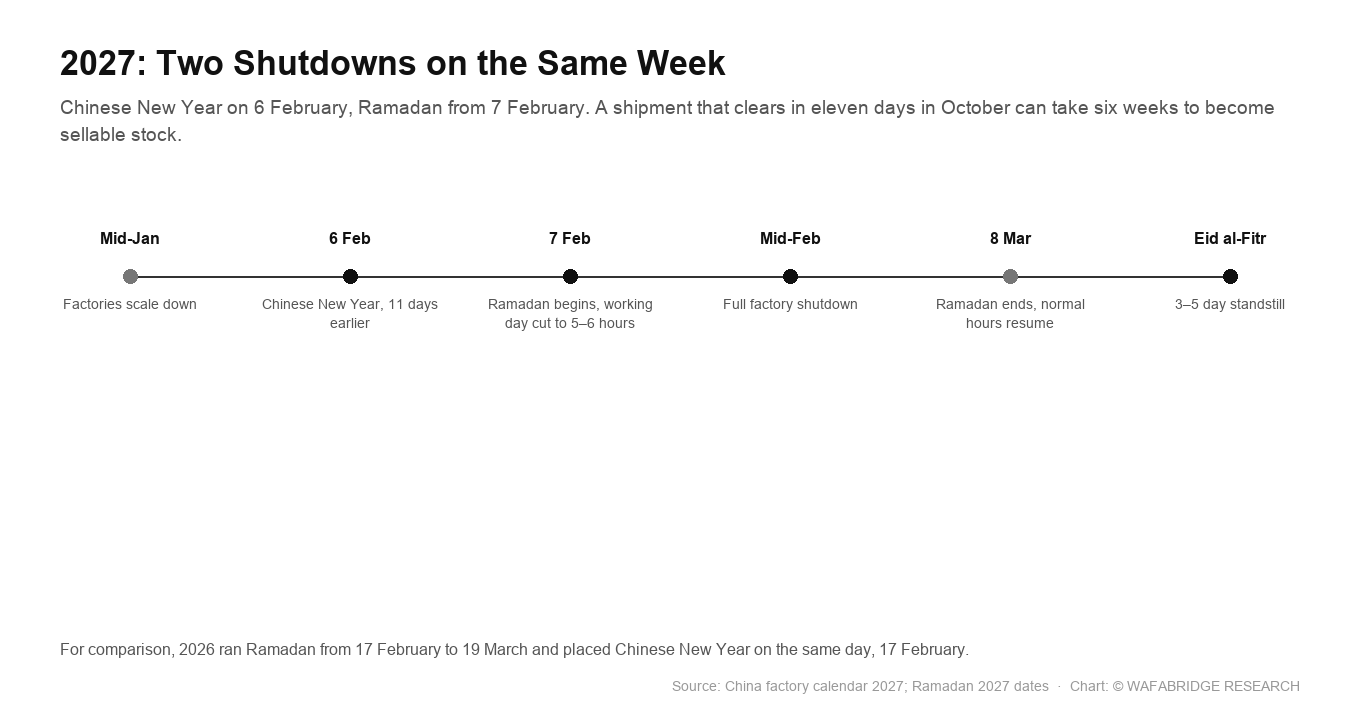
The chart above is the overlap itself. The two shutdowns do not take turns in 2027; they land in the same week.
Counting Backwards: A 90-Day Purchase Order Deadline
The viewpoint this chart carries: Drift is not a flat penalty you can add to a transit quote and price away — it rises and falls with the calendar, so the month you order in changes the delivery date more than the lane you choose does. The chart plots the drift range month by month against standard transit, and the shape is the argument: a small difference in order date between December and February produces a difference of several weeks in arrival. Use it as a booking decision rather than a budgeting one: find the month that puts your arrival inside the shelf date you need, then work backwards from the drift band rather than the optimistic end of it.
The date that matters is the day your stock must be sellable on a shelf in Riyadh, Jeddah or Dubai. Work back and the purchase order deadline falls roughly 90 days out: a production window including the pre-holiday taper, a sailing window on the booked lane, and a clearance window with a Ramadan buffer in it. Take the Ramadan case. Goods must be in the warehouse before Ramadan opens on 7 February 2027. Subtract the sailing window your forwarder quotes, subtract the three-week clearance buffer, and subtract the factory production window. The order then needs to be signed around mid-November 2026; signing it in January puts you behind every buyer who did the same thing.
Read the bands as a range, because the width of the band is information in itself. A +0 to +7 day band in December means the outcome is close to predictable, so a delivery appointment can be scheduled against it. A +21 to +45 day band in February means a business that books warehouse space, staff shifts and a marketing launch against that arrival is committing to a date it cannot hold. If the category cannot absorb six weeks, move the order.
| Order month | Drift against standard transit | What drives it |
|---|---|---|
| December | +0 to +7 days | Tighter space, peak-season surcharges |
| January | +14 to +28 days | Factory cutback, earlier on-water deadlines |
| February | +21 to +45 days | Chinese New Year and Ramadan overlapping, slower clearance |
| March | +7 to +21 days | Ramadan tail, pre-Eid restocking arrivals |
| April onwards | +0 to +5 days | Recovery period |
These are structural estimates derived from the shutdown and clearance calendar, not measured transit performance on a lane, so read them as a planning range. The December slot is the cheapest insurance in the calendar. January and February are where drift compounds, because factory cutback, on-water deadline pressure and Gulf clearance slowdown land on the same weeks. One boundary condition applies to the table: these ranges describe calendar pressure rather than lane performance, so they sit on top of whatever transit time your forwarder quotes. Where both are large, only the order date and the mode are left to move.
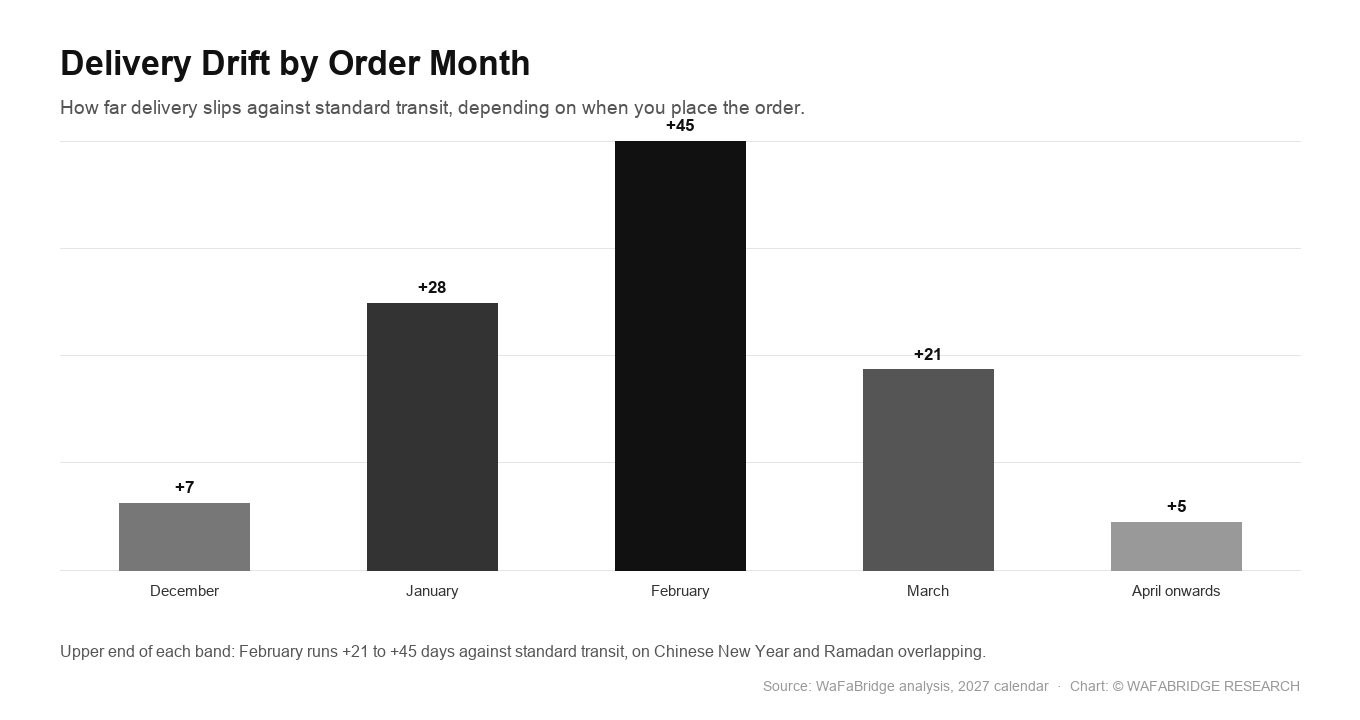
The chart above is that drift as a band by order month. A February order is not a slightly later February order; it is a different order month.
The 2027 Planning Calendar for China-Gulf Buyers
| You order in | Cargo leaves China | Expected arrival | Buffer you need |
|---|---|---|---|
| December 2026 | Before the factory slowdown | Late January 2027 | Low, booking is still open |
| January 2027 | Struggles to clear the factory | Late February to March | Medium, add a week |
| February 2027 | Mostly impossible at the factory end | March to April | High, plan for a month of slack |
| March 2027 | April, once production resumes | April to May | Medium, Eid still bites |
| April 2027 onward | Normal | May to July | Low, back to a normal schedule |
The viewpoint this chart carries: This chart converts a calendar into a sequence of decisions with owners and deadlines, which is the only version of it that is actionable. Each month carries a decision attached to it — confirm dates, commit order value, lock production, book capacity, consolidate — rather than a holiday label. Read it left to right as a set of gates: every gate you pass in the right month keeps the next gate open, and a missed gate does not delay that step alone, it compresses everything downstream. Use it as the agenda for your supplier and forwarder conversations, because it turns “we need to be early this year” into instructions a factory, a carrier and a customs broker can each act on.
The month-by-month version below is a sequence of commitments, not a list of dates, because each month asks you to fix something before the next problem appears.
- October 2026. Confirm the Ramadan and Eid dates with your factory and forwarder, and settle your sailing windows. Lunar dates shift, so a schedule published in October beats one re-derived in January.
- November 2026. Move a third of your order value into the November and December slots, and book ocean and air capacity four weeks ahead of the Eid rush. White Friday lands this month, so freight tightens, and the Ramadan order deadline falls inside.
- December 2026. Pre-Ramadan production runs while lines still have people on them. Expect modest drift and thinner space, and this is the last point at which a factory can hold a production slot and still deliver before the shutdown.
- January 2027. Lock production before mid-month. From mid-January new orders start costing you weeks, and orders in production need their cartons, labels and documents settled before the lines stop.
- February 2027. Chinese New Year on the 6th, Ramadan from the 7th. Nothing confirmed this month lands in time for the season. Use it to consolidate what was committed earlier and clear what is in transit.
- March 2027. Factories rebuild from early March, staffing normalises by mid-month, Ramadan ends on the 8th, then Eid al-Fitr takes three to five days of standstill. Workable, but late for seasonal lines.
- April 2027 onwards. Transit times return to normal. The window for autumn and winter categories, and the cheapest place to place the orders you are least in a hurry for.
The chart also shows where the risk concentrates. Four of the seven months in the first half of the year carry a decision that must be taken before the previous month’s decision has fully landed, so the buyer who treats November as a quiet month is mistaken. November and December together carry the order commitment, the production lock and the capacity booking for the whole first quarter. Putting a third of order value into those slots is a spread rather than a bet. The plan assumes you know your shelf dates before you order, which holds for seasonal categories and fails for speculative buys. The same rhythm appears in our Gulf Eid logistics calendar.
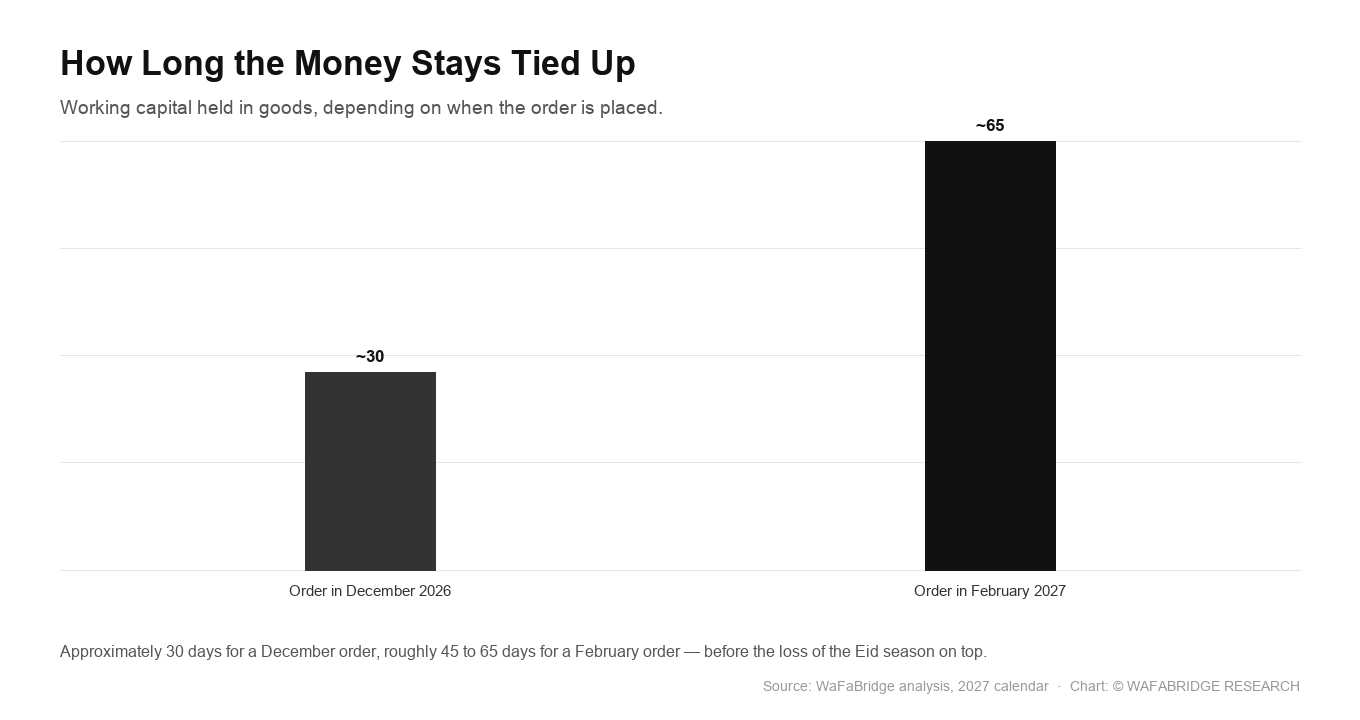
The chart above is what that overlap costs in cash held, before any loss of the selling season is counted.
How We Run the 2027 Peak: Operational Detail
The calendar work above holds only if the order is executed against it.
Production scheduling and the pre-holiday inspection. For any 2027 order that has to ship before the shutdown, the production slot is agreed with the factory in writing and against a date, not a phrase like “early February”. A restocking date and a slot are separate commitments, and the second means nothing unless the first is fixed. Goods are inspected before the line closes rather than after it restarts, so carton counts, labelling and packing specifications are settled while the factory can still correct them. A defect found in January is a bench fix; in March it is a re-pack and an unbudgeted delay.
Consolidation and warehousing. Orders from multiple suppliers are consolidated in China before they move as one consignment, which is where the 30 days of free warehousing sits in the timeline. That 30 days lets a December order wait for a January sailing without becoming a storage charge, and it is the difference between a delay that costs a week and one that costs a month of demurrage. Consolidation also means one shipping document set and one clearance chain, which matters more in a month when every customs working day is short.
Booking and the mode decision. Ocean and air capacity for the Eid rush is booked four weeks ahead. Sea LCL on this lane runs 30+ days and air DDP runs 6–12 days, and the mode question in January and February is really about which part of the chain you are willing to shorten. Air shortens the water but does nothing about the factory taper, so it cannot rescue a late order on its own; it rescues one once the goods are finished and on the quay. Where the order is already late at the factory stage, dearer freight buys back water time and leaves the production delay in place, so check the production date first.
Clearance and the buying fee. Every shipment clears DDP door to door, so the customs chain, the green-channel movement and the last mile are handled as one obligation rather than passed between three parties. In a Ramadan month that matters, because the shortened working day is absorbed by the party managing the whole chain instead of by your team chasing four separate ones. Where Saudi certification requirements apply to your category, they are prepared in the same window as the commercial documents rather than after the container has landed, because a document exception found at the quay in February is a clearance delay measured in weeks. The sourcing and buying service runs at a flat 8% of order value, with no separate line items for negotiation, production follow-up, inspection or consolidation. How we run China purchasing for Gulf buyers is covered in how we run 1688 purchasing for Gulf buyers.
Worked Example: One USD 50,000 Order, Two Order Months
The clearest way to see what the 2027 calendar costs is to hold the goods constant and move only the order month. The example below uses a single USD 50,000 consolidated order of general merchandise into Saudi Arabia on a DDP basis. The order value and the 8% buying fee are the only figures fixed by the terms; freight, duty and VAT depend on the lane, cargo and sailing, so they appear as the elements that change.
| Line | Order placed in December 2026 | Order placed in February 2027 |
|---|---|---|
| Goods value (USD) | 50,000 | 50,000 |
| Buying fee at 8% (USD) | 4,000 | 4,000 |
| Production window | Production locked before mid-January | Order reaches the floor in March, after the shutdown |
| Mode available without penalty | Sea LCL 30+ days, or air DDP 6–12 days | Sea LCL with drift, or air at premium on already-late goods |
| Arrival drift against standard transit | +0 to +7 days | +21 to +45 days |
| Days in free warehousing (30 available) | Inside the 30-day window | 21 to 45 days, so up to 15 days beyond the free window |
| Stock sellable | Late January 2027 | Late February to mid-March 2027, later if inspected |
| Commercial consequence | Shelf date held for Eid al-Fitr stock | Eid al-Fitr window missed, peak pricing lost |
| Working capital held in goods | Approximately 30 days | Approximately 45 to 65 days, before the loss of the season on top |
Two lines carry the argument. The fee line is identical in both columns, at USD 4,000 on a USD 50,000 order, so the commercial terms do not change when the order moves into the compressed window. The working capital line is the other one: the same USD 50,000 sits in goods for roughly 30 days in one column and 45 to 65 days in the other, and the extra 15 to 35 days separate a business that can pay its next supplier on time from one funding a second stock cycle while the first sells down.
The free warehousing line shows where the cost starts. Thirty days covers the December order comfortably. The February order consumes 21 to 45 days of it and can run up to 15 days past the free window, at which point storage is charged and the delay becomes a cost line rather than a scheduling inconvenience. That is the point at which a delay stops being an operational problem and starts being a balance sheet one, and it arrives earlier in 2027 than buyers expect because the calendar has shifted eleven days forward. The drift bands and working-capital ranges are planning estimates, not measured outcomes, so the example shows the shape of the trade rather than a precise number. If the February order is placed, split it, push the priority SKUs into an earlier sailing once production is secured, and accept the balance lands in March.
FAQ: Questions Buyers Ask About the 2027 Calendar
Should I place my 2027 orders before or after Ramadan?
Place them before. For stock that must be sellable during Eid al-Fitr, the purchase order deadline falls around mid-November 2026, roughly 90 days back from the shelf date, because production taper, sailing time and a Ramadan clearance buffer all fit inside that window. A February order works for stock selling in spring, but carries a drift of +21 to +45 days against standard transit.
Is Chinese New Year really 11 days earlier in 2027 than in 2026?
Yes. Chinese New Year falls on 6 February 2027 in the Year of the Goat, against 17 February in 2026. What makes 2027 harder is not the earlier date alone but the combination with Ramadan, which opens on 7 February and runs to roughly 8 March, leaving almost no window where factory output and Gulf clearance are both normal.
How much clearance buffer should I build in for a Ramadan arrival?
Three weeks on top of normal transit. Ramadan shortens Gulf government and customs working days to five or six hours, which stretches discharge, declaration, green-channel movement and the delivery appointment without any single step formally stopping. Decide the buffer when the booking is made, in November, because the alternative is finding the shortfall in February with the cargo still on the quay.
Can air freight solve a February delivery problem?
Only partially. Air DDP runs 6–12 days, so it shortens the water leg, but it does nothing about the factory taper or the shortened customs day. It recovers time once the goods are finished and waiting; it cannot recover production time that never happened.
What happens to a shipment that lands during the Eid standstill?
The cargo keeps moving and the clearance chain stops. Bookings, inspections, document releases and delivery appointments pause for three to five days around Eid al-Fitr, and Eid al-Adha closes Saudi customs for its own period. A consignment that would have cleared on a Thursday waits for a working Tuesday, and an inspection in that window adds 5–7 days.
Send us your 2027 order book and the dates your stock needs to be sellable, and we will map each line against factory capacity, sailing windows and Gulf clearance before you commit the first purchase order. Talk to the WafaBridge team to apply the calendar to your SKUs, or price the shipment in the landed cost calculator.
Sources
- GCC-SG (Gulf Cooperation Council) — official GCC holiday and working-hours announcements, used to confirm Ramadan and Eid closure dates.
- IslamicFinder — cross-check of the Ramadan 2027 window of roughly 7 February to 8 March and the lunar dates for Eid al-Fitr and Eid al-Adha.
- Timeanddate — independent verification of Chinese New Year on 6 February 2027, Year of the Goat, and the Saudi National Day date of 23 September.
- Return-to-work rates of 60–70% and the arrival drift bands are planning estimates from supplier and forwarder experience, not published statistics. Confirm them against your own lane and suppliers.