Composite cases in this article are drawn from consignments we handle on the Guangzhou–Gulf corridor; names and figures are changed, the mechanics are not.
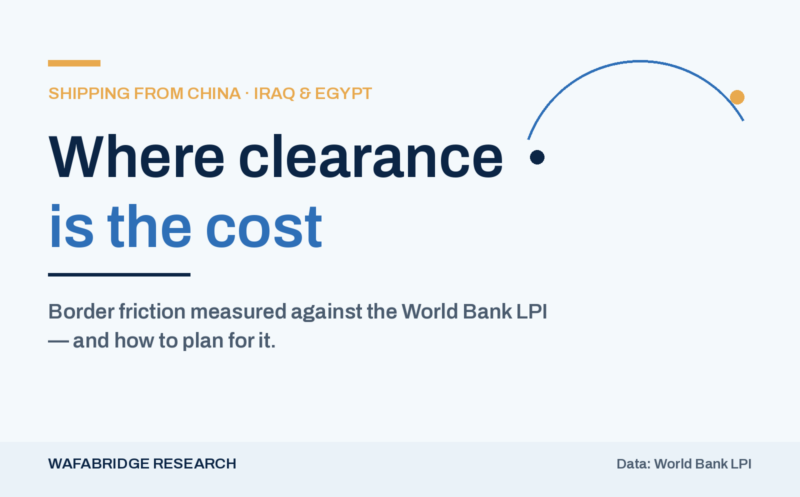
Iraq and Egypt are the Gulf corridor’s hard lanes not because they are far — they are not — but because import clearance is where these markets absorb friction the freight quote never shows: Iraq scores 2.1 and Egypt 2.8 on the World Bank’s Logistics Performance Index, against the UAE’s 3.7, and that gap is paid in days, storage charges and documentation discipline. The freight is the cheap part. Getting the paperwork through is the product.
The consignment that was never lost, and never moved
A Baghdad buyer — call him Omar — ordered shopfitting hardware from Guangzhou: shelving, display units, signage, about $14,000 of goods. The ocean leg was unremarkable — the Gulf’s ports sit a reasonable sailing from South China, and the feeder connection into Umm Qasr runs weekly when it runs. The container reached Iraq on schedule. Then it entered the part of the journey the tracking page cannot draw: Iraqi customs.
The goods were ordinary. The documents were correct. What followed was nonetheless three weeks of controlled friction — an inspection queue, a valuation query on a line item the examining officer wanted supported with a second invoice copy, a clarified HS description, an authentication the broker needed re-stamped. Each item was resolvable; each took days. Omar’s goods were never lost, never rejected, never officially delayed. They simply aged in a yard, accruing storage, while the machine processed them at the speed the machine processes everything.
Multiply Omar’s three weeks across a year of orders and you have the real economics of the hard lanes. These markets are not served less because they are unreachable; they are priced differently because the clearance environment — not the ocean — is where the cost and the variance live.
What the LPI actually measures, and why 2.1 versus 3.7 matters
The World Bank’s Logistics Performance Index is the closest thing trade logistics has to a ruler. Its 2023 edition scores the UAE 3.7 (14th globally), Saudi Arabia 3.0 (47th), Egypt 2.8, and Iraq 2.1 — near the bottom of the global table. The gap between those numbers is not an abstraction; the LPI aggregates exactly the things Omar paid for: customs process efficiency, infrastructure quality, shipment tracking, and timeliness.

Read the customs dimension alone and the story sharpens further. The Gulf’s established markets score in the 3.0–3.7 band on customs — systems where documentation is electronic, tariff classifications are stable, and queries, while real, resolve through defined channels. Egypt’s customs score sits materially lower; Iraq’s lower still. The practical meaning: in the Emirates, a document error costs a correction; in the hard lanes, the same error costs a queue — and queues are where storage, demurrage and missed selling weeks come from.
This is why we say these lanes are priced by clearance, not by freight. Ocean rates into Umm Qasr or Alexandria differ from Gulf rates by margins that would never justify the experienced difference in total journey cost. What justifies it is the variance: the hard lanes carry wider distributions of both time and money, and markets” src=”https://wafabridge.com/wp-content/uploads/2026/11/chart-a3-lpi-customs.png” />
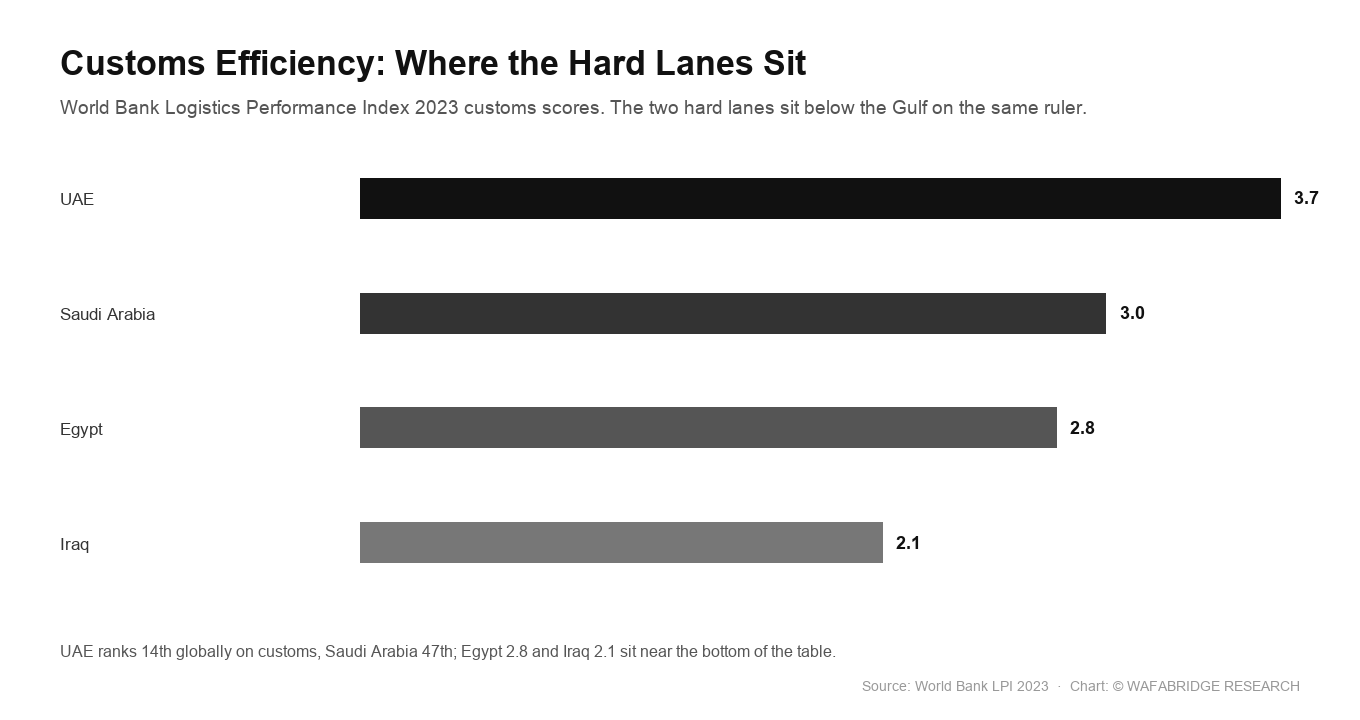
The chart above puts both hard lanes on the same ruler as the Gulf markets. The gap is not sentiment; it is the measured customs environment.
Egypt: the big market with a compliance entrance exam
Egypt is the strategic opposite of Iraq — a hundred-million-person market, a major Red Sea position on the Suez transit, and a manufacturing base of its own — which makes its import regime more surprising to first-timers. Egypt does not primarily block goods with slowness; it blocks them with requirements, and the list has teeth.
Imports into Egypt run through a regime that demands, among other things, importer registration with the relevant authorities, and — the provision that has restructured the entire China–Egypt trade — a policy that certain consignments require the exporter relationship to be documented through registered channels, with letters of credit or documented payment methods required for many commercial imports. Product-specific rules add their own layers: the GOEIC (General Organisation for Export and Import Control) operates conformity requirements on regulated categories, and testing against Egyptian standards is a real gate for consumer goods, not a formality.
The market’s scale keeps the trade flowing regardless — Egypt remains one of China’s largest North African partners by goods volume — but the compliance entrance exam changes who trades successfully. The buyers who struggle are the ones who treat Egypt like a Gulf market with different stickers: same goods, same invoice, same habits. The buyers who do well treat it as a distinct regulatory jurisdiction from day one — importer-of-record arrangements, conformity routes for regulated lines, payment documentation planned before the deposit, not argued with the broker after arrival.
Iraq: the high-friction, high-reward lane
Iraq is the purer case of clearance economics. The market’s demand is real and underserved — reconstruction, retail rebuild, a young population buying consumer goods — and its import flows have grown accordingly. But the institutional machinery behind the border is still maturing: documentation requirements vary in practice between entry points and inspecting officers; valuation queries are common; and the operational ecosystem — licensed brokers, bonded storage, inland transport — is thinner than the Gulf’s, which makes every queue longer and every mistake stickier.
The profit logic of the lane follows directly. Because friction deters casual entrants, the buyers who systematise Iraq — consistent HS descriptions, complete document packs that survive multiple inspection styles, brokers with real working relationships, buffer weeks built into every promise — face less competition and command better local prices. Iraq pays for discipline. The buyers who lose money on the lane are almost always the ones who priced it as if it were Kuwait with worse roads.
What friction costs, line by line
Generalities about “friction” deserve a bill, so here is the shape of Omar’s three weeks in cost terms. Storage and demurrage at an Iraqi terminal accrue daily once free time expires — free periods on these lanes are typically shorter than the Gulf’s, and the daily bands step up rather than stay flat, so week three of a hold costs meaningfully more per day than week one. Broker rework — the re-stamped authentication, the supplementary invoice, the amended declaration — bills as professional services, small individually and relentless in aggregate. Inland delivery, re-booked twice around a changing release date, carries re-booking charges. And the least visible line is the largest: the selling weeks themselves. Omar’s shopfitting goods landed for a season that had three weeks less of itself by the time the cartons reached his shop — a cost no invoice prints, and the only one that doesn’t get negotiated.
Egypt’s version of the bill skews documentary: a conformity test repeated because the wrong standard was applied, a registration chased after the fact, a payment channel re-papered to match the import rules — each one a week-shaped hole in the schedule. The point of writing the costs out is not deterrence. It is proportion: every line above is preventable in Guangzhou for a fraction of its on-the-ground price, which is exactly why the hard lanes’ professionals spend their money before departure and their patience nowhere.
How the hard lanes are actually managed
The operating discipline on both lanes reduces to three habits, and they cost far less than the failures they prevent.
Documents as the product. On easy lanes, documents support the goods. On hard lanes, documents are the goods as far as the border is concerned — and they are prepared to a higher standard: descriptions that match carton to invoice to certificate word for word, HS codes chosen to survive an examining officer’s scrutiny rather than to minimise duty by a point, second copies and authentications staged before departure. Every hour spent in Guangzhou making a document pack boring is worth a day of Iraqi or Egyptian queue.
Buffers as pricing, not padding. Hard-lane quotations and promises carry wider margins — in days, in contingency costs, in customer communication — as a deliberate design. The buyer who quotes a Gulf timeline into Iraq is manufacturing a broken promise; the professional quote says thirty-five days and delivers in twenty-eight, which in the hard lanes is what reliability actually looks like.
A partner who owns the border. The single largest variable on these lanes is who stands at the clearance end. A DDP arrangement shifts the entire clearance risk — queries, storage, broker relationships — onto the party that runs the border daily, priced into one door-to-door number. For the Gulf’s established markets, DDP is a convenience; for Iraq and Egypt, it is closer to a necessity, because the alternative is the buyer personally underwriting a variance he cannot see, in a system he does not operate, in a language he may not read.
The human infrastructure
There is a reason the same names keep appearing on successful hard-lane consignments, and it is not in any tariff schedule: these markets run on relationships as much as regulations. The licensed broker at Umm Qasr who knows which inspection team wants original stamps and which accepts scans; the port official whose queue moves when the document pack is pre-formatted the way his office reads; the Alexandria conformity lab whose test report Egypt customs trusts without re-testing — this is infrastructure, as real as cranes and roads, and it cannot be downloaded or bought with a freight budget. It accumulates: years of consignments, favours returned, files whose format a specific office has learned to process without query.
For a buyer, this has an uncomfortable but useful implication: on the hard lanes, the partner matters more than the price. On the Gulf’s easy lanes, two DDP quotes ten percent apart are near-equivalents — the border machinery is standardised and either operator passes through it. On the hard lanes, the same ten percent can separate an operator who owns the broker relationship from one who is meeting it for the first time, and the difference lands not in the quote but in the calendar: days of query resolved in hours by a phone call, valuation questions settled by a file format the office recognises. The buyer comparing hard-lane providers should weight three questions above price: how many years on this specific border, whose brokers, and what happens to a consignment that gets queried — with a named person and a number, or with an email address.
It also explains the pricing. Hard-lane DDP quotes carry a premium over Gulf quotes that looks disproportionate against the ocean freight difference. The premium is not the ocean. It is the accumulated relationship capital standing behind the cartons — the years of files and favours that make Omar’s three weeks only three weeks — and like any capital asset, it is either rented through the fee or built, slowly and expensively, by the buyer himself.
When the hard lanes get harder
The baseline friction described above is the good version, and it has seasons. The hard lanes amplify every calendar stress the Gulf corridor knows, plus a few of their own. Ramadan thins the same clearance offices here as everywhere, but with thinner staffing to begin with, the Ramadan slowdown costs more days. Year-end budget cycles in Iraq’s public sector slow the institutional demand that drives much of its import flow, and payment friction upstream of the border pushes more traders toward tighter, riskier shipment schedules. Egypt adds its own cycle: foreign-exchange availability shapes import timing in ways no Gulf market experiences, and documentation requirements have tightened in waves that arrive with regulation changes rather than seasons — a consignment planned under one rulebook can arrive under another.
Then there are the events that have no season. Port congestion from regional disruption, inspection backlogs after procedural changes, entry-point closures that reroute a week of flow — the hard lanes absorb these with the least redundancy in the region, because the machine has fewer parallel paths. The operating response is not forecasting, which nobody can do here, but structure: wider buffers in the promise, contingency budgets in the quotation, air as a standing lever for the cartons that cannot wait, and inventory cover sized for the worst quarter rather than the average one. The buyers who trade these lanes for years are not the optimists with the fastest schedules. They are the ones whose business model never assumed the baseline would hold.
What this means depending on who you are
If you are eyeing Iraq or Egypt from the Gulf’s comfortable lanes, go in with the pricing inverted: model the clearance environment first — weeks, storage exposure, broker reality — and the freight second. If the margin survives an honest clearance model, the competition is thinner than anything you face in Dubai.
If you are already shipping to these markets and bleeding time, audit your document pack before you audit your freight forwarder. In our experience the weeks vanish in the same three places: descriptions that don’t match, HS codes chosen too cleverly, and authentications that should have existed before departure. The ocean has never once been the delay.
If you are a buying-agent customer weighing whether these lanes are serviceable at all: they are — through the same DDP machine as the Gulf, with the hard-lane friction priced honestly into the quote rather than discovered at the border. What you should demand from any agent on these lanes is not a lower number but a wider one: buffers named, contingency priced, promises built for the machine that actually runs there.
Friction is a price, if you can see it
The hard lanes are not a warning; they are a price list that most buyers never get shown. Iraq and Egypt charge for friction — in days, storage and documentation discipline — and they reward, disproportionately, the importers who can read that price list before committing. The LPI numbers in the charts above are that price list in public form. Everything else is learning to pay it deliberately, in Guangzhou, instead of accidentally, in a queue.
Clearance practice and requirements change with regulation; verify current rules for your product and entry point, or ask us to model the hard-lane cost for your specific shipment.
Internal links: DDP Shipping · Cost Calculator · UAE vs Saudi Arabia · Nine Markets, One Standard
Sources: World Bank Logistics Performance Index 2023 (overall and customs scores); UN Comtrade (bilateral goods flows); lane operations data on the South China–Umm Qasr / Alexandria corridors.
Chart: © WAFABRIDGE RESEARCH
Frequently asked questions
How long does shipping from China to Iraq take?
Door-to-door ocean DDP to Iraq typically runs 40–55 days including the clearance environment at Umm Qasr — significantly longer than Gulf destinations, with clearance rather than the ocean leg driving the variance. Buffer planning is essential; quotes promising Gulf timelines into Iraq are the most common source of broken commitments.
Why is import clearance harder in Iraq and Egypt than the Gulf?
Measured by the World Bank LPI, both markets score well below the UAE and Saudi Arabia on customs efficiency and logistics infrastructure (Iraq 2.1, Egypt 2.8, vs UAE 3.7). Practically: more document queries, slower inspection queues, thinner broker ecosystems and wider day-to-day variance at the border.
What documents does Egypt require for commercial imports?
Egypt requires registered importers, documented payment methods (letters of credit or registered channels for many commercial imports), and conformity documentation for regulated product categories through GOEIC channels, with testing against Egyptian standards on consumer goods. Requirements vary by product family and change with regulation — verify before the deposit, not after arrival.
Is DDP available for Iraq and Egypt?
Yes, through agents who operate the clearance end daily. DDP matters more on these lanes than in the Gulf: it transfers the clearance variance — queries, storage, broker management — onto the service provider, priced into one door-to-door figure, instead of leaving the buyer exposed to a system he does not operate.
Are the hard lanes profitable despite the friction?
Often more profitable than the Gulf — that is the compensation the friction buys. Wider clearance variance deters casual entrants, so importers who systematise documentation, build honest buffers and hold real broker relationships face thinner competition and stronger local pricing. The margin is the payment for discipline.