SABER’s 2026 changes are about codes and certificates, not taxes: SASO moved to 12-digit product codes on 1 January, added technical-regulation groups in July, and tightened rules on plastics, air conditioners and energy efficiency through December. Quotes take three to five days, air DDP runs six to twelve days and sea LCL thirty-plus, and every shipment clears DDP door to door with duty and 15% Saudi VAT prepaid before dispatch, on a flat 8% sourcing fee. Other guides explain what SABER is; this one covers what changed.
For the fundamentals of SABER certification itself, see our earlier guide: Shipping from China to Saudi Arabia: SABER Certification Explained. That guide explains what a PCoC and an SCoC are and how the platform works. This one covers what changed in 2026 and what it does to a shipment already at sea.
Three dates carry most of the risk: the code change on 1 January, the regulation expansion in July, and the plastic rule on 18 August. Each landed quietly. Nothing arrives at your door and nothing breaks in your factory; the breakage shows up as a system response on a consignment already at sea, with storage charges running.
The 2026 Rulebook: What Changed and What Did Not
2026 tightened category by category, not all at once
A certificate valid in January can need re-filing by December
-
Nov 2025
SASO issues the notice
Tariff codes align with ZATCA
-
Jan 1 2026
12-digit codes take effect
Old codes are rejected on submission
-
Apr 2026
USB-C laptop rule
IEC 62680 conformity required
-
Jul 2026
New technical regulations
Paints, machinery, steel, SQM mark
-
Aug 18 2026
Plastic products rule
Importer declaration required
-
Aug 31 2026
Old AC certificates stop
SASO 2663 and 2874:2025
-
Dec 1 2026
New energy standards
Mandatory nationwide
The viewpoint this chart carries: the 2026 changes arrived as a sequence of separate dates rather than one new law, and each one lands on a different document in the same file. Read the timeline as a filing calendar: the code decides which certificate a product needs, the July dates decide whether a product you already ship needs a technical certificate at all, and the August and December dates sit on the shipment certificate and the product label. Every entry is a deadline, because after it a consignment can be rejected or held.
SASO published the revised notice on 18 November 2025. From 1 January 2026 the platform moved to 12-digit product codes aligned with the classification ZATCA already runs. The certificate system did not change; the codes behind it did. New applications on an old code structure are rejected on submission, with no queue and no warning email. Certificates issued earlier do not vanish, but they point at a code customs no longer expects.
Two things follow. The code selects the regulatory route, so a 12-digit code is not just a longer version of the old one; it can place a product in a regulated category the old code did not reach. And none of it changes the money: duty rates and VAT rules are unaffected, so getting this wrong costs delay and demurrage, not a different tax bill.
The July expansion moved four product groups into technical regulation: coatings and clear paints, abrasives, steel semi-finished products and construction pipes, and building materials. These now need a certificate route that did not apply to them before, which matters more to importers than the code migration did. Certain steel sheet products require the SQM Saudi quality mark, effective within 30 days of the regulation.
One earlier date involves a technical standard rather than a code: from 1 April 2026 the USB-C charging requirement under IEC 62680 became mandatory for laptops and related devices, with the grace period closing on 1 May.
From 18 August 2026, anything under HS 39219010 and 39219090 needs more than a shipment certificate: the SC submission must carry an importer declaration approved by the Saudi Ministry of Industry and Mineral Resources, a ministerial approval attached to the shipment rather than a generic certificate, sitting on top of the SABER requirement. Two features make it awkward: the declaration is tied to the importer, so the entity named in it has to match the importer of record on the FASAH declaration, and it is approved per shipment, so it cannot be produced months ahead and parked in a file.
Two more deadlines belong in the same audit. From 31 August 2026, air conditioners are no longer accepted against the older SASO 2663:2025 and 2874:2025 certificates, and from 1 December 2026 the new energy efficiency standards apply nationwide, covering appliances broadly rather than one product line. None came with a grandfathering window for stock already in a warehouse: the regulation applies to the product, and the product does not lose its history by waiting three months. Together they describe one behaviour: the regime checks products more closely at shipment than a year ago.
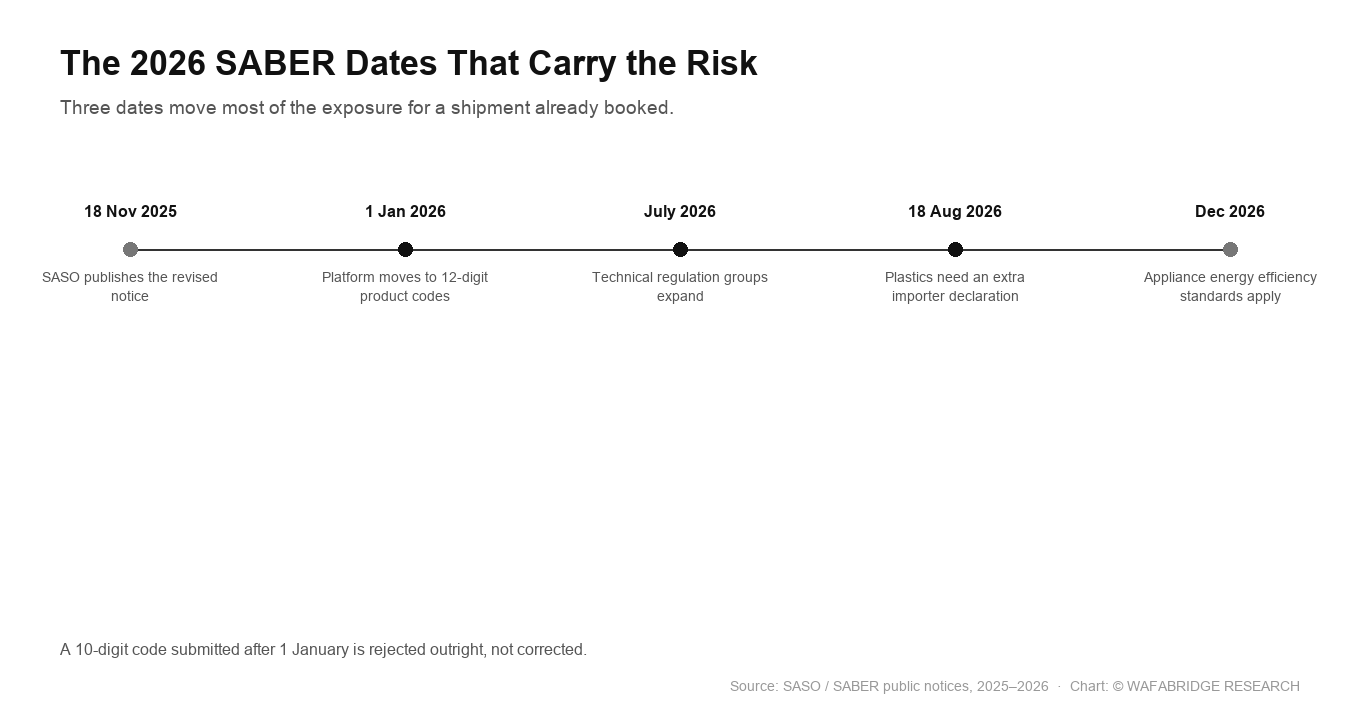
The chart above puts the three dates that carry the risk on one line, because a shipment booked before any of them still meets all three.
Old Certificates Against the New Code Structure
| Situation | System behaviour | Customs behaviour | What you do |
|---|---|---|---|
| Old code, new application | Submission rejected outright | Nothing yet | Re-file the PCoC under the 12-digit code |
| Existing PCoC still valid | Not automatically void | Re-coded on arrival, possible delay | Tell your broker early, leave buffer |
| PCoC holder is not your IOR | FASAH and SABER disagree | Cargo held | Match the certificate holder to the importer of record |
| SCoC not uploaded before loading | Not accepted at the port | Unconditional hold | Upload before the vessel departs, keep the receipt |
The viewpoint this chart carries: a certificate can fail in four distinct ways, and only one shows up before you commit money. A rejected application is visible on the day you submit it. A re-coded certificate, a party mismatch and an unuploaded shipment certificate stay invisible until the container is at the port, where the cost is storage, a missed delivery slot and a customer waiting on stock you already sold. Read this as a triage table: check the code and the importer of record first, because the other three outcomes are discovered late and paid for late.
The platform does not treat old and new certificates the same way, and the difference decides how much time you lose when something goes wrong. Four situations cover almost every case.
| Situation | System behaviour | Customs behaviour | Your action |
|---|---|---|---|
| New application on an old code | Rejected outright | — | Re-apply for the PCoC under the 12-digit code |
| Existing PCoC still valid | Not automatically invalidated | Re-assigns the code on arrival, which may cause delay | Tell your clearance broker in advance and build in buffer |
| PCoC holder is not your importer of record | FASAH and SABER records disagree | Goods held | Check that the IOR and the certificate holder match |
| SCoC not uploaded to SABER before shipment | — | Unconditional hold | Upload before the vessel departs and keep the receipt |
The second row is the one that catches experienced buyers. A valid PCoC stays valid on paper, so nothing in your file tells you there is a problem. The trouble surfaces at the port, when customs re-assigns the code against the current tariff and finds the description on the certificate no longer matches. The container clears eventually, but you have lost the delivery slot you sold your customer and paid storage for the days it took to sort it out.
The third row has nothing to do with codes and produces the same outcome: when the name on the PCoC, the importer of record and the import licence holder are not the same party, the platform and customs carry two different answers for one shipment, and customs resolves that disagreement by holding the goods. The fourth row is the most expensive: an SCoC uploaded after the vessel sailed is held without discretion, no expedited release and no waiver, so the upload must happen while the cargo is in China and the receipt is the only proof you have that it did.
Sequencing decides whether a re-file costs you a week or a month. A certificate issued on a code the system no longer recognises does not match the shipment when it arrives, and re-filing takes longer than the lead time you thought you had. The order is fixed: code first, then product certificate, then shipment certificate, then the FASAH declaration, then the importer of record check, then your paperwork.
How Much Paperwork Each Category Now Carries
The viewpoint this chart carries: the reconciliation load is not spread evenly across a shipment, and the categories with the heaviest load are the ones where a single missing document turns into a held container. Read this as a routing table for your order book: the number beside each category is how many documents have to agree with each other before the shipment is allowed to move, so it tells you where to spend audit time and which lines deserve a pack prepared once. The categories at the top are not the ones with the highest value, they are the ones with the most places to get it wrong.
Steel and building materials carry the heaviest load at eight documents to reconcile per shipment. Electric vehicles and electronics need seven, ICT equipment, automotive parts and coatings need six, and textiles and plastic products need five. A category you order monthly at the top of that list deserves a pack pre-built once.
Those counts come from a fixed set of eight possible checkpoints, and a category takes the subset that applies: the product certificate, the shipment certificate, the FASAH import declaration, the commercial invoice, the packing list, the bill of lading, the product label and the contract. Steel and building materials touch all eight, because the technical regulation, the SQM mark, the label and the contract must describe the same grade of material. A textile order reconciles five, a different job from reconciling eight.
Two categories deserve their own handling. Plastics under 39219010 and 39219090 now carry the Ministry of Industry and Mineral Resources importer declaration on top of the shipment certificate, so the count goes up rather than down. Air conditioners and appliances sit against standards that changed twice inside 2026, with the older SASO 2663:2025 and 2874:2025 certificates no longer accepted from 31 August and the new energy efficiency standards applying nationwide from 1 December, so a file that passed in June can fail in November for the same product. Our category pages set out which families we handle.
How We Run a 2026 File Before the Container Loads
The certificate work is administrative rather than technical, so it can be done properly by people who do it every week, and it is done badly when treated as a task somebody completes after the cargo is booked. This is the sequence we run on a Saudi consignment, and the point of each step is the one that follows.
Classification first. We read the listing and specification, settle the product category, and pull the 12-digit code from the current tariff lookup. The code decides which certificate route the product needs and whether the July technical regulations reach it, which makes classification the highest-leverage judgement on the file. We do not accept a supplier-supplied code or reuse one from a previous order: those are the two ways a stale code reaches a shipment.
Certificate production against the current rules. Once the code is settled we check what it triggers: a PCoC to file or re-file, a technical regulation to cite for a product in one of the July groups, an SQM mark for the covered steel sheet, a Ministry of Industry and Mineral Resources importer declaration for plastic lines, the current standard for air conditioners and appliances. Each is issued against the code and the product description, so a certificate matching neither counts as not issued.
The shipment certificate, uploaded before the vessel departs. This is the step with a hard deadline and no discretion. The SCoC goes onto the platform while the cargo is still in China, and the upload receipt is kept with the shipment file. If it goes on after the vessel sails, the consignment is held on arrival with no penalty option and no waiver.
Importer of record alignment, then the document set. The name on the PCoC, the importer named in the FASAH declaration and the import licence holder are checked against each other before documents are released, and the commercial invoice, packing list, bill of lading, product labels and the contract are reconciled against each other and against the code. This is where a consolidated shipment commonly goes wrong: a group buyer may hold certificates in one entity’s name and the licence in another’s.
Before the container is booked, we run a pre-shipment audit on the order:
- Every line carries a 12-digit code pulled fresh from the SABER tariff lookup, not carried over from a previous shipment.
- Each product’s category is checked against the July 2026 additions, so you know whether it needs a technical certificate.
- Plastics under 39219010 and 39219090 have a Ministry of Industry and Mineral Resources importer declaration ready for the SC.
- Air conditioners sit on SASO 2663:2025 and 2874:2025, and appliances are checked against the December 2026 energy efficiency standards.
- The importer of record on the FASAH declaration matches the PCoC holder, and both match the licence.
- The PCoC has been re-filed under the current code, and the SCoC uploaded to SABER before the vessel departs.
- Commercial invoice, packing list, bill of lading and product labels describe the same goods under the same code.
On the commercial side, the sourcing and buying service runs at a flat 8% of order value with no separate line items for negotiation, production follow-up, inspection or consolidation. Quotes come back in three to five days. Air DDP runs six to twelve days door to door and sea LCL thirty-plus days, and the first thirty days in our Guangzhou warehouse are free while a shipment fills, which is where a certificate question gets resolved without turning into a storage charge. On DDP routes, duty and Saudi VAT at 15% are settled before dispatch, our local partner handles clearance, and the Arabic documentation is prepared before the carton leaves. We cover nine markets on one standard and do not give tax advice.
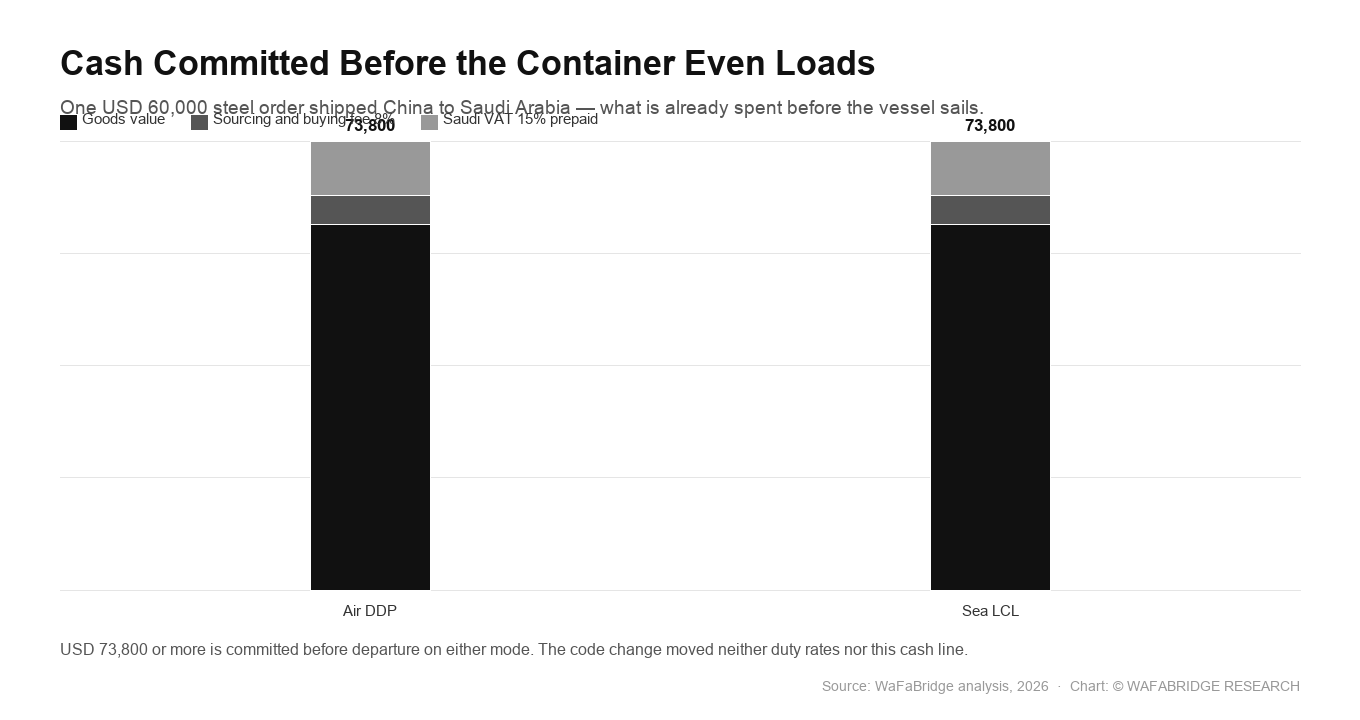
The chart above is what is already committed before the vessel sails. The code change moved neither the duty rate nor this cash line.
Worked Example: One USD 60,000 Order and the Cost of a Wrong File
The clearest way to size this is to hold the cargo and the order value constant and look at what the certificate work costs, because it is neither a tax line nor a freight line. The example uses one USD 60,000 order of steel and building materials shipping China to Saudi Arabia, at the heavy end of the documentation load with eight checkpoints to reconcile. The order value is a stated example used to make the arithmetic concrete; the rates applied are ours, and the shares shown are structural rather than a quote.
| Line | Air DDP | Sea LCL |
|---|---|---|
| Goods value (USD) | 60,000 | 60,000 |
| Sourcing and buying fee, 8% flat (USD) | 4,800 | 4,800 |
| Saudi VAT at 15%, settled before dispatch (USD) | 9,000 or more | 9,000 or more |
| Cash committed before the container sails (USD) | 73,800 or more | 73,800 or more |
| Door-to-door transit | 6–12 days | 30+ days |
| Goods value in transit (USD × days) | 360,000–720,000 | 1,800,000+ |
| Treatment on arrival, file ready | Released normally | Released normally |
| Treatment on arrival, PCoC still on an old code | Code re-assigned, delay possible | Code re-assigned, delay possible |
| Treatment on arrival, SCoC never uploaded | Unconditional hold | Unconditional hold |
| Port storage and demurrage | Quoted per shipment against the port’s free time | Quoted per shipment against the port’s free time |
Read the table in three parts. The fee line is the only part of the certificate work that shows up as a price, and it is a flat 8% of order value with nothing itemised on top of it. The VAT line is cash timing rather than cost for a registered importer, because it is recovered through the return, but it has to be funded before the container sails, which is why it sits inside the cash committed line at 9,000 or more on a 60,000 order. The transit line carries the exposure: 60,000 of goods in transit for 6–12 days by air is 360,000–720,000 of USD-days.
That last figure is what a certificate mistake costs, and it is why the treatment rows matter more than the arithmetic above them. A PCoC still filed on an old code does not stop the container arriving, it stops the description on the certificate from matching what customs expects, and the result is a re-assignment and a delay that runs into storage. An SCoC never uploaded is held without discretion, and the same 60,000 of steel sits at the port instead of moving. An error a forwarder could have caught at the quay in an afternoon becomes a week of stock you already sold. There is deliberately no line for duty, because the code change did not move duty rates, and none for a certificate fee, because the 8% covers that work here. The cost of getting the 2026 rules wrong is not a new tax bill but storage, a missed delivery slot, and working capital sitting in a container that has stopped moving.
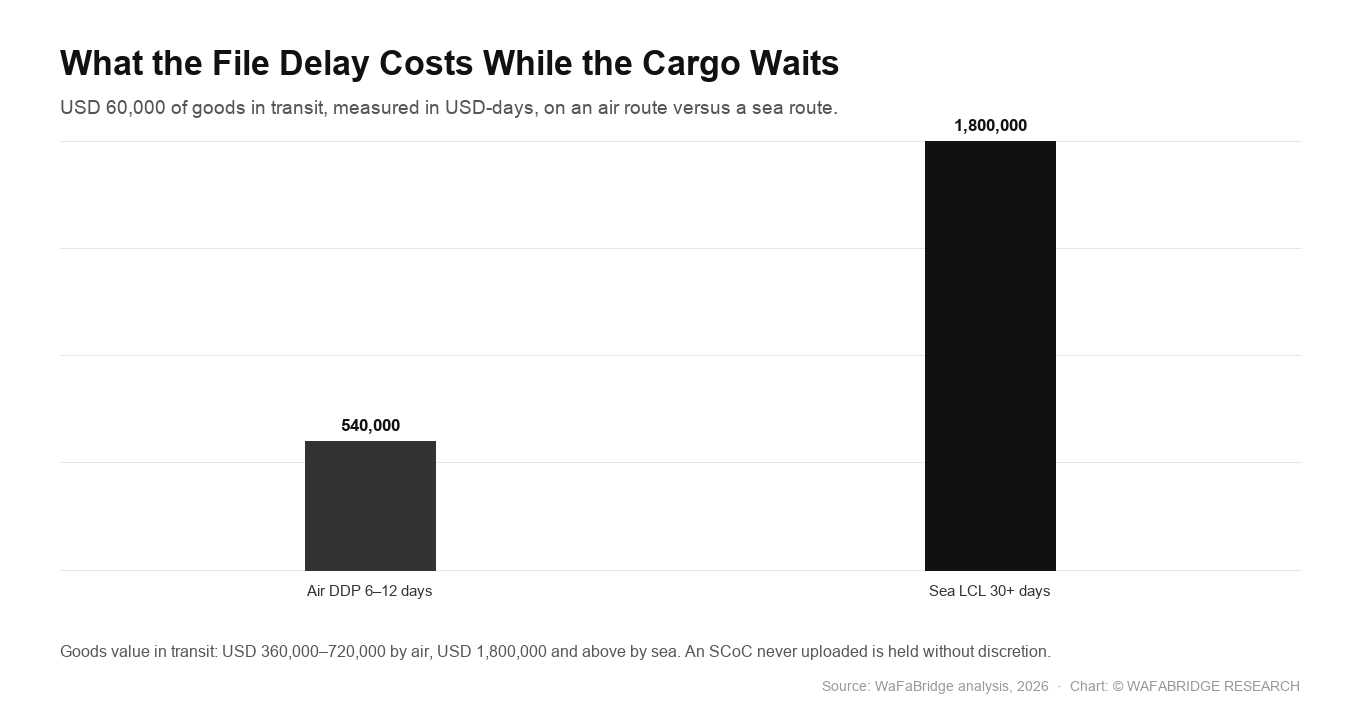
The chart above is the same USD 60,000 measured in USD-days rather than in days, which is the number a working-capital conversation actually turns on.
FAQ: Questions Buyers Ask About the 2026 Changes
My PCoC was issued in 2025 and still shows as valid. Do I have to re-file it?
Yes, because the certificate points at a code that no longer matches what Saudi customs expects. The platform does not invalidate it on paper, so the problem appears only when the container arrives and the code is reassigned.
Can I upload the shipment certificate after the vessel has sailed?
No, and this is the one rule in the 2026 regime with no discretion attached to it. An SCoC uploaded after the vessel departs means an unconditional hold, with no penalty option and no expedited release.
What extra approval do plastic products need from 18 August 2026?
Goods under HS 39219010 and 39219090 need an importer declaration approved by the Saudi Ministry of Industry and Mineral Resources, attached to the SC submission. The approval is tied to the importer and granted per shipment, so it cannot be produced months ahead.
How many documents do I have to reconcile for my product category?
Between five and eight, depending on the category. Steel and building materials reconcile the most at eight, electric vehicles and electronics need seven, ICT equipment, automotive parts and coatings need six, and textiles and plastic products need five.
Does any of this change the duty or the VAT I pay?
No. The 12-digit code structure did not move duty rates or VAT rules, so getting the codes wrong costs delay and storage rather than a heavier tax bill. Saudi VAT at 15% is still settled before dispatch and recovered through the return.
Send us the SKU list and the date you need the stock to land, and we will tell you which lines need a re-filed PCoC, which need the plastic importer declaration and what it costs to land door to door. Send it here, or model it in the cost calculator first.
Sources:
- SABER (SASO platform) — product code lookup, PCoC and SCoC submission, and shipment certificate upload.
- SASO (Saudi Standards, Metrology and Quality Organization) — the revised notice of 18 November 2025, the July 2026 technical regulations and SQM requirement, the IEC 62680 charging requirement, the air conditioner standards and the December 2026 energy efficiency rules.
- ZATCA (Zakat, Tax and Customs Authority) — customs classification alignment behind the 12-digit code, the FASAH import declaration, and Saudi VAT at 15%.
- The worked example’s order value is a stated example used to make the arithmetic concrete; the rates applied are ours and the shares are structural rather than a quote.
Note on the figures: The dates, product codes and rate references here come from published SASO and ZATCA notices current as of writing. ZATCA rates, exemption thresholds and platform rules can be adjusted, and the GCC-China free trade agreement is still in negotiation. Before you sign anything, confirm the current position with SASO, Saudi Customs and ZATCA. Research and figures compiled by 亚觅出海集团 AMI Global.