Selling on Noon or Amazon.sa is two decisions, and the second catches most sellers out. The seller gate takes 5–7 working days, compressible to 48 hours for USD 299, and needs a mainland China, Hong Kong, Macau or Taiwan licence at least 12 months old. Into the fulfilment centre, the invoice and packing list must be marked FBN inbound, platform barcode labels go on in China, and stock is sellable 1–2 days after receipt. Landed cost runs 55–65% goods, 8–12% commission. WafaBridge handles both ends.
The failure pattern is consistent. A seller clears the platform’s onboarding gate and then treats fulfilment as a parcel delivery, and ends up with a pallet of cartons in a bonded warehouse because the label format was wrong. A seller labels correctly and then books the delivery appointment a week late, and misses the receiving window. Neither failure shows up as a customs or transport problem, which is why they are often misdiagnosed. This guide covers the two shipping jobs, the seller gates, the paperwork, the labelling, the timing and the reorder calendar that keeps stock in front of buyers without tying up more cash than the category can carry.
Five things to settle before you manufacture anything
- Decide whether the order is wholesale to your own door or stock into a fulfilment centre. The two use different documents, labelling and delivery appointments.
- Clear the seller onboarding gates first. Review runs 5–7 working days, and the expedited option compresses it to 48 hours.
- Label in China with the platform barcode, and mark the invoice as FBN inbound so the consignment is routed correctly from the first scan.
- Book the delivery window and the inbound appointment together, because the receiving warehouse checks them against each other.
- Plan the reorder cycle against the platform’s go-live date, not against your factory date. The two are rarely the same week.
Two Different Jobs: Wholesale to Your Door Versus Stocking into FBN
| Wholesale to your door | Stock into a fulfilment centre | |
|---|---|---|
| Who sells it | You, to your own buyers | The platform, to end customers |
| Documents | Commercial invoice and packing list | Same, plus FBN inbound wording, platform labels, ASN and pallet ID |
| Labelling | Your own carton marks | Platform barcode and QR over the old marks, Arabic labels applied in China |
| Tax | You clear and pay at the border | You clear at the border, the platform collects VAT at the till |
| Timing | Delivery is the finish line | Receiving and 1 to 2 days of shelf put-away come after |
| Cost shape | One all-in quote | Three legs: freight, inbound handling, and platform fees |
The viewpoint this chart carries: The chart sets the two models side by side on documents, labelling, appointment, cost structure and cash cycle, and the finding is that they are not two variants of the same shipment. They differ on who controls the arrival date, and that difference cascades into every other line. Read it before you choose a route: once stock is inside a platform’s fulfilment network, the platform sets the delivery window, the label format and the receiving rules, and your go-live date depends on its operations rather than yours. Use it to decide which job each SKU belongs in, and to stop treating a wholesale shipment to your own warehouse as a cheaper version of an FBN inbound.
Wholesale to your own door means you are the importer of record for your own commercial stock. Your customer is a business buyer in Riyadh or Jeddah, your invoice is yours, your warehouse is yours, and the delivery appointment is a truck slot with your name on it. You handle the customs declaration, the VAT and the last mile. The volume profile is lumpy, often one or two containers, and the shipping decision is driven by cost per cubic metre and by when the cartons must be on the floor.
Stocking into FBN means you sell to the platform’s own customers through the platform’s warehouse network. Noon requires sellers to use its designated warehousing and distribution network, including the Dubai Hub and the Riyadh Fulfillment Center. Amazon.sa operates its own fulfilment network. In both cases the platform dictates the carton format, the label, the delivery window and the appointment slot, and your stock becomes sellable only after it is received, checked and shelved. You no longer control the arrival date of your own inventory, which is why calendar discipline matters more here than on any other lane into the Gulf.
The practical test is simple. If you are building a category position and expect repeat volume, FBN is the structure. If you are serving named wholesale accounts with mixed case sizes and your own delivery schedule, shipping to your door is. The mistake is running a wholesale programme into FBN because the platform fee sounded simpler, or running an FBN programme out of your own warehouse because the first container was in transit.
Seller Onboarding Gates Before a Single Carton Moves
The seller gates are where most new sellers underestimate the work, and they sit upstream of everything else. You cannot hold a go-live date that depends on a review you have not started.
The registration requirements are specific. The business licence must be issued in mainland China, Hong Kong, Macau or Taiwan. Sole proprietorships are not accepted, so if your sourcing entity is registered as an individual business owner, that structure will not pass. The entity must have been established for at least 12 months. Recent trading activity is required, with real transaction records across the previous six months, which means a document history rather than a shop that opened last month. You also need your own import and export rights or a signed agency agreement with a licensed forwarder, which is the route most first-time sellers use.
On the timing: standard review runs 5–7 working days, and expedited review is available for 299 US dollars, which compresses it to 48 hours. For your first batch, platform guidance points to 15–30 SKUs, a reasonable number to test with and small enough to withdraw if the category does not work. Pricing must be displayed in AED, USD and SAR simultaneously, so you need a working exchange rate process rather than a manual conversion at listing time.
One further constraint catches people: the self-fulfilment model is limited to the first 30 days of the testing period, so you cannot plan a permanent self-shipping operation on day one. Plan the first month as a test window and build the FBN flow as the destination from the outset.
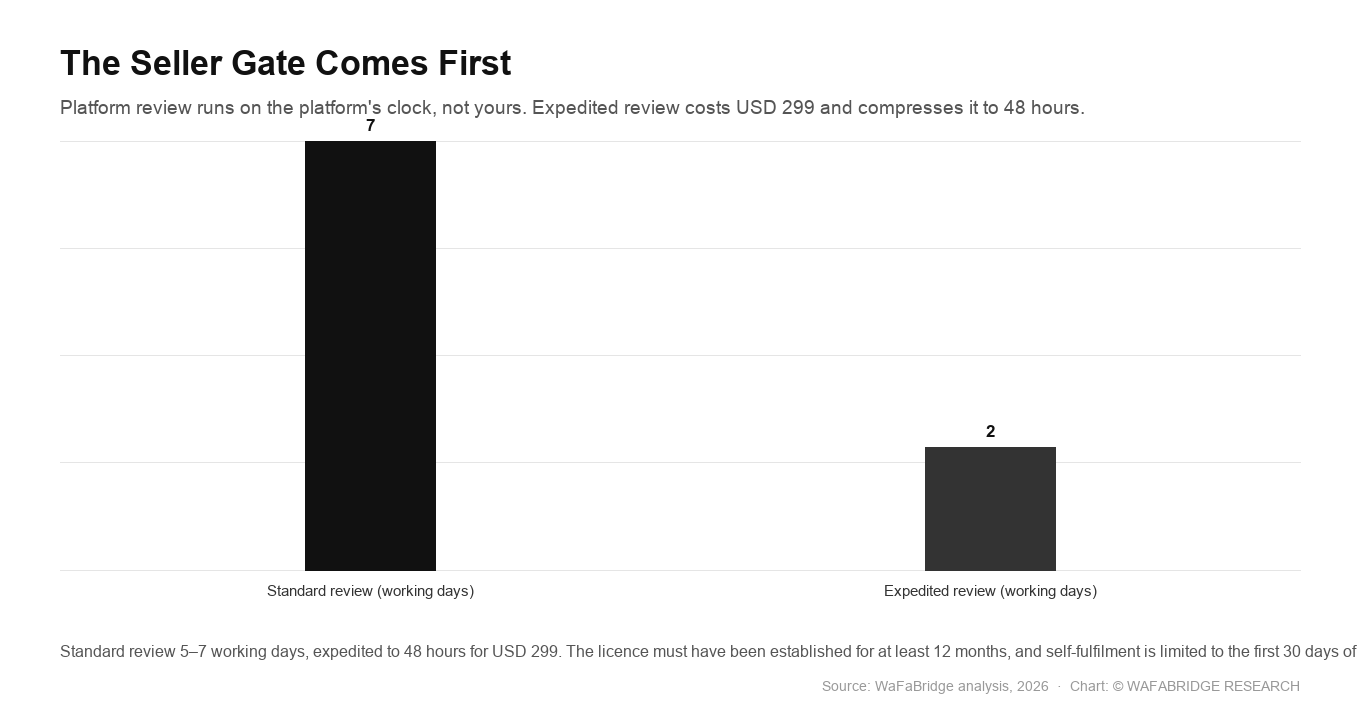
The chart above is the gate that runs on the platform’s clock, not yours, and it sits before every other date in this operation.
The Paperwork Set Both Platforms Expect
Both platforms expect a basic commercial documentation set, and the difference from a standard wholesale shipment is one phrase on the packing list. That phrase determines whether your cartons are routed to a fulfilment centre or held as an unregistered consignment.
- Commercial invoice, with the consignment marked as FBN inbound. This wording routes the delivery to the fulfilment network rather than to your own address.
- Packing list, with the same FBN inbound marking and carton counts that match the physical delivery.
- Compliance certificates for regulated categories — anything with a battery, a magnet, or cosmetics requires its own conformity documentation before it can be received and shelved.
- No additional qualification for ordinary general cargo, beyond the standard commercial documents. This is the part that keeps general merchandise moving without delay.
The full lifecycle from selection to sellable runs like this: select the product, submit for platform review at 5–7 working days, prepare stock, apply labels, move the first leg, clear at the port, book the inbound appointment, then receive and shelve over 1–2 days before the listing can sell. Each stage has a dependency, and the go-live date sits at the end of the chain rather than the middle of it. That is also why preparation errors are expensive: a labelling error found at the delivery appointment is not a same-day fix, because the appointment is booked and the truck slot allocated.
Labelling and the inbound appointment sit on the critical path. Freight does not.
The life of one replenishment, from selection to sellable stock
-
Select
Product selection
15 to 30 SKUs for a first batch
-
Approve
Platform review
5 to 7 working days, 48 hours if expedited
-
Produce
Manufacturing
Your production lead time
-
Label
Labelling in China
Platform barcode, QR and Arabic labels
-
Ship
Headhaul
Ocean or air to the gateway
-
Clear
Customs clearance
Documents checked against the shipment
-
Book
Inbound appointment
Delivery window booked with the warehouse
-
Shelf
Receiving and put-away
1 to 2 days before it can be sold
The viewpoint this chart carries: The timeline runs left to right from review to sellable stock, and the segment that decides your launch is the last one before the listing goes live. What the chart makes visible is that receiving and shelving take 1–2 days on their own, and that they sit behind a delivery appointment you cannot move once the truck is booked. Use it to build the go-live date backwards from the appointment rather than forwards from the factory date, and to hold float between delivery and launch to absorb a receiving delay. The boundary the chart does not show is the platform’s own launch calendar, which can set your go-live date independently of your supply chain.
One regulatory change sits on the inbound leg and applies to every container, whether it goes to a platform or your own warehouse. Since 8 May 2025, Saudi Arabia requires palletised handling for all container imports, with a 12-month transition period and exemptions for bulk cargo, heavy machinery and oversized goods. The practical effect on a fulfilment-centre delivery is that the pallet identifiers are not optional paperwork. They are the mechanism by which the receiving team matches what arrived against what the platform expects, and a delivery without pallet IDs gets counted manually.
Labelling, Barcodes and the FBN Inbound Wording
Labelling is the part that decides whether the receiving team can process your delivery without stopping it. There are three components, and they have to work together.
First, the official compliance barcode. It has to be the current platform barcode for the listing, not one generated from your own catalogue. Second, the AWB. Third, a QR label. These labels must cover the old barcode: the new ones go over the existing ones rather than beside them, because a carton carrying two live barcodes will scan ambiguously and get pulled as a discrepancy at receiving.
For a full container, you also need the pallet ID and the ASN inbound number marked. Those identifiers tie your physical pallet to the advance shipping notice in the platform’s system, and let the receiving team match what arrived against what was expected. Arabic labels are applied in China, and this is the point most often left late. The label has to be affixed before the goods leave, not added at the Saudi fulfilment centre or by your forwarder on arrival. If your supplier prints and applies labels in China, this belongs in the purchase order as a delivery item, not a request you make afterwards.
Note that “FBN inbound” on the invoice is a separate requirement from the label work. The barcode tells the warehouse which listing the carton belongs to; the invoice wording tells the logistics chain where it is going. Both are needed, and both are checked at different points: one at the scan, one at clearance. A delivery with correct labels but an unmarked invoice still ends up sitting, and so does an unmarked consignment with perfect labels.
Getting the Timing Right: Booking, Uplift, Delivery Windows, Go-Live
The timing question for a fulfilment-centre shipment is not “when will it arrive” but “will it arrive inside an accepted window”. The receiving operation runs on appointments, and an appointment is a slot with a date and a time window, not a general permission to deliver.
The sequence works like this. You book the delivery window with the fulfilment centre first, and the appointment is then linked to your inbound shipment reference. Uplift from the origin warehouse and the delivery appointment are checked against each other. A container that arrives outside its booked window is a booking that has to be renegotiated, and renegotiation with a busy receiving operation in peak season means waiting for the next slot.
That is why booking and appointment are arranged together rather than sequentially. Book the transport only once the window is confirmed, or book both in the same conversation. This applies to FCL deliveries in particular, where the volume makes a missed window expensive.
The go-live date is the final variable, and it belongs to the platform rather than to you. The listing goes live when the platform says it does, which depends on review completion, stock arriving and being shelved, and the platform’s own launch calendar. Your factory date is upstream of all of it. The failure pattern to avoid is a factory schedule that delivers stock in the same week the platform expects to launch, with no float for receiving and shelving, which run 1–2 days after delivery. Build the plan backwards from the go-live date.
How We Run an FBN Inbound Order
The seller-side gates are the visible part of this work. The inbound side is where most of the operational detail sits, and where a mistake costs a delivery slot rather than a fee.
Gate and document preparation in parallel. We start the seller review as soon as the entity documentation is in order, because the 5–7 working day review runs on their clock and not ours. While that is in progress, the commercial invoice, packing list and FBN inbound markings are prepared against the actual carton configuration rather than a draft SKU list, so the document pack matches the pallets that will arrive. A document pack built from a guess and corrected afterwards is the most common cause of a delivery that clears customs and then cannot be received.
Labelling as a purchase order deliverable. Platform barcode, AWB and QR labels, plus Arabic labels and the pallet ID and ASN inbound number, are specified in the purchase order and applied in China before the goods leave the supplier. We verify the label set against the current platform format before the container is sealed, because a superseded barcode produces a discrepancy at receiving that cannot be fixed from the warehouse floor.
Appointment before transport. The delivery window is booked with the fulfilment centre and then the transport is arranged to match it, rather than the other way round. For regulated categories we confirm the conformity documentation is accepted before the goods are loaded, not after they reach the gate. Where the seller is within the first 30 days of the testing period, the self-fulfilment route is planned as a test, not the operating model, so the FBN flow is built from the start.
One consignment, one document pack. Stock from several suppliers is consolidated before it moves, so the delivery arrives as a single consignment with one set of commercial documents, one pallet list and one appointment. That keeps the inbound flow predictable: the receiving team works from the advance shipping notice, and a container whose contents do not match the notice is the case that gets counted manually. The consolidation mechanics are covered in how we consolidate China orders for Gulf buyers.
Worked Example: One USD 40,000 Order Into Amazon.sa or Noon
The viewpoint this chart carries: The chart splits the landed cost into the share you set and the share the platform sets, and the finding is that two thirds of the total sits outside your negotiating room. Goods at 55–65% dominate, so the buying decision outweighs every logistics saving combined. But the lines you cannot negotiate — commission at 8–12%, last-mile delivery at 5–8% and inbound handling and labelling at 3–6% — add up to 16–26% of the landed cost, and they are collected from the first day the listing is live. Read the chart that way: it shows which errors are expensive, and why a rejected label or a missed appointment costs more than its fee suggests.
The clearest way to see where the money goes is to fix the order value and apply the cost structure to it. The example below uses a single USD 40,000 order of general merchandise into a Saudi fulfilment centre. The percentages are the structural shares of a typical category, not a quote, so the figures are ranges. Read them as the shape of the landed cost rather than a price, and note which lines you control and which the platform sets.
| Cost line | Share of landed cost | On a USD 40,000 order (USD) | Who sets it |
|---|---|---|---|
| Goods value | 55–65% | 22,000–26,000 | You, through the buying decision |
| First-leg freight | 12–18% | 4,800–7,200 | Lane and mode |
| Platform commission | 8–12% | 3,200–4,800 | The platform |
| VAT | 7–9% | 2,800–3,600 | Recoverable, so it hits cash flow before cost |
| Last-mile delivery | 5–8% | 2,000–3,200 | The platform network |
| Inbound handling and labelling | 3–6% | 1,200–2,400 | Format and pallet rules |
| Duty | 3–5% | 1,200–2,000 | HS code and origin |
| Landed cost above the goods value | 38–58% | 15,200–23,200 | — |
| Total landed cost | — | 37,200–49,200 | — |
Two lines decide whether this order works. The first is the goods value line, at 55–65% of the total and therefore the only part large enough to change the arithmetic. A buyer who negotiates 5% off the goods price has moved more money than any realistic saving on freight or labelling, which is why sourcing decisions get made before the shipping plan rather than after. The second is the VAT line at 7–9%: because Saudi’s 15% VAT is recoverable, it lands on cash flow before it lands on cost. A USD 40,000 order carries roughly USD 2,800–3,600 of VAT that you pay and then reclaim, and if the reclaim lags the payment, that gap is funded out of your working capital on the second order.
The lines you do not control are worth reading together. Platform commission at 8–12%, last-mile delivery at 5–8% and inbound handling and labelling at 3–6% account for 16–26% of the landed cost, and every one is set by rules you accept rather than negotiated. That is the practical argument for getting the compliance steps right: a rejected label, an unaccepted conformity certificate or a missing pallet ID does not only cost a fee, it costs a delivery slot that pushes the order past its launch date while the commission structure keeps running.
One caution on the table. The shares are structural and the ranges are wide, so the totals are a band rather than a price. The arithmetic is what transfers: take your own order value, apply the band for each line, and you can see which lines are large enough to be worth a decision. Freight and duty are set by the lane and the HS code, so they belong in a quote. The commission, delivery and handling lines are set by the platform, so they belong in the go-live plan. Our itemised landed cost breakdown sets out the method line by line.
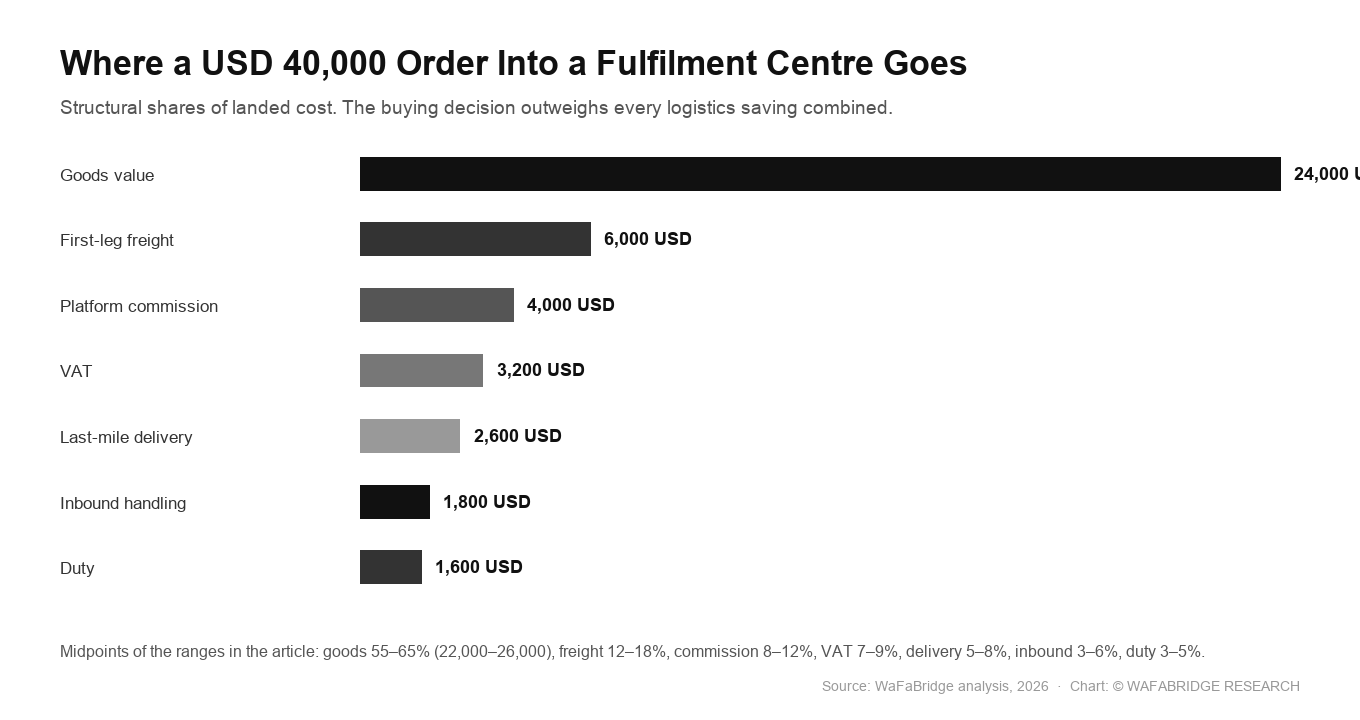
The chart above is the same order as structural shares, and it shows that the buying decision outweighs every logistics saving combined.
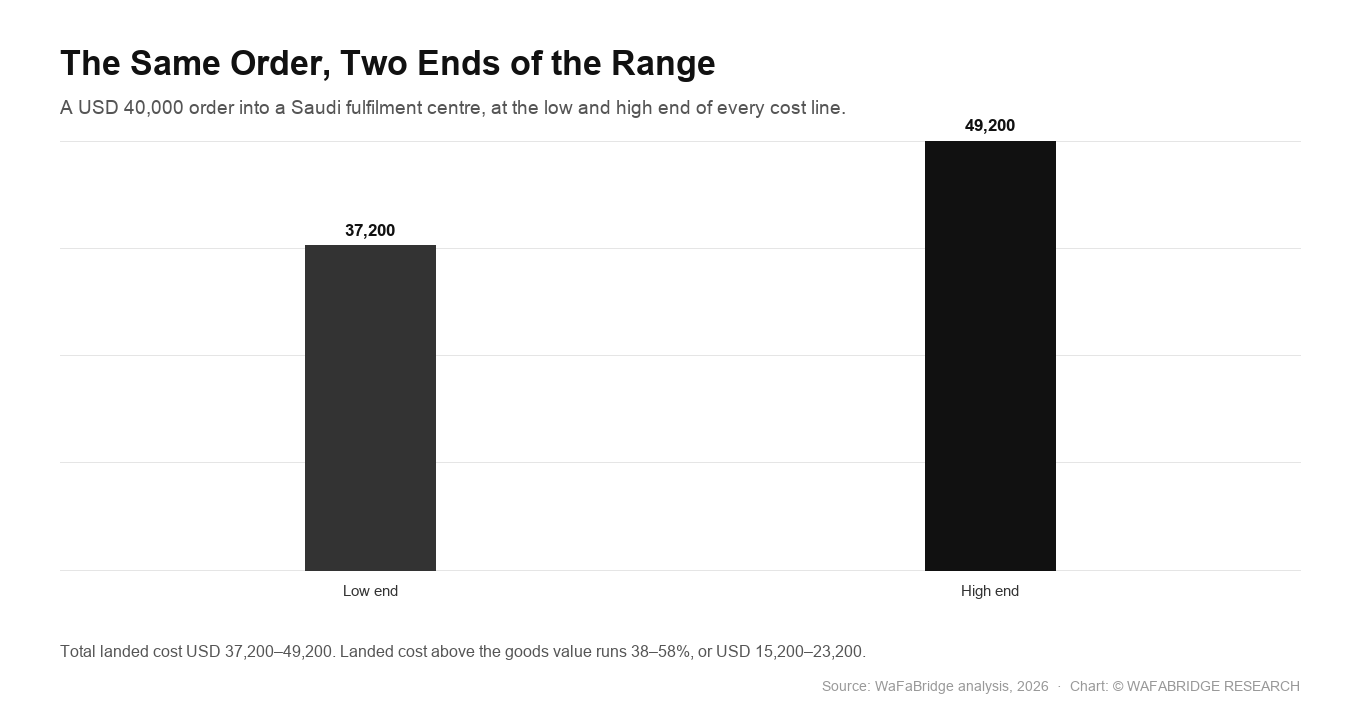
The chart above is the same order at both ends of every range, which is the honest way to quote it: the spread is wide, and it is driven by the buying decision.
FAQ: Questions Sellers Ask About Fulfilment Inbound
Can a Chinese sole proprietor sell on Noon or Amazon.sa?
No. Sole proprietorships are not accepted. The business licence must be issued in mainland China, Hong Kong, Macau or Taiwan, the entity must have been established for at least 12 months, and real transaction records across the previous six months are required. If your sourcing entity is registered as an individual business owner, the structure has to change before you apply.
Do I need a VAT registration number to list, and what happens without one?
From 2026 sellers are expected to provide a valid VAT registration number, and where it is missing the platform withholds 15% and remits it directly. That rests on a single source, so confirm it with the platform or your tax adviser before you build a margin model on the assumption that the number is optional.
What documents does a Noon FBN inbound delivery need?
A commercial invoice and a packing list, both marked as FBN inbound, with carton counts matching the physical delivery. Anything with a battery, a magnet, or cosmetics needs its own conformity documentation before it can be received and shelved. Ordinary general cargo needs no qualification beyond the standard commercial documents, which is the part that keeps most shipments moving without delay.
How long does it take from delivery to a sellable listing?
Receiving and shelving run 1–2 days after delivery, and the listing goes live only when the platform confirms it. Build the plan backwards from the go-live date and leave float between delivery and launch, because the appointment is a booked slot with a time window, and a container delivered outside it waits for the next available one.
Do all container imports need palletised handling now?
Since 8 May 2025 Saudi Arabia requires palletised handling for all container imports, with a 12-month transition period and exemptions for bulk cargo, heavy machinery and oversized goods. For a fulfilment-centre delivery this is not optional paperwork: the pallet ID and ASN inbound number are how the receiving team matches what arrived against what was expected, and a delivery without them is counted manually.
Send us your SKU list, target go-live date and fulfilment centre, and we will confirm the onboarding gate status, the label format and a delivery window that lines up with your launch. Talk to the WafaBridge team before you print a single label, or model the landed cost in the cost calculator first.
Sources
- Noon Seller Centre — seller registration requirements, document and labelling specifications for FBN inbound, and the designated warehousing and distribution network including the Dubai Hub and Riyadh Fulfillment Center.
- Noon Partners — seller onboarding, review timelines, accelerated review and the first-batch SKU guidance used in this guide.
- Amazon.sa Seller Central — seller account requirements, inbound shipment documentation and FBN receiving procedures for the Saudi marketplace.
- Cost shares are the structural breakdown of a typical category, stated as ranges rather than as a quote. The VAT registration number requirement rests on a single published source, so confirm it with the platform or your tax adviser before relying on it.