Composite cases in this article are drawn from consignments we handle on the Guangzhou–Gulf corridor; names and figures are changed, the mechanics are not.
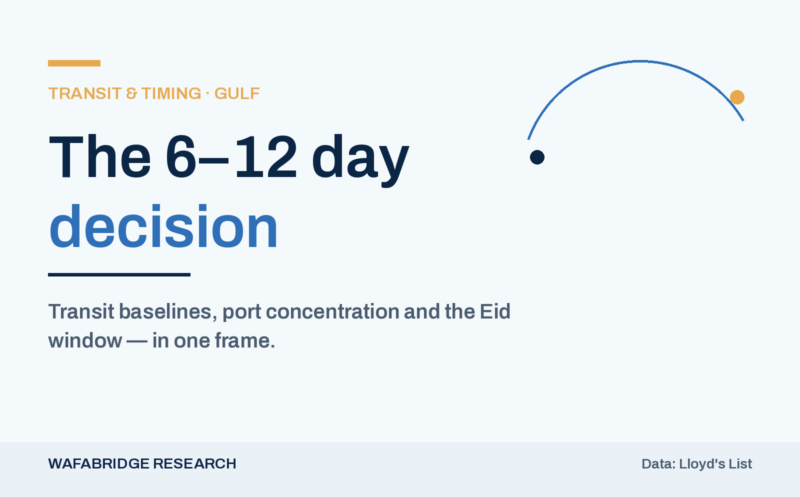
Air DDP from China to the Gulf delivers in roughly 6–12 days door-to-door; sea LCL takes 30-plus days — and the right choice is not “whichever is cheaper” but whichever arrives before your deadline, because on this corridor the cost of lateness usually dwarfs the cost of freight. Ask the calendar first, the invoice second.
Two hundred cartons and one question
A Jeddah buyer — call him Mazen — had 200 cartons of kitchenware to move from Guangzhou. The quotations were unambiguous: sea LCL, DDP to his door, in the low thousands of dollars and around 35 days; air DDP, in the mid four figures and 8 days. He asked the question every buyer asks: “Is air worth that much more?”
The honest answer is that the question is unanswerable as asked — because “worth it” is a function of what the goods are doing during those 27 extra days, and the freight quote knows nothing about that. If the cartons are replenishment for a steady line with six weeks of stock on the shelf, the sea quote is obviously right and the air quote is money burned. If the cartons are stock for a shop opening in three weeks, or Eid seasonals with a collapsing window, or a product Mazen’s competitors are one order behind him on — then the sea quote is the expensive one, and the air quote is the cheap option that only looks expensive.
This article is the framework for answering the question properly: what each mode actually costs and delivers on this corridor, the three factors that decide between them, and the decision rules we apply when buyers ask us to quote both.
What each mode actually is
Air DDP, 6–12 days. Air freight from South China to the Gulf is a mature, high-frequency trade: daily departures into Dubai, Riyadh, Jeddah and Doha, and — for DDP consignments — clearance and last-mile delivery handled by the forwarder’s network, with Aramex, DHL, FedEx and UPS carrying the final kilometre in most Gulf markets. Door-to-door in one to two weeks is the honest baseline; the variance comes from flight routing and, in Saudi Arabia, from clearance preparation done before departure. Air’s other property is predictability: capacity is bought per kilogram on scheduled flights, so a booked consignment moves roughly when its booking says it will.
Sea LCL, 30-plus days. Less-than-container-load sea freight consolidates your cartons with others into a shared container, sails the South China Sea and Indian Ocean to a Gulf gateway — Jebel Ali for the eastern Gulf, Jeddah for the Red Sea coast — clears, strips the container at a deconsolidation warehouse, and delivers. Door-to-door of 30 to 40 days is the realistic envelope, not the 18-day port-to-port fantasy that ocean maps suggest. The variance sources are structural: consolidation cut-offs before sailing, port handling, deconsolidation queues, and the inland leg (Dammam and Riyadh sit days beyond the berth). Sea’s compensating virtue is cost per cubic metre, which air cannot approach — and its floor is volumetric pricing on badly packed cargo, which is where “cheap” sea quotes quietly grow.
The Middle East container ports chart in our Eid article shows the funnel: the region’s flow concentrates through a handful of gateways, and Jebel Ali — about 15.5 million TEU in 2024, back inside the global top ten — is the eastern Gulf’s default. Frequency is air’s home ground; scale is sea’s.

Factor one: the calendar, always first
The first question is never “air or sea” — it is “when does this stock need to be sellable?” Everything else is arithmetic backwards from that date. Replenishment with comfortable cover: sea, every time, and the freight saving drops straight to margin. Seasonal stock with a hard window — Eid above all: sea is only a real option if booked six weeks before the holiday, and the space itself is contested (our Eid calendar article carries the full eight-week template). A deadline inside five weeks is, in practice, an air-freight decision wearing a sea-freight question’s clothes.
The corridor’s history sharpens this: the Gulf imported a record $161.2 billion from China in 2024, and the seasonal waves inside that flow — Ramadan, Eid al-Fitr, the school year, National Days — keep crashing into the same weekly vessel loops. The buyer who decides mode by quote alone is deciding the same question the market has already answered against him.
Factor two: the goods, and what time does to them
The second question is what those extra weeks do to the value of what you’re shipping. Three categories of answer:
Goods that don’t decay in value: household staples, spare parts, slow-fashion basics — time costs almost nothing, sea wins on arithmetic. Goods with a season: anything bought for a date — gifts, festive lines, back-to-school — where the value curve falls off a cliff after the window; here freight cost is nearly irrelevant next to the cost of missing the date, and air is the rational default once the sea cut-off is uncertain. Goods with competitors: new products, trending items, anything where being first to the local market captures the margin — the air premium is best understood not as freight cost but as the price of arriving before the copycats’ containers do.
There is also the volume truth that surprises newer buyers: air is priced by actual weight or volumetric weight, whichever is greater; sea LCL by cubic metre. Light, bulky goods (lampshades, plastic furniture, stuffed toys) pay a brutal volumetric penalty in air — sometimes enough to erase air’s speed advantage on pure cost grounds even when the calendar allows it. Dense goods (hardware, tools, cosmetics) travel disproportionately well by air. Before choosing, weigh the cartons and me ghput, 2022–2024″ src=”https://wafabridge.com/wp-content/uploads/2026/11/chart-c5-jebel-ali-trend.png” />
Factor three: the risk stack behind each mode
The third factor is risk, and the two modes distribute it differently. Sea consignments carry longer exposure to schedule variance — port congestion, transhipment delays, the pre-Eid space crunch — and a longer window in which a clearance query can compound into demurrage. Air consignments move fast enough that a document error costs days rather than weeks, but they concentrate another risk: any non-conformity found on arrival is discovered after the premium has been paid, which is why DDP air on this corridor should always be paired with pre-departure inspection at the China warehouse. The mode doesn’t remove the risk of bad goods; it changes when you find out, and at what price.
What each mode costs, honestly
Ranges on this corridor move with fuel, capacity and season, but the structure of the two cost lines is stable enough to carry in your head. Sea LCL is priced per cubic metre: a mid-value consumer consignment commonly sees all-in sea freight — origin haulage, ocean, deconsolidation, destination clearance handling — land in the low hundreds of dollars per cubic metre, with the spread driven by season and by how well the cartons pack. Air is priced per chargeable kilogram: on the same goods, air’s freight line typically runs several multiples of sea’s — and the multiplier is not fixed, because the chargeable weight is the greater of actual and volumetric weight, so a pallet of lampshades pays air rates on its box dimensions while a pallet of hand tools pays on its scale weight.
Work the same 2-cubic-metre consignment both ways and the shape appears. Sea LCL, packed well, might carry a $600–900 freight line and deliver in five weeks. Air, at 80 kg actual but 333 kg volumetric (2 cbm × 1,000,000 ÷ 6,000), charges on 333 kg — and the freight line lands several thousand dollars higher, in exchange for delivery inside ten days. Neither number is “the cost.” Each is the price of a different promise, and the volume arithmetic — not the weight on the scale — is usually what writes the air bill.
The hybrid play
The mode question is also rarely all-or-nothing, and the corridor’s most cost-efficient operators rarely answer it that way. The standing pattern is the split: sea-freight the predictable base — the 70–80% of the order that the market will absorb at its normal pace — and air-freight the launch quantity or the best-seller subset, so the shelf is stocked and selling while the container still sits a week from the strait. The air premium is then paid only on the cartons whose early arrival earns it, and the sea line carries the rest at its honest price.
A second hybrid works across orders rather than within one: air the first order of a new line, sea the reorders. The first order’s job is to test the market in units of time, not to optimise freight; the reorders, once the line proves out, ride the sea lane where the saving compounds monthly. Buyers who invert this — testing new lines by sea, paying air forever on proven ones — manage the remarkable achievement of overpaying on both.
The season writes its own prices
Everything above describes the two modes in an average quarter; the corridor rarely offers one. Rates on both modes breathe with the calendar, and the buyer who quotes in February and ships in April has watched the answer move under his feet. The pre-Eid window is the loudest: sea space is auctioned, peak-season surcharges land on the loops, and air — the pressure valve for everyone who missed the sea cut-off — reprices upward exactly when the most urgent buyers enter it. A 2-cbm consignment that quoted at $700 by sea in January can be unquotable by April, and its air alternative can run half again what the same air quote said in January.
The seasonality is not random; it has a fixed geography. Ramadan’s final weeks and the run to Eid al-Fitr are the year’s annual peak. The back-to-school weeks, the Gulf’s National Days, and Q4’s global peak each put their own shoulder on capacity. And the Red Sea era added a permanent wobble: displaced capacity and re-deployed strings keep baseline rates and schedule variance higher than the pre-2024 memory suggests. The practical translation for a buyer: the mode decision and the calendar decision are the same decision made twice. A mode that loses on price in the trough can win on availability in the peak — and a quote older than a quarter is not a price, it is a rumour.
What you are actually buying in an air quote
“Air freight” is one phrase covering three different products, and knowing which one a quotation describes matters as much as its price. Express integrator service — the DHL/FedEx/UPS tier — is the corridor’s premium product: door-to-door in days, customs handled inside the network, tracking down to the delivery scan, priced accordingly. It is the right product for samples, documents, small urgent parcels and launch quantities — and the wrong product, economically, for a pallet. Air consolidation — general air freight, palletised into an agent’s consolidation, cleared and delivered by the destination network — is the workhorse behind most DDP air quotations on this corridor: mid prices, 6–12 day door-to-door, and the mode the transit baselines in this article describe. Above both sits charter and part-charter, the emergency tier for outsize or critically urgent volume, priced case by case and irrelevant to 99% of buyers except as the reason the other two tiers stay honest.
The buyer-facing consequences are practical. Consolidation cut-offs are real: goods must reach the origin warehouse before the pallet closes, and missing it costs a week, not an hour. Chargeable-weight arithmetic differs by product mix, so an air quote is only as good as the carton dimensions behind it — measured, not assumed. And clearance speed in the Gulf is partly a pre-departure variable: the consignments that clear in two days on arrival are the ones whose documents were built in Guangzhou, which is why air DDP on this corridor is always paired with pre-shipment inspection and document preparation. Paying air prices to move fast and then losing a week at the border to paperwork is the corridor’s most avoidable expense.
The split, in numbers
The hybrid play earns a worked example, because its arithmetic is what converts “clever idea” into standard practice. Take Mazen’s 200 cartons again — a kitchenware line launching in Jeddah with a selling season that opens in five weeks and runs four months. Full-sea and full-air are the two naive answers; the split is the third.
Full sea: the whole order rides LCL at, say, $2,400 of freight, arrives in week five — the season is already open, and the launch misses its own first weeks. Full air: the whole order flies at roughly $9,000, lands in eight days, and the launch is perfect — and $6,600 of premium was paid to hurry cartons that would have sold at exactly the same pace in week seven as in week two. The split: 40 cartons of the proven best-sellers fly ($1,800), the remaining 160 ride the sea ($2,400 — same cubic metres, slightly better packed), and the season opens on schedule with the shelf stocked while the bulk arrives into selling, not into a launch. Total freight: $4,200 — $2,400 more than all-sea, $4,800 less than all-air, and the only cartons that paid the air premium were the ones whose early arrival actually sold.
The numbers generalise into a rule of thumb: air the first two weeks of expected demand, sea the rest. What that equals in cartons depends on the line’s velocity, which is why the split is built off a demand estimate rather than a freight quote — and why the buyers who run it well are the ones whose reorder data from previous lines tells them what “two weeks of demand” actually weighs. The split is the corridor’s standing compromise between the calendar’s honesty and the invoice’s, and it is available on almost every order with more than a month of selling season in front of it.
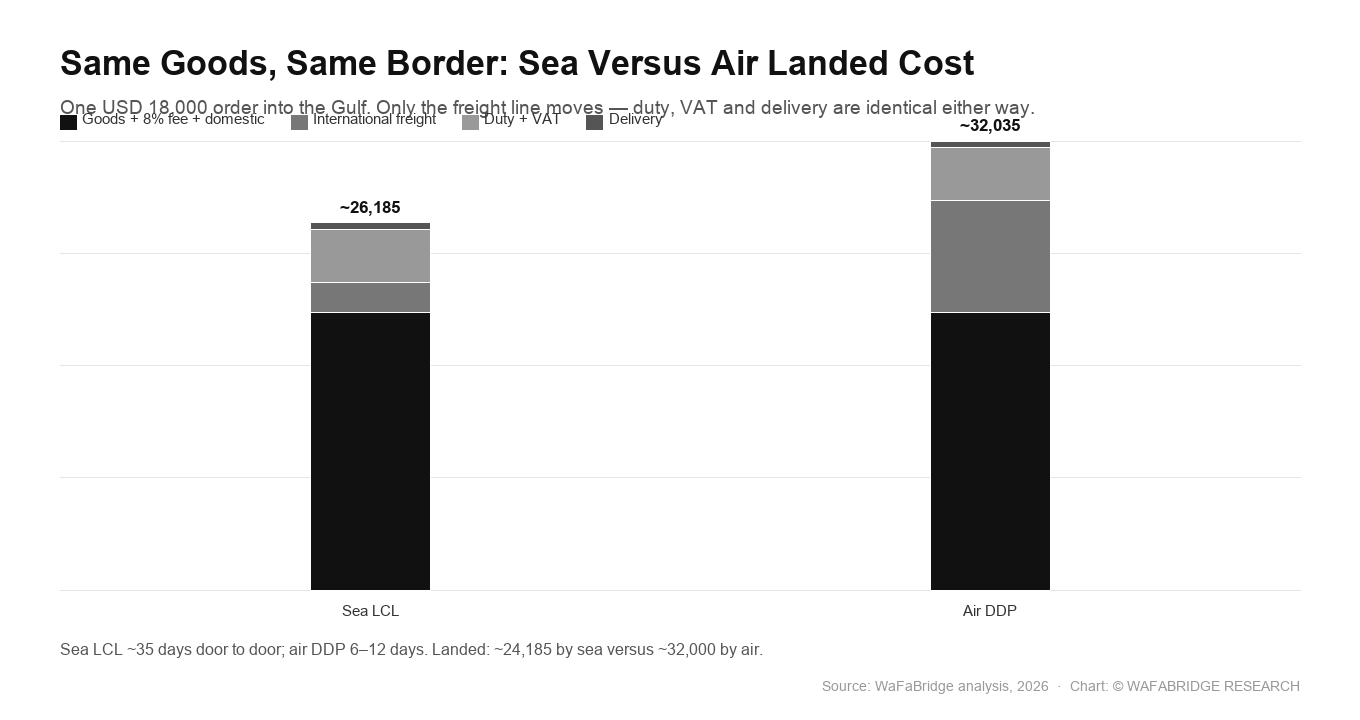
The chart above prices the same order both ways. Everything except the freight line barely moves, so the decision comes down to what those extra days are worth.
The decision rules we actually use
Compressed from thousands of quotations, the working rules look like this. Deadline inside five weeks: air. The sea option is theoretical. Deadline beyond six weeks with comfortable cover: sea, and bank the saving. Seasonal stock with a window: decide at the Eid cut-off table, not at the freight-quote table — if confirmed sea space lands before the window, take it; if not, the debate is over. First order of a new product line: lean air. The first order’s job is to test the market fast and cheaply in units of time; reorders, once the line proves out, migrate to sea where the saving compounds. Replenishment of proven lines: always sea, booked against the calendar, with air reserved as the emergency lever. And above all: quote both, always. The corridor’s rates move enough — fuel, capacity, season — that a standing assumption (“air is 4x sea”) is stale within a quarter. The relative price is a number to check, not a rule to remember.
One decision, two prices
The air-versus-sea question feels like a freight question because it arrives with two freight quotes attached. It is actually a business question wearing a freight costume: what is this stock for, when must it sell, and what does each extra week of transit do to its value? Answer those three and the mode chooses itself. Buyers who keep asking “is air worth it?” in the abstract will keep overpaying — in freight on the easy loads, and in missed windows on the urgent ones. The corridor charges for the wrong answer on both ends.
Transit baselines and rates move with capacity and season; confirm current lead times for your lane and dates, or ask us to quote both modes door-to-door before you commit.
Internal links: Cost Calculator · Gulf Eid Logistics Calendar · DDP Shipping · Landed Cost, Itemised
Sources: Lloyd’s List One Hundred Ports 2024 (Jebel Ali throughput); GCC Statistics Center (GCC–China trade); carrier transit-time baselines on the South China–Gulf lanes.
Chart: © WAFABRIDGE RESEARCH
Frequently asked questions
How long does air freight from China to the Gulf take?
DDP air freight door-to-door typically runs 6–12 days from Guangzhou to Gulf destinations including clearance and last-mile delivery. The variance comes from flight routing, consolidation schedules and, in Saudi Arabia, pre-departure clearance preparation.
How long does sea freight from China to the Gulf take?
Sea LCL door-to-door realistically takes 30–40 days: a 18–22-day ocean leg to Jebel Ali or Jeddah, plus consolidation before sailing and deconsolidation, clearance and inland delivery after arrival. Port-to-port maps understate the true envelope.
Is air freight worth the extra cost?
Only when time has value: seasonal windows, urgent replenishment, new product launches, or any stock whose value falls with each week of delay. For steady replenishment with comfortable cover, sea freight’s lower cost per cubic metre wins and the saving drops to margin.
Why is my air freight quote based on volume, not weight?
Air is priced on chargeable weight — the greater of actual and volumetric weight (length × width × height ÷ 6000). Light, bulky goods pay a volumetric penalty that can erase air’s speed advantage on cost. Dense goods travel disproportionately well by air. Measure cartons before comparing quotes.
Can I switch from sea to air after booking sea?
Sometimes, and it is expensive: the goods must be at a point where the switch is physically possible, and air capacity is bought close to departure at peak rates. This is why mode should be decided against the calendar before booking, not revised after the sea space is lost.