Weekly
Monday to Friday
Customs and ports operate through the standard business week. Saturday clearances happen for express and e-commerce flows; Friday afternoon is the quiet pocket to plan around, not a closure.

The 5+5 rule, the two different duty-free thresholds — and which one your parcel actually gets. Written for buyers sourcing from Chinese platforms and Chinese suppliers, delivering into Dubai, Abu Dhabi and beyond. The Gulf's easiest lane — if you know where the thresholds sit.
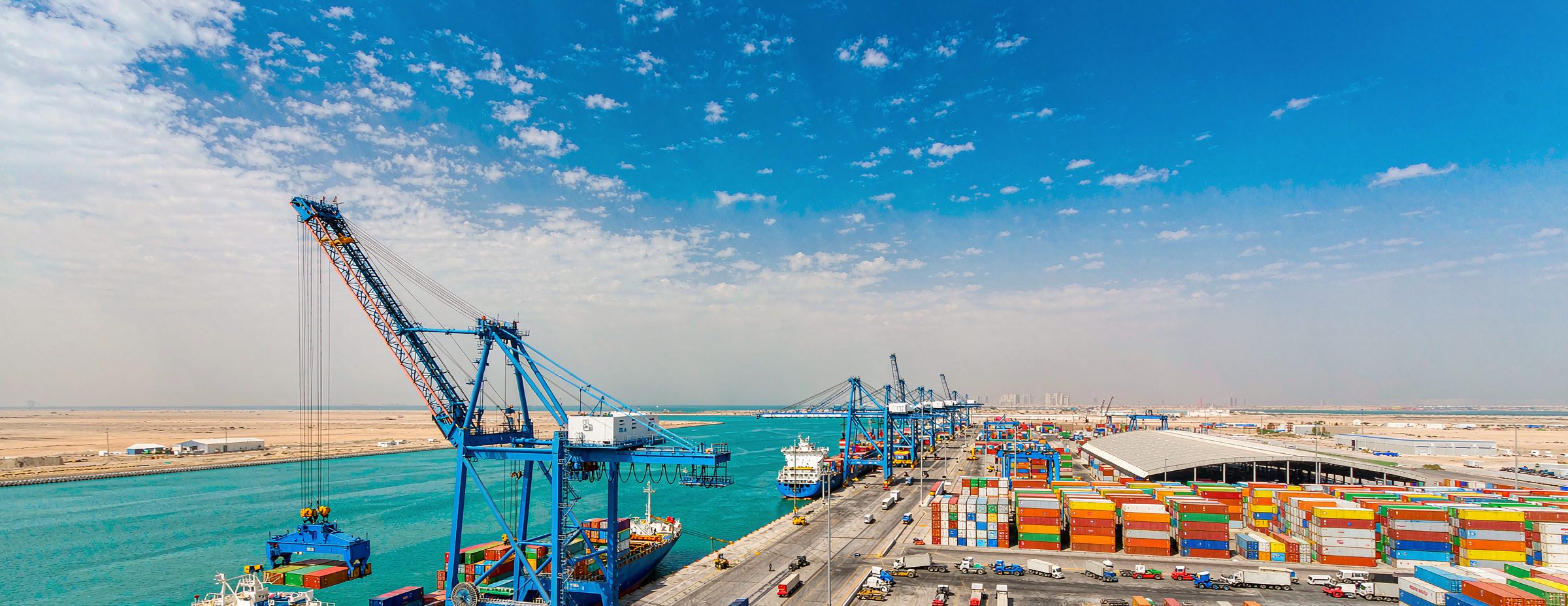
The UAE is a transshipment economy: most air cargo to Dubai continues onward to the Gulf, Africa and South Asia, which means frequencies are high and rates are competitive — an air shipment to Dubai usually beats one to Riyadh by two to four days on the same week. Sea freight enters through Jebel Ali, the largest port in the Middle East, or Khalifa Port for Abu Dhabi.
| Route | Entry point | Transit from Guangzhou | Best for |
|---|---|---|---|
| Air, consolidated | DXB · DWC · AUH | 5–8 days door to door | Electronics, samples, apparel restocks, marketplace orders with a clock on them |
| Sea LCL | Jebel Ali, Dubai | 25–32 days + 3–6 days clearance | Furniture, homeware, fixtures, orders above 3 CBM |
| Sea LCL | Khalifa Port, Abu Dhabi | 27–34 days + 3–6 days clearance | Abu Dhabi and Al Ain deliveries |
| Sea FCL | Jebel Ali | 24–30 days + clearance | Full containers; free-zone storage and re-export options on request |
Transit is measured from pickup at the Chinese supplier to delivery at the UAE address, documents complete at departure. Missing conformity paperwork adds days at clearance but rarely weeks — the UAE holds goods for queries, not for principle.
The UAE is the cheapest major market in the Gulf to land goods into — roughly 10.5% on top of CIF for a standard consignment, against Saudi Arabia's twenty-plus. Both rates are flat. The only things that move the number are the product category and the emirate your parcel lands in.
        // step 1 — dutiable value

        CIF = goods + international freight + insurance


        // step 2 — duty, then VAT on the duty-inclusive value

        duty = CIF × 5%

        VAT  = (CIF + duty) × 5%

        excise = only for listed categories, on the retail price


        // step 3 — landed cost, before our fee

        landed = CIF + duty + VAT (+ excise)
No service-fee line. Unlike Saudi Arabia's ZATCA charge, the UAE adds no per-declaration customs fee — the only extra is the courier's clearance disbursement, roughly AED 25–80, which DDP terms absorb. Our sourcing fee is charged on the goods value only and is not part of the customs base.
The consolidated air order we cost on the Saudi Arabia page — 42 kg of consumer electronics, CIF ≈ 5,123 AED-equivalent — pays roughly half the tax entering the UAE:
| Tax line | Saudi Arabia | United Arab Emirates |
|---|---|---|
| Customs duty | 5% (this category) | 5% |
| VAT | 15% | 5% |
| Service / clearance fee | 0.15% of CIF, cap SAR 500 | None (courier fee AED 25–80 under DAP only) |
| Tax on this basket | ≈ SAR 1,093 (≈ AED 1,070) | ≈ AED 525 |
If your goods qualify for both markets and price is the decider, the arithmetic is not close. What the UAE charges in tax it partially takes back in competition: landed costs are lower, but so are most competitors' — which is exactly why the sourcing side, not the tax side, is where the margin is protected.
Low-value courier imports into the UAE are exempt from duty below a threshold. What almost nobody tells you: the threshold depends on which emirate clears your parcel. Dubai draws the line lower than Abu Dhabi and the northern emirates. For a small-order business, this decides whether splitting a shipment makes sense at all.
≈ USD 82. Personal-use courier shipments at or below this CIF value are exempt from duty. VAT is still applied in most cases. The line is checked against CIF — goods plus freight plus insurance — not against the item price.
≈ USD 272. Same exemption, three times the headroom, for shipments cleared outside Dubai. Deliveries to Sharjah, Ajman, Ras Al Khaimah, Fujairah, Umm Al Quwain and Abu Dhabi all get this line.
Business shipments don't get it. The threshold is for personal-use imports; anything entering a company, a trade license holder or a marketplace warehouse is a commercial import at full rate — regardless of value. Tobacco, alcohol and perfume are excluded at any value. And the lines are applied per shipment: splitting one order into four parcels to stay under a threshold is visible on the consolidated manifest and treated as a declaration issue, not a saving.
Treat the threshold as a convenience, not a strategy — Dubai Customs reviews it regularly, and we plan shipments the same way whichever emirate they land in.
Excise is a separate tax from duty and VAT, charged on specific categories — and unlike duty, it is charged on the retail reference price, not on what you paid. This is the layer that makes "cheap vapes" not cheap.
| Category | Excise | Notes |
|---|---|---|
| Tobacco products & e-smoking devices | 100% | Devices and liquids both. Unlike Saudi Arabia, the category is legal in the UAE — with MoIAT conformity and the full excise attached |
| Energy drinks | 100% | Includes imports for resale; labelling rules apply |
| Carbonated drinks | 50% | Sweetened and flavoured sodas, not sparkling water |
| Sweetened drinks | Tiered | Since January 2026, by sugar content per 100 ml — the tier you land in is set by the formula, not the brand |
| Alcohol | 50% | Plus 50% customs duty and a licence requirement at every step. We do not carry this category |
Excise is calculated on the designated retail selling price, which customs assesses — a declared purchase price below the reference price does not reduce it. If your product category appears in this table, the excise will appear in your quote as its own line, never folded into "taxes".
The UAE's clearance runs through Mirsal 2, Dubai Customs' electronic platform — declarations are filed digitally, duties are calculated automatically, and queries arrive as specific document requests rather than a general "held". The conformity layer in front of it is lighter than Saudi Arabia's SABER, but it is real, and it is per category.
Electrical goods, toys, cosmetics and vehicles need ECAS conformity registration before market entry. Electronics are the most common miss: a charger without an ECAS file is a query, not a clearance.
Type approval for anything that transmits — phones, routers, smart watches, drones. Per model, like Saudi Arabia's CST. Without it the device clears as hardware and dies at activation checks.
Food needs ingredient review and Arabic labelling; cosmetics require product registration. Supplements sit with MOHAP. Unregistered cosmetics are refused, not taxed harder.
Administers import VAT and the reclaim cycle. Businesses with annual taxable supplies above AED 375,000 must register, and import VAT moves from a cost to a reclaim on the return.
One more line worth knowing: goods entering a free zone — Jebel Ali (JAFZA) and its peers — pay no duty until they leave the zone for the mainland, and re-exports from the zone to third countries pay none at all. This changes the maths for anyone storing stock in the UAE rather than shipping straight through to a customer, and it is the quiet reason Dubai became the region's distribution hub. We quote mainland and free-zone entries as different routes, because they are.
Same process as every WafaBridge lane: the categories below are assessed individually before a purchase is made, and the decision comes back in writing with the reason. The UAE's rules differ from Saudi Arabia's on several of these — sometimes in your favour.
| Category | Our position | What the review looks at |
|---|---|---|
| Replica & alternative goods | Review required | We do not assist with counterfeit or trademark-infringing goods. Unbranded alternatives sold on their own merits may be carried; each case is checked before purchase. |
| Branded goods without an authorisation chain | Review required | The UAE enforces trademark protection aggressively at Jebel Ali and DXB. The review asks whether the authorisation chain can be shown on paper. |
| E-cigarettes, vapes, e-liquids | Review required — legal with conditions | Unlike Saudi Arabia, this category is legal in the UAE. It requires MoIAT conformity registration and carries 100% excise. The review confirms the conformity route and puts the excise in the quote before you commit. |
| Drones and radio transmitters | Review required | TDRA type approval plus, for camera drones, registration requirements that differ between emirates. We establish which approvals your model needs before you buy. |
| CBD, kratom, nicotine alternatives | Refused — no review changes this | Prohibited categories under UAE federal law, including CBD products that are legal elsewhere. Consignments are seized, not returned. |
| Alcohol, pork products | Not carried — no review changes this | Licence-gated at every step. There is no compliant route for a personal import, so these do not enter the review process. |
| Adult content & proselytising material | Refused | Prohibited categories, enforced at media screening. Religious materials for personal use are assessed case by case; materials aimed at conversion are not. |
How to start a review: send the product link through the contact page with the note "sensitive review". Single consumer items are typically answered within one working day.
A consolidated air shipment: 42 kg of consumer electronics and accessories from three sellers, delivered to a Dubai address. Figures in AED at the pegged rate of 3.6725 to the US dollar — the same basket costed on the Saudi page, so you can compare lanes line for line.
| Goods value, as paid to sellersUSD 1,200 · sourcing fee charged separately at 8% | AED 4,407.00 |
| International air freight, chargeable weight42 kg · 0.24 cbm — actual weight governs, not volumetric | AED 661.08 |
| Insurancedeclared value cover | AED 55.09 |
| CIF — the dutiable value | AED 5,123.17 |
| Customs duty5% on CIF · standard consumer electronics band | AED 256.16 |
| VAT5% on (CIF + duty) = AED 5,379.33 | AED 268.97 |
| Excisenone — this category is not listed | AED 0.00 |
| Courier clearance feeabsorbed under our DDP terms | AED 0.00 |
| Total taxes and duties | AED 525.12 |
| Landed cost, before our fee | AED 5,648.29 |
| Delivered, all-inincluding 8% sourcing fee of AED 352.56 | AED 6,000.85 |
Since 2022, most UAE private businesses run Monday to Friday, with Friday afternoons light — a day ahead of Saudi Arabia's Sunday-to-Thursday rhythm, and the reason a Dubai clearance that starts on Saturday morning is normal while a Riyadh file sits until Sunday. Sharjah still observes Friday–Saturday.
Customs and ports operate through the standard business week. Saturday clearances happen for express and e-commerce flows; Friday afternoon is the quiet pocket to plan around, not a closure.
Reduced hours through the month, three to four days of closure for the Eid. Government portals and inspection queues slow noticeably; budget five extra days on any delivery inside this window.
Combined with the Hajj period, this is the longest break in the UAE calendar — up to a week of practical slowdown across government services.
Official holiday, usually bridged into the National Day break below.
Two official days that typically bridge into a long weekend. Ports run skeleton operations; clearance files wait.
Unlike Europe, the Gulf's logistics calendar does not pause for summer. August heat slows people, not planes — service levels hold.
The UAE has no universal postal-code system, and since 2024 carriers routinely request the consignee's Emirates ID number at clearance for personal imports. Most delivery friction on this lane is an address problem, not a customs problem — and it is preventable at the point of order.
| Destination | Delivery basis | What we need from you |
|---|---|---|
| Dubai & Sharjah | Door delivery, same-day options in central districts | Building name, area, Makani number where available, mobile number that answers |
| Abu Dhabi & Al Ain | Door delivery, one to two days | Same as Dubai; clearance at Khalifa Port adds a day on sea freight |
| Northern emirates (AJM · RAK · FUJ · UAQ) | Door delivery on the AED 1,000 threshold line | Landmark plus building name; coverage is complete but pickup points appear in some districts |
| Free zones & business addresses | Commercial import — full rate, no threshold exemption | Trade license and TRN for the receiving entity, declared as a business shipment |
For personal imports, have the Emirates ID number ready when we request documents — carriers now ask for it as standard, and a missing ID is the single most common reason a cleared parcel waits an extra day. Business consignments substitute the trade license and tax registration number (TRN).
Duty, VAT, excise and delivery in one reply, usually within one working day, with the threshold that applies to your address stated up front. If the item cannot enter the UAE, you will hear that first.